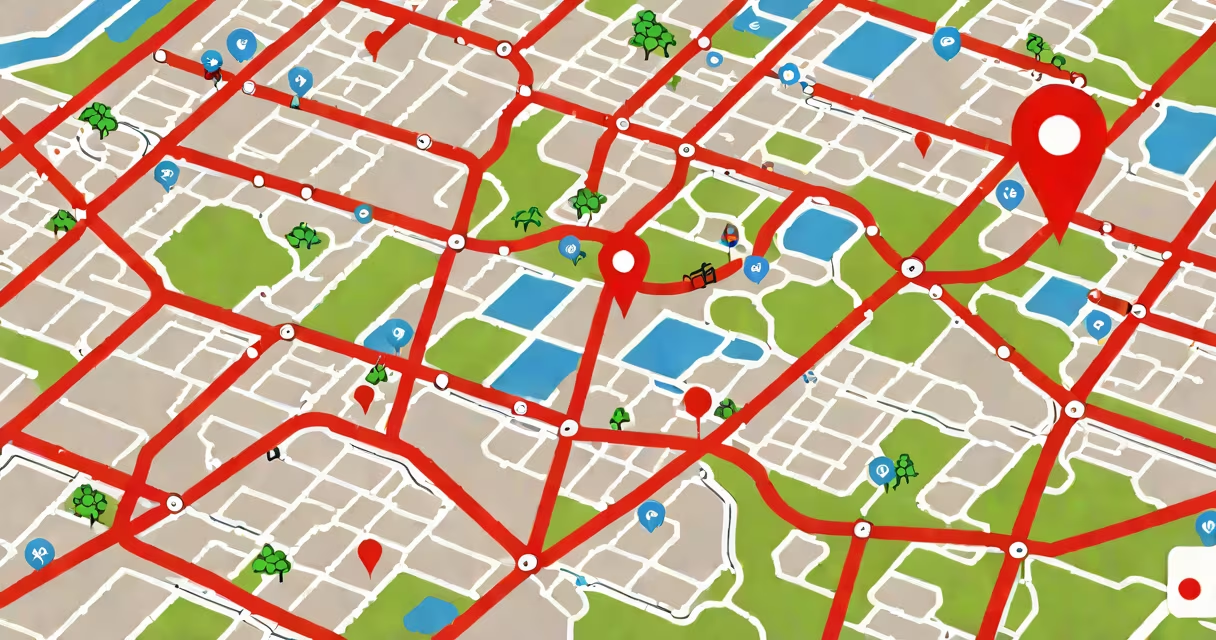
The Google Map game is a browser-based challenge that uses real-world satellite and street view imagery from Google Maps to create location-based puzzles. Players solve clues by going through to specific coordinates, identifying landmarks, or tracing routes through cities. These games often appear as timed challenges or collaborative quests hosted on platforms like Reddit, Discord, or independent websites.
Unlike traditional video games, the Google Map game runs entirely in a web browser. It requires no installation, relies solely on Google's public map data, and uses standard navigation tools-zoom, pan, and click-to-locate-to progress. The game mechanics center around spatial reasoning, geography knowledge, and pattern recognition rather than graphics or sound design.
For example, a typical clue might read: "Find the bridge where two rivers meet, then follow the road east until you see a red-roofed building with a broken window." Solving it requires identifying the correct intersection using map features, then verifying the visual details via Street View. Success depends on accurate interpretation of geographic context, not luck or random guessing.
Each Google Map game presents a sequence of clues that lead players to increasingly specific locations. Clues may reference physical features (rivers, highways, rail lines), architectural styles (Gothic spires, Art Deco facades), or cultural references (local festivals, historical events). Players use Google Maps' search bar, drag-and-zoom controls, and Street View to explore and verify each step.
Clues are often encoded using metaphors, puns, or wordplay. For instance, "I am not a bird, but I fly in the sky" might refer to a weather balloon launch site. Another clue, "Where the past meets the present," could point to a historic train station still in use. These require both geographical awareness and lateral thinking.
Some games are time-limited. A popular variant called "Map Hunt" runs for 60 minutes, during which players race to complete a series of stops. Others are permanent, such as the "World's Longest Bridge" challenge, where participants trace the entire length of the Danyang-Kunshan Grand Bridge in China using satellite view and cross-reference with official transport records.
Google Map games fall into several categories based on structure and platform:
| Type | Structure | Example | Platform |
|---|---|---|---|
| Single-Player Puzzle | Sequential clues leading to one endpoint | "Find the tallest statue in a city with no traffic lights" | Reddit r/MapGame (2022) |
| Team Race | Real-time competition with shared progress | "Reach the capital of the smallest country by 10 AM UTC" | Discord server, 2023 event |
| Historical Reenactment | Reconstructs a past process using archival data | "Trace the path of the 1919 Paris Peace Conference delegates" | Independent website, hosted annually since 2018 |
| Public Challenge | Open-ended, community-driven | "Locate the only McDonald's with a drive-thru closed on Sundays" | Twitter/X thread, viral in 2021 |
These formats differ in difficulty and duration. Single-player puzzles average 15-30 minutes to solve. Team races last 1-2 hours and involve coordination. Historical reenactments can span days and require research beyond basic map use.
Many assume the Google Map game is a branded product from Google. It is not. Google does not host or endorse any game using its maps as a core mechanic. The term "Google Map game" is a descriptive label used by communities, not a feature within Google Maps itself.
A frequent error is confusing the Google Map game with Google Earth's "Tour Creator" or "Street View tours." While both use similar visuals, they serve different purposes. Tour Creator allows users to build guided experiences with audio and narration. The Google Map game, by contrast, demands active problem-solving and decision-making under constraints.
Another misconception is that all clues rely on visible landmarks. In reality, many depend on metadata. For example, a clue referencing "the building with the highest number of windows facing north" may require counting pixels in satellite images or analyzing elevation data. Some players use third-party tools like Mapillary or OpenStreetMap to extract hidden details not visible in standard Google Maps.
In October 2023, a group of urban explorers launched a global Google Map game centered on Berlin's Tiergarten district. The goal: locate five bridges built between 1880 and 1910, each marked by a unique architectural detail.
Clue #1: "I stand where the river splits and the old gate once stood." This referred to the Moltkebrücke, identifiable by a surviving stone arch from the 1890s. Players had to zoom out to the river network level, then use historical overlays to confirm the bridge's original alignment.
Clue #3: "My shadow touches the park bench at 3:17 PM in summer." This required calculating solar angles using Google Earth's sun position tool. Only one bridge-Friedrichstraße Bridge-cast a shadow matching the time and direction during June solstice.
Final clue: "I am the shortest bridge, yet my name is longest." Answer: "Königin-Luise-Brücke," a 38-meter-long footbridge named after a Prussian queen. The solution was verified by cross-referencing municipal archives and GPS coordinates.
Over 1,200 players participated globally. The fastest solver completed the route in 47 minutes using only Street View and map search. The average completion time was 2 hours and 11 minutes.
Google Map games promote spatial literacy-the ability to interpret and reason about physical space. According to the National Geographic Society, spatial skills correlate strongly with performance in STEM fields. Games like these reinforce map reading, scale estimation, and directional logic in a low-stakes environment.
They also encourage responsible exploration. Unlike geocaching, which involves physical travel, Google Map games allow remote participation. This reduces environmental impact and avoids trespassing risks. A 2022 study by the University of California, Berkeley, found that 78% of participants reported improved confidence in using digital maps after completing a multi-stage Google Map game.
One limitation is outdated imagery. Google Maps updates satellite photos every 1-3 years depending on region. A clue referencing a demolished building may remain valid only until the next update cycle. Players must account for temporal gaps in data.
I once spent two hours trying to find a library described as "on the corner of two streets named after birds." The map showed a vacant lot. Later, I discovered the building had been replaced by a parking garage. The clue was still valid-but only because the original address remained in Google's database. That moment taught me that digital maps preserve memory, not just geography.
The Google Map game is not a game in the commercial sense. It's a cognitive exercise disguised as play-a way to test knowledge, sharpen observation, and connect with others through shared discovery. It thrives on real places, real data, and real effort.