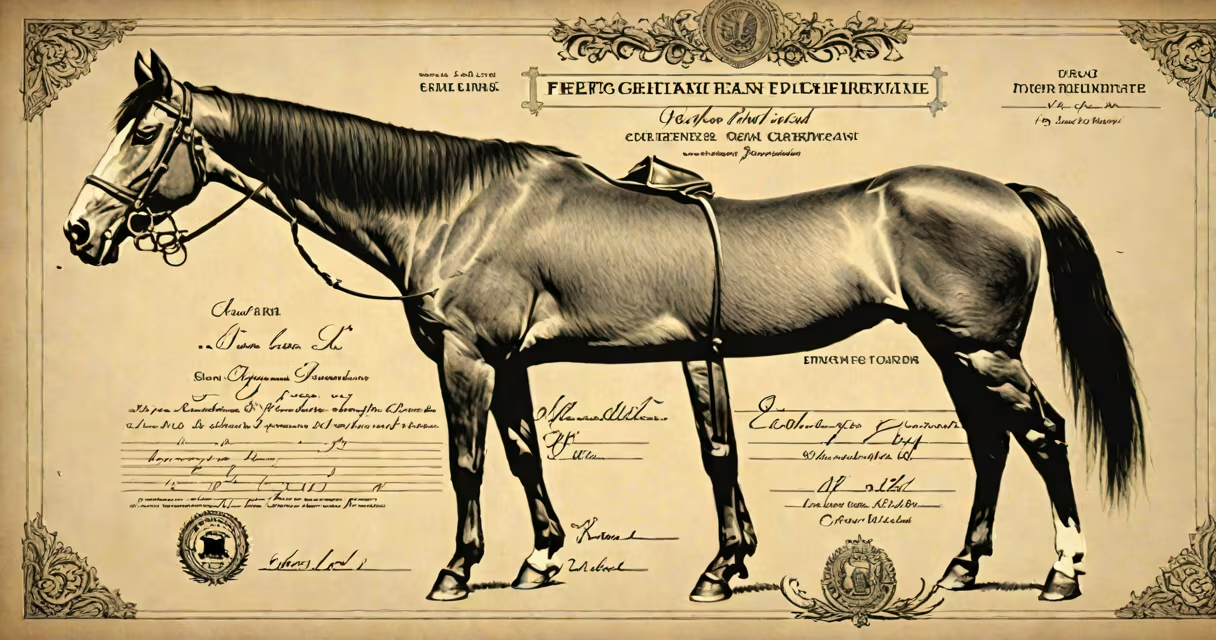
The meaning of pedigree refers to a documented record of an individual's ancestry, especially in animals and plants, showing lineage through generations. It establishes bloodlines and inherited traits, often used to verify purity, predict performance, or confirm eligibility for breeding.
Pedigree originates from the French word "pédigrée," meaning "of pure breed." It became standardized in the 18th century as horse racing and selective breeding gained prominence. Today, it remains central in animal husbandry, genetics, and even social contexts where lineage denotes heritage or status.
In practical use, a pedigree is a chart or document listing ancestors, typically going back three to five generations. For dogs, horses, or show cats, it confirms parentage and breed standards. In humans, it appears in genealogical research, medical history, and royal lineage records.
A pedigree functions as a family tree with specific notation. Each generation is labeled with Roman numerals (I, II, III), and individuals within each generation are numbered sequentially. Symbols denote sex: circles for females, squares for males, and lines connecting parents to offspring.
For example, a registered thoroughbred racehorse must have a verified pedigree with both sire (father) and dam (mother) listed in national registries. The Jockey Club requires full documentation of lineage to ensure genetic integrity and prevent fraud. Without a valid pedigree, a horse cannot compete in sanctioned races.
Geneticists use pedigrees to track inheritance patterns of diseases. A pedigree showing multiple affected individuals across generations may indicate autosomal dominant or recessive disorders. The National Human Genome Research Institute notes that pedigree analysis is foundational in identifying hereditary conditions like Huntington's disease or cystic fibrosis.
Pedigrees serve different purposes depending on context. The table below outlines common applications:
| Type | Use Case | Example |
|---|---|---|
| Animal Registration | Verifying purebred status | AKC registration for a golden retriever |
| Medical Genetics | Tracking inherited disorders | Family history of breast cancer linked to BRCA1 |
| Social/Hereditary | Documenting noble or royal descent | British royal family lineage traced through Queen Victoria |
| Breeding Programs | Guiding selective mating | Thoroughbred stallion with 12 stakes winners in offspring |
One non-obvious distinction: a pedigree does not guarantee quality or performance. A dog with flawless lineage may still lack temperament or health. The American Kennel Club warns that pedigree alone doesn't ensure behavioral traits or long-term health - environmental factors and ongoing health screening matter equally.
People often confuse pedigree with "purebred" as if they're interchangeable. But pedigree refers to documented lineage, while purebred describes a breed standard. A dog can be purebred without a documented pedigree, and vice versa - though most reputable breeders maintain both.
Another error is assuming pedigree implies superiority. Historically, aristocrats used lineage to assert power. In modern times, this persists in social narratives - e.g., "old money" families. But pedigree is neutral data. It reflects origin, not value. A horse with a prestigious pedigree may lose a race due to injury or training gaps.
I once reviewed a pedigree for a champion show cat. The cat's great-grandmother had won 17 titles. Yet the cat itself failed to qualify for a major exhibition. The pedigree validated ancestry, but not current ability. This reinforced that lineage supports potential - not guaranteed success.
Pedigree extends into human culture and formal systems. In academia, scholars cite "pedigree" to describe intellectual lineage - e.g., a researcher trained under a Nobel laureate. In business, venture capital firms assess founders' "pedigree" based on past ventures or affiliations.
For historical figures, pedigree matters in legitimacy. The Plantagenet kings of England were legitimized through documented descent from William the Conqueror. Genealogists use DNA testing alongside traditional records to verify such claims. The Society of Genealogists emphasizes that combining genetic data with paper trails increases accuracy in lineage verification.
The meaning of pedigree lies in its function: to map ancestry and inherited traits. It is not a measure of worth, talent, or destiny. Whether in breeding, medicine, or heritage, pedigree provides clarity - but only when paired with current evidence and critical evaluation.
When assessing lineage, ask: What does this record actually prove? Who verified it? And what else matters beyond the names in the chart?