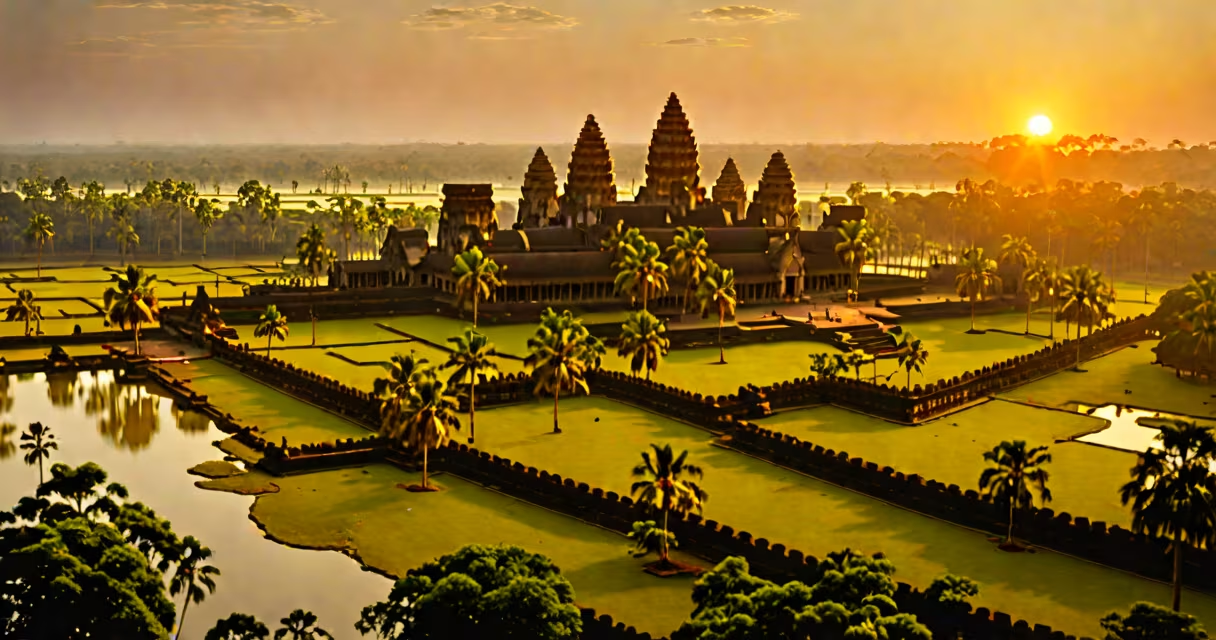
cambodia tourist attractions include ancient temple complexes like Angkor Wat, bustling capital city landmarks in Phnom Penh, and unique ecosystems such as the floating villages on Tonlé Sap Lake. These sites blend spiritual heritage, colonial history, and natural beauty across a country shaped by resilience and tradition.
Angkor Wat dominates the list of cambodia tourist attractions. Built in the early 12th century as a Hindu temple dedicated to Vishnu, it later became a Buddhist site. Its five lotus-shaped towers rise above a vast moat, reflecting the sky at dawn. Over 1 million visitors annually walk its corridors, many drawn by the iconic silhouette seen in countless travel photos. UNESCO recognizes it as a World Heritage Site for its architectural precision and symbolic depth.
Other major cambodia tourist attractions center on Siem Reap, the gateway town to the Angkor Archaeological Park. Beyond Angkor Wat, the park holds 400+ structures spread across 400 square kilometers. Bayon Temple features 216 serene stone faces carved into its towers-each expression subtly different, suggesting a meditative state. Ta Prohm, popularized by the film *Tomb Raider*, shows trees growing through ancient walls, roots gripping sandstone like living hands.
| Attraction | Location | Key Feature | Visitor Notes |
|---|---|---|---|
| Angkor Wat | Siem Reap | 12th-century Khmer temple complex | Best visited at sunrise; entry fee $37 for foreigners |
| Bayon Temple | Siem Reap | Stone faces with serene expressions | Best photographed in morning light; avoid midday heat |
| Phnom Penh Royal Palace | Phnom Penh | French-inspired architecture and silver pagoda | Open daily 8:00-11:30 AM; dress modestly |
| Tonlé Sap Floating Villages | Near Siem Reap | Houseboats and schools on water | Visit with licensed guides; respect local privacy |
Phnom Penh offers a different kind of cambodia tourist attraction experience. The Royal Palace, constructed in 1866, blends Khmer, French, and Thai design elements. Inside, the Silver Pagoda houses a floor paved with 5,000 silver tiles and a Buddha statue encrusted with 20,000 diamonds. Nearby, the National Museum displays over 7,000 artifacts from the Funan, Chenla, and Khmer empires-some dating back to the 1st century CE.
Tonlé Sap, the largest freshwater lake in Southeast Asia, hosts communities living on water. Families build homes on stilts, fish from boats, and children attend school on floating classrooms. These floating villages are among the most unique cambodia tourist attractions, offering insight into sustainable adaptation. A visit requires a local guide and a small fee-around $10 per person-to support community projects.
Some travelers mistake the scale of Angkor Wat's influence. While it's the most famous site, it represents only one phase of Khmer civilization. The city of Angkor itself covered 1,000 square kilometers at its peak-larger than modern-day Paris. Recent LiDAR scans reveal hidden urban networks beneath jungle canopy, showing that the Khmer Empire was far more extensive than previously believed. This complexity challenges the idea that Angkor Wat is simply a "temple" rather than a religious and political capital.
Another common misperception is that visiting cambodia tourist attractions means focusing only on ruins. In reality, modern Cambodia offers changing experiences. The riverside district of Phnom Penh features cafes, art galleries, and street markets. In Siem Reap, night markets sell handwoven textiles and dried fruit. These cultural spaces provide context for the ancient sites-showing how traditions endure amid change.
I once spent a week cycling from Siem Reap to Battambang, stopping at smaller temples like Banteay Srei. That site, though less known, features complex carvings of mythological scenes in pink sandstone. The craftsmanship rivals Angkor Wat's-but it's quieter, less crowded. I met a local artisan who showed me how he still uses traditional chisels to carve stone, just as his ancestors did. That moment revealed something deeper: cambodia tourist attractions aren't just relics-they're living parts of identity.
Travelers often overlook the seasonal rhythm of cambodia tourist attractions. The dry season (November to April) sees fewer rains and lower humidity-ideal for exploring temples. But the wet season (May to October) brings lush greenery and fewer crowds. Some sites, like Preah Vihear Temple near the Thai border, are harder to access during monsoon months due to muddy roads. Planning around weather improves both comfort and safety.
For those seeking alternatives beyond the usual spots, consider the Cardamom Mountains. Remote and sparsely visited, they hold ancient cave paintings and endangered wildlife. Trekking through this region requires a licensed guide and permits from the Ministry of Environment. Still, it offers a rare chance to see untouched landscapes and indigenous communities.
When comparing cambodia tourist attractions to similar destinations, the difference lies in continuity. Unlike Greece, where ancient sites stand as ruins, Cambodia's temples remain active places of worship. In Edinburgh, historic buildings serve as museums or government centers. In Cambodia, monks chant in Angkor Wat's halls every morning. This ongoing spiritual presence makes the experience more layered than a mere sightseeing tour.
Among lesser-known cambodia tourist attractions, the Choeung Ek Killing Fields near Phnom Penh stands as a solemn reminder of the Khmer Rouge regime. It contains mass graves and personal belongings of victims. Visiting with a trained guide ensures respectful engagement. The site serves as both memorial and educational space-part of understanding Cambodia's full history, not just its monuments.
Cambodia tourist attractions offer more than visual spectacle. They invite reflection on endurance, memory, and renewal. Whether standing before the silent faces of Bayon or watching fishermen cast nets on Tonlé Sap, each site connects past and present. The country's resilience shapes every visit-not just the ruins, but the people who live beside them.