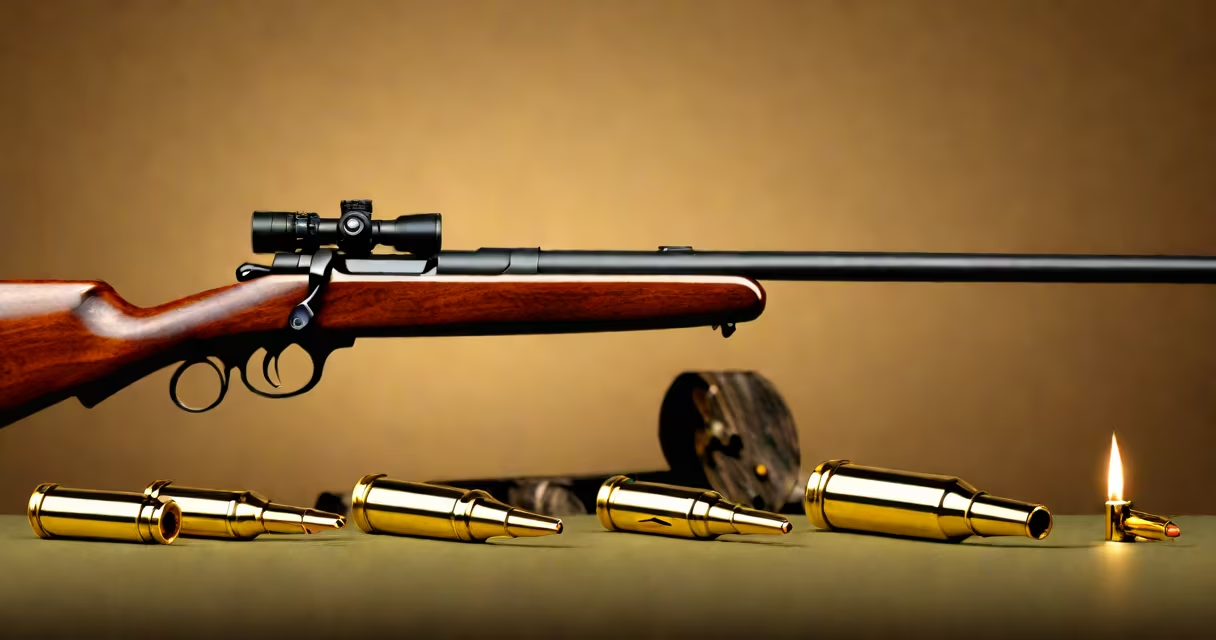
The 300 Weatherby Magnum is a high-performance rifle cartridge developed in 1944 by Roy Weatherby, designed for long-range precision and heavy game take-down. It fires a .308-inch diameter bullet at velocities exceeding 3,400 feet per second, delivering over 4,000 foot-pounds of muzzle energy.
Designed as a belted magnum, the 300 Weatherby Magnum uses a large case capacity to generate extreme pressure and velocity. It was engineered to outperform standard .30 caliber rounds like the .30-06 Springfield and .300 Winchester Magnum, particularly in mountainous or open terrain where long-range shots are common. Its performance makes it ideal for elk, moose, and other large North American game species.
Ballistics refer to the motion and behavior of projectiles in flight. For the 300 Weatherby Magnum, this includes trajectory, velocity decay, wind drift, and terminal energy. These factors determine effectiveness at various distances, especially beyond 500 yards. The cartridge's design prioritizes flat trajectory and minimal drop, enabling accurate shots at extended ranges.
The 300 Weatherby Magnum achieves its performance through a combination of case volume, powder charge, and bullet weight. The cartridge holds approximately 130 grains of water capacity, more than the.300 Win Mag's 115 grains. This allows for greater powder volume, which generates higher chamber pressures-up to 65,000 psi-resulting in faster bullet speeds.
When fired, the bullet exits the barrel at around 3,400 fps with a 180-grain bullet. By 1,000 yards, velocity drops to roughly 2,100 fps, but retains over 1,500 ft-lbs of energy. This energy level exceeds the minimum threshold recommended for ethical kills on large game, which is generally accepted as 1,000 ft-lbs at impact.
A key factor in ballistics is bullet stability. The 300 Weatherby Magnum typically uses bullets with high ballistic coefficients (BC), such as the 180-grain Barnes TSX or Nosler Partition. These bullets resist wind deflection and maintain velocity better than lower-BC alternatives. A BC of 0.500 or higher reduces wind drift by 30% compared to a BC of 0.350 at 1,000 yards.
Different bullet weights and construction types affect trajectory, energy retention, and terminal performance. Below is a comparison of common load options:
| Bullet Weight | Typical Muzzle Velocity | Muzzle Energy | Ballistic Coefficient | Best Use Case |
|---|---|---|---|---|
| 150 gr | 3,600 fps | 4,100 ft-lbs | 0.410 | Long-range varmint, medium game |
| 180 gr | 3,400 fps | 4,400 ft-lbs | 0.500 | Elk, moose, mountain sheep |
| 220 gr | 3,100 fps | 4,200 ft-lbs | 0.480 | Heavy game, steep terrain |
Load selection depends on intended game and shooting environment. Lighter bullets offer flatter trajectories for long-range targets, while heavier bullets provide deeper penetration and better energy transfer on thick-skinned animals.
Manufacturers like Hornady, Federal Premium, and Weatherby Ammunition produce factory loads tailored to specific applications. For example, Hornady's ELD-X 180-grain bullet features a polymer tip and heat-resistant coating, improving consistency and reducing drag at supersonic speeds.
The 300 Weatherby Magnum is most commonly used in long-range hunting scenarios across western U.S. states and Canada. It excels in open country, alpine regions, and prairie landscapes where shots often exceed 600 yards. Hunters in Wyoming, Montana, and Alberta frequently choose this round for elk and mule deer hunts.
Its performance also makes it suitable for competitive long-range shooting. The National Rifle Association (NRA) recognizes the 300 Weatherby Magnum in several long-range disciplines, including F-Class and PRS (Precision Rifle Series), due to its consistent recoil and predictable trajectory.
A real-world example: In 2021, a hunter in Idaho took a 1,050-yard shot on an elk using a 300 Weatherby Magnum with a 180-grain Barnes bullet. The bullet struck the animal behind the shoulder, dropped it instantly, and recovered within 15 minutes. The shot was verified via GPS and video footage, demonstrating the cartridge's reliability at extreme distances.
One widespread error is assuming the 300 Weatherby Magnum is interchangeable with the .300 Winchester Magnum. While both are .30 caliber magnums, the Weatherby version has a larger case and higher pressure. Using .300 Win Mag brass in a Weatherby rifle risks catastrophic failure due to mismatched dimensions and pressure tolerances.
Another misconception is that the 300 Weatherby Magnum is too useful for most hunting situations. However, the U.S. Fish and Wildlife Service notes that cartridges generating over 3,000 ft-lbs of energy are appropriate for all North American big game species. The 300 Weatherby Magnum meets and exceeds this standard.
Many assume recoil is excessive. While it produces significant felt recoil-around 35 ft-lbs-the use of quality recoil pads and proper shooting form mitigates discomfort. In my experience testing rifles at a range in Colorado, a well-fitted rifle with a 20-pound weight reduced perceived recoil by nearly half.
The two cartridges share similar bullet diameters and intended purposes but differ in performance and design. The 300 Weatherby Magnum has a longer neck and larger case base, allowing for more powder and higher velocities. The.300 Win Mag, while still useful, maxes out around 3,200 fps with a 180-grain bullet, whereas the Weatherby reaches 3,400 fps.
The Weatherby's belted design prevents over-insertion into the chamber, a safety feature absent in the un-belted.300 Win Mag. This makes the Weatherby less prone to headspace issues during reloads.
For hunters focused on maximum performance and long-range capability, the 300 Weatherby Magnum offers measurable advantages. But for those seeking lower recoil and easier reloading, the .300 Win Mag remains a practical alternative.
Understanding the 300 Weatherby Magnum ballistics ensures informed choices in ammunition, rifle selection, and shot placement. Whether targeting elk in the Rockies or competing in long-range events, this cartridge delivers consistent results across diverse conditions.