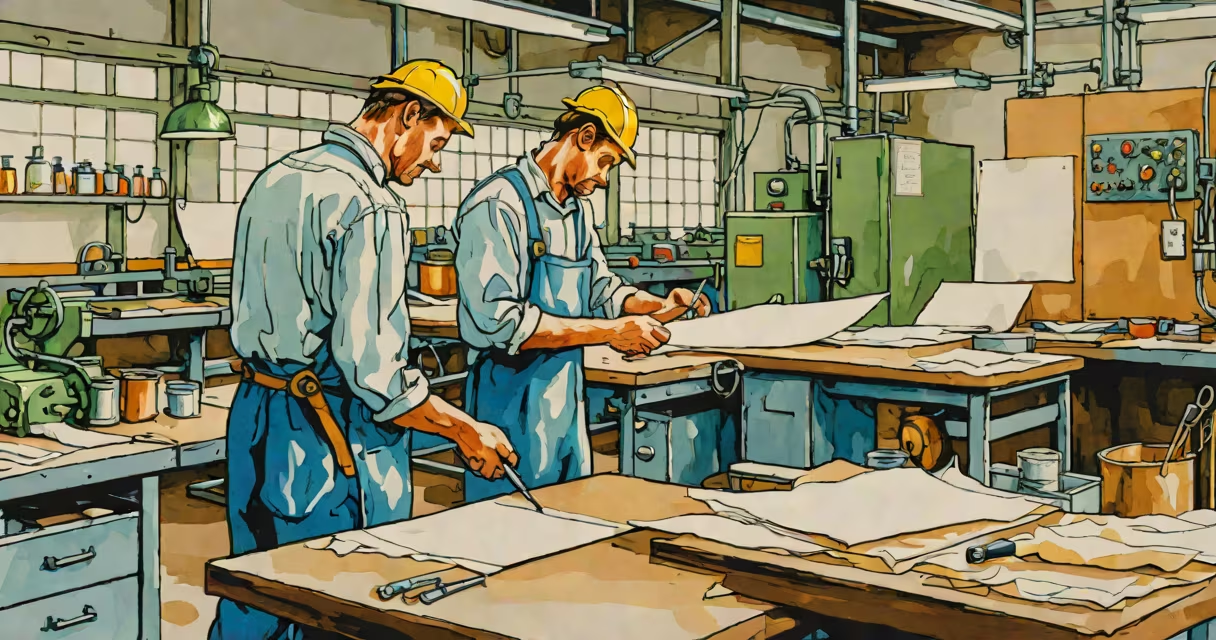
Standard work is a documented, repeatable sequence of tasks performed in a consistent way to produce a product or deliver a service with predictable quality and timing. It eliminates variability by defining the best-known method for completing a task under normal conditions.
Standard work originated in Japanese manufacturing during the 1950s, particularly at Toyota factories. It became a core element of the Toyota Production System and later a foundation of lean manufacturing principles. Today, it applies beyond factories-used in healthcare, software development, and office operations to reduce errors and improve throughput.
At its simplest, standard work answers three questions: What steps must be done? In what order? How long should each take? When followed consistently, it helps every employee performs a task the same way, regardless of who is doing it.
Standard work operates through three interdependent elements: takt time, cycle time, and work sequence. Takt time is the rate at which products must be completed to meet customer demand. Cycle time is the actual time required to complete a task. Work sequence defines the exact order of actions.
If takt time is 60 seconds per unit and cycle time is 45 seconds, the operator has 15 seconds of buffer time. If cycle time exceeds takt time, the process cannot keep up with demand. Standard work identifies such imbalances early.
For example, a call center agent handling customer inquiries follows a standard work procedure: greet the caller (5 seconds), verify ID (15 seconds), log issue (20 seconds), resolve or escalate (30 seconds). Total cycle time: 70 seconds. If average customer demand is one call every 90 seconds, the process is sustainable. But if demand increases to one call every 60 seconds, the team must either improve speed or add staff.
Standard work is not a single document-it's a system made of three layers:
These components are often visualized in a standard work chart-a table showing each step, time required, and sequence. This chart is posted at the workstation, updated when improvements occur.
There are three main types of standard work:
| Type | Description | Use Case |
|---|---|---|
| Manual | Tasks performed by hand, such as assembling parts or packaging goods. | Assembly lines, warehouse picking. |
| Controlled | Tasks involving equipment or systems with set parameters, like operating a CNC machine. | Machining, lab testing. |
| Administrative | Repetitive office processes such as invoice processing or data entry. | Accounts payable, HR onboarding. |
Administrative standard work is often overlooked but critical. A study by the American Productivity & Quality Center (APQC) found that companies using standardized administrative workflows reduced processing errors by 41% and cut average task duration by 28%.
Standard work is not a rigid rulebook that prevents innovation. It's a baseline. Once a process is standardized, teams can focus on improving it-through kaizen events or continuous improvement cycles.
A common mistake is creating standard work without involving frontline workers. When supervisors draft procedures in isolation, they often miss subtle details. For example, a hospital nurse reported that a standard medication administration form didn't account for the time needed to confirm patient allergies via electronic health records. Adjusting the form based on real-world feedback reduced medication errors by 33% over six months.
Another error is treating standard work as static. Best practice requires regular review-every 3-6 months-to reflect changes in tools, materials, or demand. A manufacturing plant in Michigan discovered that outdated standard work led to a 12% increase in defective parts after switching suppliers. Revising the documents with new material specs eliminated the defect rate within two weeks.
A mid-sized IT company had inconsistent resolution times for password reset requests. Some agents took 10 minutes; others took 45. Tickets piled up, and users complained.
The team measured cycle times across 30 incidents. They found that agents varied in whether they verified identity via email, checked access logs, or used multi-factor authentication. The average time was 22 minutes with a 15-minute standard deviation.
They created a standard work document: (1) Confirm user identity via email confirmation (3 min); (2) Check last login time and location (2 min); (3) Reset password using secure portal (5 min); (4) Send confirmation email (1 min); (5) Log incident and close ticket (1 min). Total: 12 minutes.
After training and posting the flowchart at each desk, average resolution time dropped to 13 minutes. Error rates fell from 18% to 4%. User satisfaction scores rose 37% in the next quarter.
As one technician noted, "Before, we were guessing. Now we're following a proven path."
While rooted in lean manufacturing, standard work applies wherever repetition occurs. In healthcare, standard work reduces surgical errors. In education, it ensures consistent lesson delivery. In software teams, it governs deployment checklists.
According to the Lean Enterprise Institute, organizations that implement standard work see a 20-30% improvement in process efficiency within six months. The key is not just documenting steps-but making them visible, measurable, and revisable.
When standard work is well-designed, it becomes a tool for training, auditing, and scaling. New employees learn faster. Managers spot deviations quickly. Teams identify bottlenecks before they grow into delays.
For example, a small e-commerce business used standard work to manage order fulfillment. By defining the exact steps-from packing slip creation to carrier label printing-they reduced shipping errors by 50% and cut average processing time from 18 to 9 minutes.
Standard work is not about enforcing uniformity at all costs. It's about creating clarity so people can do their jobs better, faster, and with fewer mistakes. It's the foundation of operational excellence.