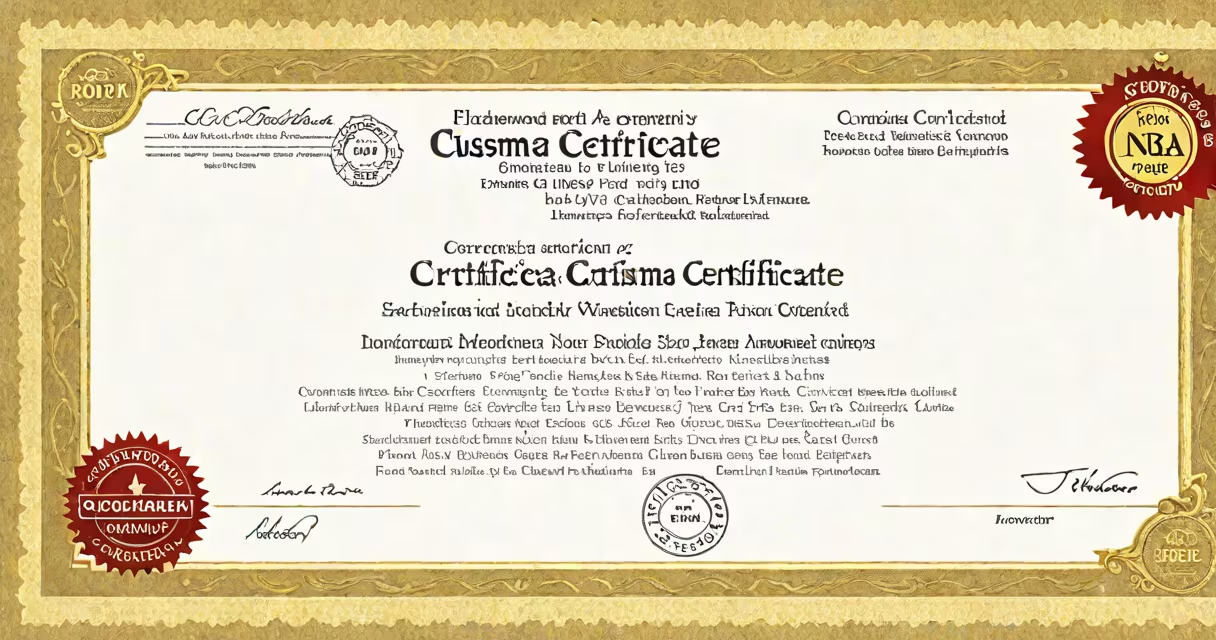
A CUSMA certificate is a document that certifies goods exported from one of the three member countries-Canada, the United States, or Mexico-qualify for reduced or eliminated tariffs under the Canada-United States-Mexico Agreement. It is required for qualifying goods entering another member country under the agreement's rules of origin.
CUSMA replaced NAFTA in July 2020 and introduced stricter requirements for origin determination. A valid CUSMA certificate must be completed by the exporter and presented to customs authorities upon importation. Without it, imported goods may face full duty rates, even if they meet origin criteria.
The U.S. Trade Representative (USTR) and Canada's Global Affairs Canada both require exporters to maintain records supporting the certificate for at least five years. Failure to produce these records during audits can result in penalties or loss of preferential treatment.
When a company exports goods from the U.S. to Mexico, and those goods meet CUSMA's rules of origin, the exporter completes a CUSMA certificate. This document confirms that the product qualifies for duty-free treatment under the agreement.
The certificate includes details such as the exporter's name and address, the importer's information, a description of the goods, the Harmonized System (HS) code, and the country of origin. It must be signed by the exporter or their authorized representative.
Customs officials in the importing country review the certificate and accompanying commercial invoice. If the information matches and the product meets the origin rules, the goods enter duty-free. If not, the importer pays standard duties.
Each CUSMA certificate follows a standardized format approved by the three governments. It contains 13 mandatory fields, including:
Exporters must ensure all entries are accurate. For example, a shipment of U.S.-made industrial valves (HS code 8481.80) valued at $12,500 USD must list the correct material composition and manufacturing process to prove regional value content (RVC) exceeds 60%.
According to the USTR, incorrect or incomplete certificates were flagged in 14% of random inspections in 2023. Common errors include mismatched HS codes, missing signatures, or failure to update the certificate when production changes.
There are two primary types of CUSMA certificates:
| Type | Use Case | Validity Period | Required Documentation |
|---|---|---|---|
| Standard Certificate | Used for most commercial shipments under CUSMA | 12 months from issue date | Commercial invoice, packing list, proof of origin |
| Self-Certification (for certain goods) | Applies to low-risk, high-volume goods like textiles or electronics components | 12 months | Internal records proving RVC compliance |
For example, a U.S. manufacturer exporting 500 units of custom circuit boards (HS code 8542.39) to Canada can self-certify if the board uses at least 60% regional materials and is assembled in the U.S. However, if the supplier source components from China, the manufacturer must obtain a standard certificate and provide supplier invoices.
Non-compliance with CUSMA rules can lead to revocation of preferential status. In 2022, U.S. Customs and Border Protection (CBP) revoked duty-free treatment for over 200 shipments due to false origin claims, resulting in back duties totaling $1.8 million.
Many businesses assume that simply using North American materials guarantees eligibility. That's incorrect. CUSMA requires not just material sourcing but also transformation rules. For example, assembling a product in the U.S. from parts sourced from Mexico doesn't automatically qualify it unless the assembly process constitutes a "substantial transformation."
Another frequent error is confusing a CUSMA certificate with a Certificate of Origin (COO) used under other trade agreements. While both verify origin, CUSMA certificates have specific formatting and are enforceable under a legally binding agreement. A COO under the African Growth and Opportunity Act (AGOA), for instance, does not carry the same weight in U.S. customs enforcement.
I once reviewed a shipment of handcrafted leather bags from a small U.S. business exported to Canada. The owner had filled out a CUSMA form but listed the materials as "100% U.S.-sourced" without providing supplier contracts. CBP rejected the certificate because the supporting documentation was missing. After submitting the original purchase invoices and a letter from the tannery, the shipment cleared within 48 hours.
You need a CUSMA certificate when exporting goods from the U.S., Canada, or Mexico to another member country and the goods are eligible under CUSMA's rules of origin. This applies to manufactured goods, agricultural products, and certain services-related goods.
For example, a Canadian company exporting precision tools (HS code 8205.50) to the U.S. must provide a CUSMA certificate if the tools contain more than 50% value from Canadian-origin materials and undergo substantial processing in Canada.
Importers must request the certificate before shipment. Some foreign buyers will reject deliveries without it. The USTR notes that 38% of U.S. exporters reported delays in 2023 due to missing or late CUSMA documentation.
A CUSMA certificate is not optional for eligible goods moving between the three nations. It is a legally binding document that must be completed accurately and supported by verifiable records. Exporters who skip proper documentation risk paying full tariffs, facing penalties, or losing future eligibility.
If you're considering entering the North American market, understand that even minor changes in production-like switching a component supplier-can affect eligibility. Regularly audit your supply chain and update your CUSMA documentation accordingly.
For professionals exploring roles in trade compliance, offloading Microsoft shares is not relevant, but understanding CUSMA documentation is essential for careers in international trade law or logistics.