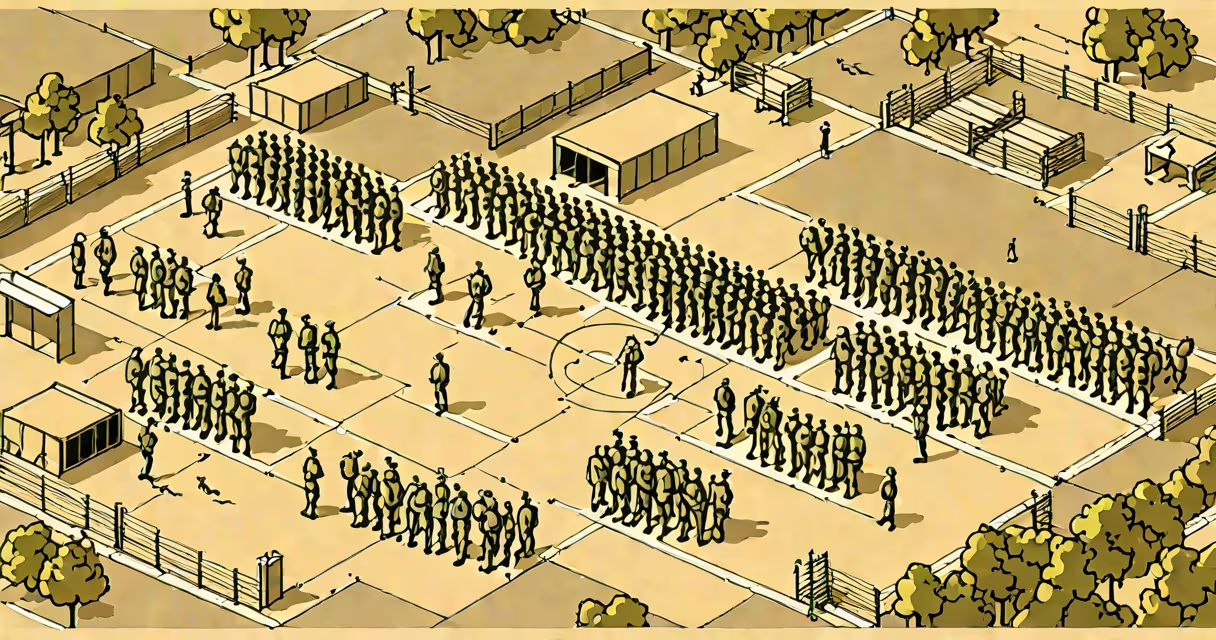
Boot camp is a highly structured, immersive training program designed to rapidly build skills under intense conditions. It typically involves long hours, physical exertion, strict discipline, and immediate application of knowledge. Whether military, coding, or cybersecurity-focused, boot camp environments prioritize rapid skill acquisition through repetition, feedback, and pressure testing.
Physical space varies by type. Military boot camps occupy large, fenced compounds with barracks, obstacle courses, firing ranges, and drill fields. Coding or cloud-focused boot camps often take place in classrooms or co-working spaces with rows of desks, multiple monitors, and whiteboards covered in equations and diagrams. Both settings emphasize minimal distractions and constant supervision.
Participants enter boot camp with little time for adjustment. The schedule begins early-often 5:30 AM-and ends late, sometimes past 9 PM. Days are packed with lectures, labs, group challenges, and individual assessments. Breaks are brief and strictly timed. Success depends on consistent performance, not just final results.
For example, a U.S. Marine Corps recruit at Parris Island spends 13 weeks undergoing physical conditioning, weapons handling, combat drills, and military customs. Each day includes morning calisthenics, classroom instruction on tactics, and evening written exams. By week 6, recruits must complete a 12-mile ruck march with full gear in under 3 hours-failure means repeating the entire segment.
In contrast, a cloud computing boot camp hosted by AWS or Google Cloud uses a virtual lab environment. Students access pre-configured servers via browser-based terminals. They deploy Kubernetes clusters, configure firewalls, and troubleshoot network outages-all within a simulated production system. Instructors monitor progress in real time and intervene when errors occur.
Boot camps differ by purpose. The following table compares common formats:
| Type | Typical Duration | Environment | Key Features |
|---|---|---|---|
| Military | 8-13 weeks | Outdoor compound, barracks | Drill instructors, physical fitness tests, chain of command |
| Coding/Software Development | 8-12 weeks | Classroom or remote with virtual labs | Pair programming, daily stand-ups, live project deployment |
| Cybersecurity | 6-10 weeks | Secure lab rooms, isolated networks | Red team/blue team exercises, penetration testing simulations |
| Cloud Engineering | 10-14 weeks | Remote access to cloud infrastructure | Hands-on AWS/GCP/Azure labs, CI/CD pipeline builds |
Each format shares core traits: high cognitive load, immediate feedback loops, and a culture of accountability. In cybersecurity boot camps, for instance, trainees simulate defending a corporate network against real attack vectors like ransomware or phishing campaigns. They analyze logs, trace IP addresses, and respond to breaches-all within a sandboxed environment that mirrors actual enterprise systems.
People often confuse boot camp with standard education. Unlike college courses, which allow pacing and revision, boot camp demands continuous output. There's no "redo" button. A missed deadline in a software boot camp doesn't result in a grade-it means the team fails the sprint review, and the project stalls.
A lesser-known fact: boot camp success rates are heavily influenced by peer dynamics. Research from the U.S. Army Research Institute shows that teams with balanced leadership roles-where no single person dominates decision-making-complete missions 37% faster than those with hierarchical control. This applies equally to technical boot camps, where collaborative problem-solving outperforms solo effort.
Consider a typical week in a 10-week cybersecurity boot camp run by the SANS Institute. Trainees arrive at 7:00 AM each day. The first hour is a security briefing: reviewing the latest threat intelligence report. On Day 3, they analyze a real-world phishing email campaign that compromised 12 companies in Q2 2023.
By 9:00 AM, they begin a red team simulation. Using Kali Linux, they exploit a known vulnerability in a test web server. The goal: gain root access within 45 minutes. Tools include Metasploit, Nmap, and Wireshark. Instructors watch from behind a glass partition and intervene only if a participant attempts to access unauthorized systems.
Afternoon sessions involve forensic analysis. Trainees examine disk images from a breached laptop. They identify malware signatures, locate hidden files, and reconstruct the attacker's timeline using file metadata. One group discovered a backdoor installed via a malicious PDF-a technique used in 28% of 2023's ransomware attacks, according to the FBI's Internet Crime Complaint Center.
Evenings include peer reviews. Each team presents their findings to the class. Feedback focuses on clarity, evidence quality, and methodology-not just conclusions. This mirrors real incident response protocols used by Fortune 500 companies.
Boot camp is not a vacation, a seminar, or a certification course. It is not a "learn in your pajamas" experience. Even remote boot camps enforce strict schedules. Time zones are ignored. Deadlines are absolute. Missing a session means falling behind-and falling behind means being removed from the cohort.
Some confuse boot camp with online tutorials. A tutorial teaches concepts. A boot camp forces application. Watching a video on firewall rules is passive. Configuring a firewall in a live network during a simulated breach is active, stressful, and irreversible. One participant in a cloud boot camp failed to apply a security group rule correctly and accidentally exposed a database to public internet access. The error was caught in real time, but the incident became a case study for the entire class.
Even the term "boot camp" originated in military use. The U.S. Navy began using the phrase in the 1940s to describe intensive training for sailors. Today, the term has been adopted across industries-from tech to fitness-but the underlying structure remains unchanged: compressed learning under pressure.
Understanding what does boot camp look like requires seeing beyond the surface. It's not just about uniforms or code editors. It's about environment, rhythm, and psychological intensity. The design helps participants don't just learn-they adapt, survive, and perform under stress.