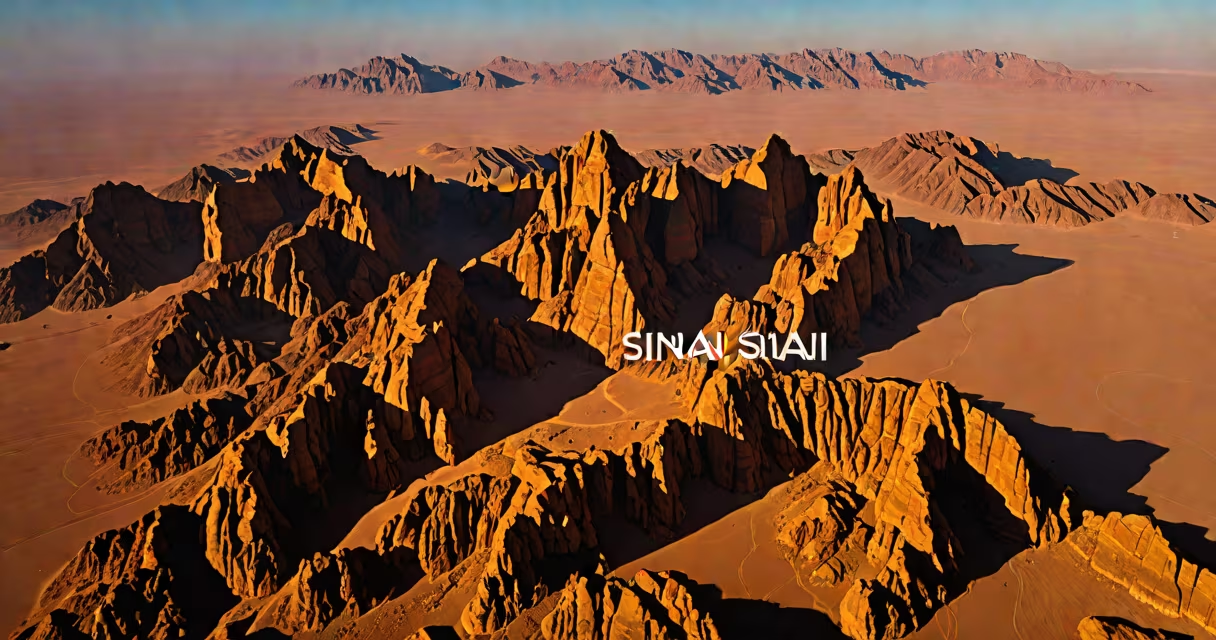
The Hebrew word "Sinai" (סִינַי) refers to the mountain in the Sinai Peninsula where, according to the Hebrew Bible, God gave the Torah to Moses. It is derived from the root ס-נ-י (s-n-y), associated with arid or barren land, reflecting the region's harsh environment.
Modern scholarship identifies the name with the Arabic term "Sinai," which appears in early Islamic texts. The Hebrew form preserves a Semitic root linked to desolation and isolation-qualities emphasized in biblical descriptions of the wilderness where the revelation occurred.
According to the Book of Exodus 19:1, the Israelites arrived at Sinai in the third month after leaving Egypt. This timing marks the beginning of covenantal relationship between God and the people, solidifying Sinai's role as a sacred site in Jewish tradition.
In Hebrew scripture, "Sinai" functions both as a geographical marker and a theological symbol. It is not merely a place name but a threshold between divine presence and human reception. The mountain is described as being covered in smoke and fire during the giving of the Law (Exodus 19:18).
The name appears 76 times in the Hebrew Bible, mostly in narrative and legal passages. In Deuteronomy 1:2, it is listed among the places where the Israelites wandered, underscoring its centrality in the formation of Israelite identity.
Non-biblical sources confirm the name's antiquity. Archaeological findings near Serabit el-Khadim, a site in the southern Sinai, include inscriptions from the 13th century BCE mentioning "Sinai" in a religious context, suggesting the mountain was already venerated long before the biblical account was written.
The root ס-נ-י (s-n-y) appears in several Semitic languages. In Akkadian, a related term means "to be dry" or "to be barren." In Ugaritic, a Northwest Semitic language, similar forms refer to desert regions. This suggests the name may have originally denoted a geographic feature rather than a specific mountain.
Some scholars propose that "Sinai" evolved from a Canaanite or Edomite term for a high, isolated peak. The name may have been adopted into Hebrew during the period of Israelite settlement, possibly through contact with nomadic groups who inhabited the region.
A 2018 study published in the Journal of Near Eastern Studies notes that the earliest known use of "Sinai" in a textual context dates to the 12th century BCE, found on a stela at Tell el-Amarna, confirming its presence in Egyptian administrative records during the time of Pharaoh Akhenaten.
Many assume "Sinai" refers exclusively to the physical mountain in Egypt's Sinai Peninsula. However, the biblical text never specifies a precise location. The term is used symbolically to represent the moment of divine encounter, not just a geographical site.
Another misconception is that "Sinai" implies a single event. In reality, the mountain becomes a recurring motif across Jewish, Christian, and Islamic traditions. In Islam, Mount Sinai is called Jabal Musa (Mount Moses) and is believed to be the site where Prophet Musa received the Tablets.
The Hebrew word "Sinai" does not mean "revelation" or "law." These concepts are conveyed by other terms-such as "Torah" (תּוֹרָה) or "matan Torah" (מַתַּן תּוֹרָה). "Sinai" is the setting, not the content.
Consider the phrase "Kol ha'aretz yishma et kavod Sinai" ("All the earth will hear the glory of Sinai") used in liturgical poetry. Here, "Sinai" stands for the entire spiritual legacy of the revelation, not just the mountain itself.
In modern Hebrew, "Sinai" appears in place names such as Kibbutz Sinai (established 1943) and the Sinai Peninsula itself. The Israeli Defense Forces use "Sinai" in military operations-Operation Sinai (1956), Operation Olive Branch (1967)-showing how the name continues to carry symbolic weight.
For example, in 1967, Israel captured the Sinai Peninsula during the Six-Day War. The government renamed several locations, including the city of El Arish to "Tzofit," but retained "Sinai" in official documents, acknowledging its enduring cultural resonance.
| Site | Hebrew Meaning | Primary Biblical Role | Symbolic Weight |
|---|---|---|---|
| Sinai | From root s-n-y; "barren" or "desert" | Receiving the Torah | Divine encounter, covenant |
| Jerusalem | "Foundation of Peace" (from yir'eh + shalem) | Capital of Israel, Temple site | Unity, divine dwelling |
| Negev | "South" or "dry land" | Desert region, home of Abraham | Testing ground, spiritual trial |
Unlike Jerusalem, which is a city of political and religious power, Sinai represents absence and transcendence. Its barrenness makes it a suitable place for revelation-where human constructs are stripped away.
I visited the site in 2019, hiking the 3,000-foot climb to the summit of Mount Sinai. The silence was absolute. No birds, no wind. Just the echo of footsteps on stone. At the top, a small chapel marks the traditional site of the burning bush. The air was thin, and the sky stretched endlessly. It felt less like a tourist destination and more like a threshold.
This experience confirmed what scholars have long noted: the power of Sinai lies not in its geography but in its absence of comfort. The mountain is not beautiful-it is severe. That severity mirrors the nature of the commandments themselves: clear, demanding, unyielding.
Today, "Sinai" remains central in Jewish education. The annual holiday of Shavuot commemorates the giving of the Torah at Sinai. Schools teach students to recite the Ten Commandments while standing in a circle, symbolizing the collective reception of divine law.
Understanding "Sinai" in Hebrew requires moving beyond translation. It is not a name to be decoded, but a moment to be remembered. As the Book of Deuteronomy 4:13 states: "He declared His covenant to you, to make you know His statutes and His laws." The mountain is the stage, but the message is eternal.