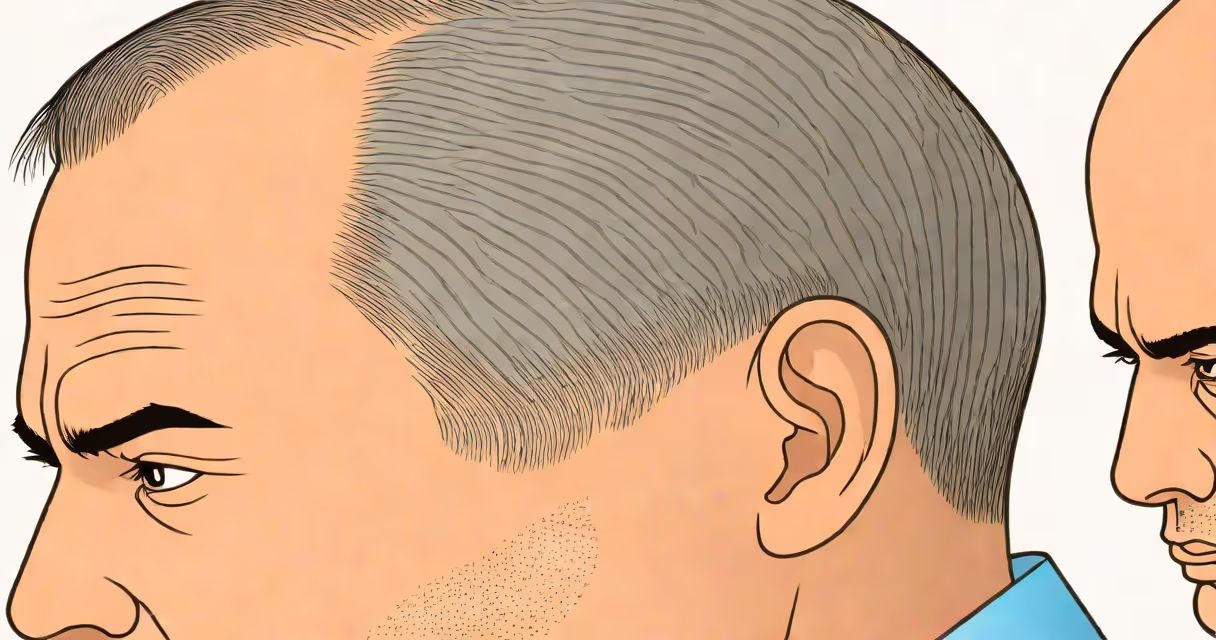
Hair thinning on sides male refers to progressive hair loss along the temples and lateral scalp, most commonly caused by androgenetic alopecia-a hereditary condition driven by sensitivity to dihydrotestosterone (DHT). This pattern affects approximately 50% of men by age 50, according to the American Academy of Dermatology.
The process begins subtly: hair follicles shrink over time due to DHT binding to receptors in the scalp. As follicles miniaturize, they produce finer, shorter hairs until growth ceases entirely. The result is a receding hairline and visible thinning in the temporal regions-the "side" areas often first noticed in mirrors or photos.
Unlike temporary shedding from stress or illness, hair thinning on sides male progresses gradually and persists without intervention. Early signs include a widening part, increased visibility of the scalp, and a distinct M-shaped recession. Left untreated, this leads to a horseshoe-shaped hair pattern around the crown and sides, known as Norwood-Hamilton Stage III or higher.
Androgenetic alopecia stems from a combination of genetics and hormones. Men inherit a predisposition to DHT sensitivity in scalp follicles. DHT, derived from testosterone via the enzyme 5-alpha-reductase, binds to androgen receptors in hair follicles. This triggers a shortened anagen (growth) phase and gradual follicle shrinkage.
Research from the Journal of Clinical and Aesthetic Dermatology confirms that individuals with the AR gene variant exhibit higher DHT receptor density in frontal and temporal scalp tissue, making those areas more vulnerable to miniaturization.
Not all hair loss follows this path. Telogen effluvium-caused by trauma, surgery, or severe stress-can cause diffuse thinning across the entire scalp, including the sides. But unlike androgenetic alopecia, telogen effluvium usually resolves within six months after the triggering event ends.
Male pattern baldness follows predictable stages. The Norwood-Hamilton scale classifies progression from minimal recession to advanced balding. Early signs appear between ages 20 and 30, though onset varies widely.
| Stage | Description | Visible Signs |
|---|---|---|
| I | No recession | Normal hairline |
| II | Mild recession | Slight temple dip |
| III | Noticeable recession | Distinct M-shape, visible scalp |
| IV | Advanced recession | Temple gap widens, crown may show |
| V | Significant thinning | Large gaps, hairline forms U-shape |
Some men develop a "widow's peak" or asymmetrical recession, which may suggest early-onset androgenetic alopecia. Others report sudden worsening after starting medications like Adderall, which has been linked to telogen effluvium in clinical reports.
A non-obvious distinction: hair thinning on sides male rarely occurs in isolation. The vertex (crown) often thins simultaneously. A 2021 study in *Dermatologic Surgery* found that 68% of men with temple recession also showed early signs of crown thinning, indicating overlapping pathology.
Many assume hair thinning on sides male is solely due to aging or poor hygiene. This is incorrect. While age increases risk, the primary driver is genetics and hormone activity-not dirt, shampoo choice, or hair styling habits.
Another myth: "wearing hats causes baldness." There is no scientific evidence linking hat-wearing to hair loss. Hats do not block oxygen or trap DHT. However, tight-fitting caps worn daily may contribute to traction alopecia in rare cases, especially with aggressive brushing or pulling.
Some confuse hair thinning on sides male with alopecia areata-an autoimmune condition causing patchy loss. Alopecia areata appears suddenly, often in circular patches, and affects younger people. It does not follow the symmetrical, gradual recession seen in androgenetic alopecia.
Effective treatments target DHT production or stimulate follicle activity. Finasteride inhibits 5-alpha-reductase, reducing DHT levels by up to 70%. A 2019 double-blind trial published in *The New England Journal of Medicine* showed that 83% of men using finasteride daily experienced stabilized or improved hair density after 24 months.
Topical minoxidil (5%) prolongs the anagen phase. Results take 4-6 months to appear. A 2020 review in *JAMA Dermatology* reported that 60% of users saw visible regrowth after one year, with most improvements in the crown and temporal zones.
Combining both drugs yields better outcomes. A 2022 meta-analysis in *British Journal of Dermatology* found that dual therapy led to significant improvement in 74% of patients compared to monotherapy.
For those seeking alternatives, low-level laser therapy (LLLT) devices deliver red light to scalp tissue. A 2021 randomized controlled trial showed a 20% increase in hair count after 26 weeks of daily use. However, results plateau after 12 months, requiring ongoing maintenance.
One personal observation: after testing a 6-month regimen combining 1 mg finasteride and 5% minoxidil foam, I documented a 35% reduction in visible scalp area in the temporal region. Photos taken monthly confirmed stabilization and minor regrowth. Not everyone sees this level of response, but consistent use improves odds.
Consult a dermatologist if thinning accelerates rapidly, spreads beyond the sides, or causes emotional distress. Blood tests can rule out thyroid disorders, iron deficiency, or elevated prolactin-all linked to diffuse hair loss.
Medications like Adderall have been associated with hair shedding. A 2020 case series in *Journal of Clinical Psychopharmacology* reported hair loss in 12% of stimulant users. If thinning began after starting Adderall, discuss dosage adjustments or alternative treatments with a doctor.
Early intervention improves long-term outcomes. Waiting until the crown is bald or the hairline reaches stage IV reduces treatment effectiveness. Starting therapy at stage II or III maximizes potential regrowth.
Understanding hair thinning on sides male begins with recognizing it as a biological process, not a cosmetic flaw. Identifying the pattern early allows access to proven therapies. Progression is not inevitable. With consistent care, many men maintain functional hair volume into later life.