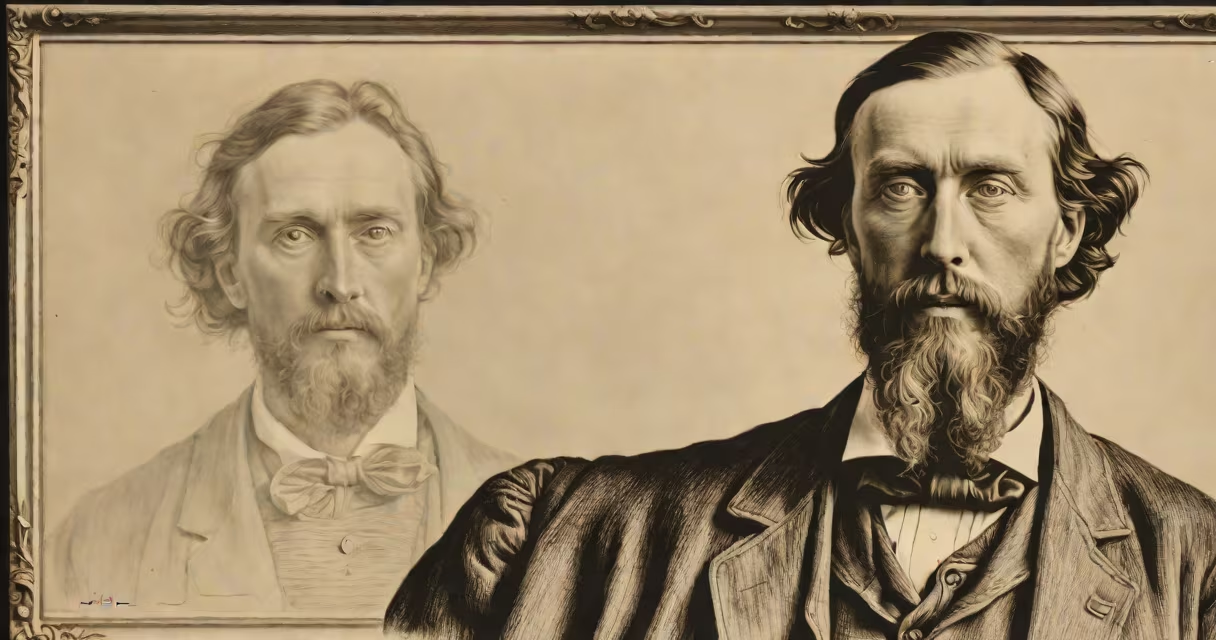
William Holman Hunt was a British painter and a founding member of the Pre-Raphaelite Brotherhood, known for his meticulous attention to detail, symbolic imagery, and deeply moral subject matter. His work fused religious themes with social realism, often depicting moments of spiritual awakening or personal redemption.
Hunt's artistic philosophy emerged in the mid-19th century as a reaction against what he saw as the mechanical and uninspired teaching of the Royal Academy. He believed artists should return to the rich detail, vibrant color, and emotional sincerity found in early Italian Renaissance works-before Raphael's influence diluted their authenticity. This commitment led him to reject academic conventions and seek truth through direct observation and symbolic narrative.
He painted scenes from everyday life imbued with deeper meaning. A single candle flame, a worn shoe, or a woman's gaze could carry theological weight. His most famous work, *The Awakening Conscience* (1853), shows a woman in a domestic setting abruptly turning toward a window, her hand lifting from a man's lap. The painting captures a moment of moral clarity amid societal corruption-a theme echoed in his later works.
Hunt's technique relied on precise observation and layered symbolism. He painted directly from life, using natural light and accurate textures. He avoided idealized forms, favoring realistic depictions of people, fabrics, and interiors. This approach aligned with the Pre-Raphaelite goal of reviving artistic integrity through truth to nature.
He often embedded religious or ethical messages within domestic scenes. In *The Light of the World* (1854), Hunt depicted Christ knocking on a door, wearing a crown of thorns and holding a lantern. The door is overgrown with weeds, symbolizing spiritual neglect. The painting became one of the most reproduced religious images in Britain, appearing in churches, homes, and public spaces.
His methods were labor-intensive. He spent months preparing backgrounds, studying anatomy, and adjusting lighting. For *The Shadow of Death* (1870), he recreated a 1st-century Judean home in his studio, using authentic materials and consulting biblical scholars. The result was a scene so detailed it felt like a photograph-yet it conveyed profound spiritual tension.
Several of Hunt's paintings became cultural touchstones due to their visual complexity and moral urgency.
| Title | Year | Subject & Symbolism | Legacy |
|---|---|---|---|
| The Awakening Conscience | 1853 | Woman in a lover's apartment realizes her moral decay. The bird in the cage represents trapped virtue. | Exposed the exploitation of women in Victorian society; inspired feminist critiques. |
| The Light of the World | 1854 | Christ at a door, holding a lamp. The door is locked and overgrown. | Over 500 copies made; widely displayed in churches and schools. |
| The Hireling Shepherd | 1861 | A shepherd ignores his flock to admire a sunset. The sheep wander into danger. | Symbolized neglect of duty; criticized clergy for spiritual apathy. |
| Awakening Conscience (revised) | 1860 | More refined version with stronger symbolism; altered lighting to heighten drama. | Now in the Tate Britain collection. |
One lesser-known fact: Hunt painted *The Light of the World* twice. The original version was rejected by the Royal Academy in 1854. He reworked it with sharper focus and added a small inscription from Revelation 3:20: "Behold, I stand at the door and knock." The revised version gained immediate popularity and became a national icon.
Many assume Hunt was purely religious or didactic. While his works often carried moral messages, they were not simplistic sermons. He intended viewers to engage emotionally and intellectually with the scene. His use of symbolism wasn't didactic-it invited interpretation.
Another error is calling him a "religious painter" in isolation. Hunt was deeply involved in social reform. He supported temperance movements and campaigned against child labor. His 1865 painting *The Scapegoat*-set in the wilderness, showing a goat being driven away-was interpreted as a metaphor for marginalized people in industrial society.
Some confuse him with Dante Gabriel Rossetti, another Pre-Raphaelite. Both were members of the Brotherhood, but their styles differed sharply. Rossetti focused on romantic idealism and poetic subjects. Hunt emphasized realism and moral responsibility. Where Rossetti painted dreamlike visions, Hunt painted moments of decision.
Hunt's paintings remain central to British art history. They appear in major collections including the Tate Britain, the National Gallery, and the Victoria and Albert Museum. His work is studied for its technical mastery and its role in shaping Victorian values.
One example: *The Light of the World* was reproduced in over 100,000 versions during the 20th century. It appeared on postcards, church banners, and even in wartime propaganda. Its enduring presence speaks to the power of visual storytelling in conveying complex ideas.
During a visit to the Tate in 2018, I stood before *The Awakening Conscience*. The woman's eyes caught the light differently than the rest of the room. I noticed the dust on the floorboards, the way the carpet frayed at the edges. The painting didn't just tell a story-it made me feel the weight of a choice.
His influence extends beyond the canvas. Modern artists like David Hockney have cited Hunt's use of light and space as foundational. Scholars at the University of Oxford note that Hunt's integration of theology and daily life helped change the role of art in public discourse.
William Holman Hunt remains a key figure in Western art. His work challenges viewers to see the sacred in the ordinary, the spiritual in the mundane. He did not paint for decoration-he painted to awaken conscience.