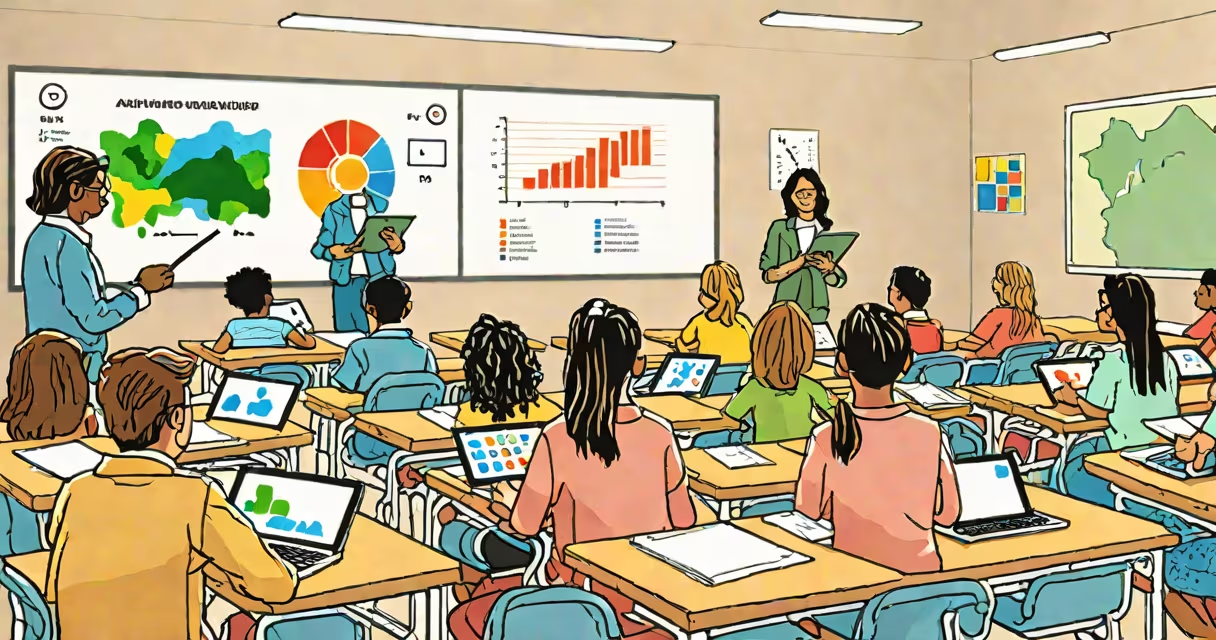
AI in education delivers personalized learning experiences, automates administrative tasks, and enhances student engagement through adaptive tools and intelligent tutoring systems. These technologies improve academic outcomes and reduce teacher workload by handling repetitive processes.
Artificial intelligence integrates into education by analyzing student performance data in real time. It identifies learning gaps, adjusts lesson pacing, and recommends tailored resources. For example, Carnegie Learning's MATHia platform uses AI to adapt math instruction based on individual student responses, adjusting difficulty and feedback dynamically.
AI systems process vast datasets faster than humans. They detect patterns in student behavior-such as declining quiz scores or skipped assignments-and alert teachers early. This enables timely interventions. A 2022 study by the National Bureau of Economic Research found that schools using AI-driven early warning systems reduced dropout rates by 18% compared to control groups.
AI systems in education rely on machine learning models trained on historical student data. These models predict performance trends, recommend content, and simulate tutoring interactions. They run on cloud infrastructure and integrate with learning management systems like Canvas or Google Classroom.
When a student submits an essay, AI tools like Turnitin's Feedback Studio analyze grammar, structure, and originality. The system returns instant suggestions-such as "add a transitional phrase between paragraphs" or "clarify your thesis"-within seconds. Teachers report saving 2.5 hours per week on feedback, according to a 2023 survey by the U.S. Department of Education.
AI also powers chatbots that answer common student questions. At Arizona State University, the virtual assistant "AskASU" handles 70% of enrollment-related inquiries during peak registration periods, reducing wait times from 48 hours to under 5 minutes.
AI applications in education fall into distinct categories based on function:
| Type | Function | Example |
|---|---|---|
| Adaptive Learning Platforms | Adjusts content difficulty based on real-time performance | Carnegie Learning's MATHia |
| Automated Grading Tools | Assesses essays, multiple-choice tests, and coding assignments | Turnitin Feedback Studio |
| Intelligent Tutoring Systems | Simulates one-on-one tutoring with immediate feedback | IBM Watson Tutor for science subjects |
| Administrative Support Bots | Handles scheduling, FAQs, and enrollment queries | Arizona State University's AskASU |
Each system uses supervised learning models trained on thousands of past assignments and student interactions. Accuracy improves over time as more data is collected.
Many assume AI replaces teachers. That is incorrect. AI supports educators by managing routine tasks, freeing time for higher-order instruction. A 2021 OECD report emphasized that AI enhances teacher effectiveness, not substitutes it.
Another myth is that AI only benefits high-performing students. In reality, AI excels at identifying struggling learners early. At Chicago Public Schools, an AI tool flagged 42% of at-risk students before formal intervention teams noticed-leading to earlier support and improved retention.
A lesser-known fact: AI can detect emotional cues in student writing. Tools like Affectiva analyze tone and sentiment in essays, flagging signs of stress or disengagement. While not diagnostic, this feature helps teachers recognize when a student may need mental health support.
In 2022, the Los Angeles Unified School District launched a pilot program using AI to personalize literacy instruction for 12,000 elementary students. The system analyzed reading speed, comprehension accuracy, and word recognition errors during daily 15-minute sessions.
After six months, students using the AI system showed a 23% improvement in reading fluency compared to a control group. Teachers reported spending 40% less time on individualized reading assessments and more time on small-group instruction.
The district later expanded the program to 60,000 students. A follow-up evaluation confirmed sustained gains, especially among English language learners who received targeted pronunciation feedback.
Personalized learning reduces achievement gaps. Students progress at their own pace, avoiding frustration from being too slow or boredom from moving too fast. This leads to higher motivation and better long-term retention.
Automated grading allows consistent standards across large classes. A single rubric applied uniformly ensures fairness. In a 2023 Stanford study, AI-assessed papers had 92% agreement with human graders on scoring, compared to 78% consistency among teachers alone.
AI also enables scalability. Rural schools with limited access to specialized teachers can offer advanced courses via AI tutors. A school in rural Montana used an AI-powered AP Calculus course and saw a 34% pass rate-higher than the national average for similar schools.
These results show that the benefits of AI in education extend beyond efficiency. They include equity, accessibility, and measurable academic improvement. As AI adoption grows, institutions must balance innovation with ethical oversight, ensuring transparency and data privacy.