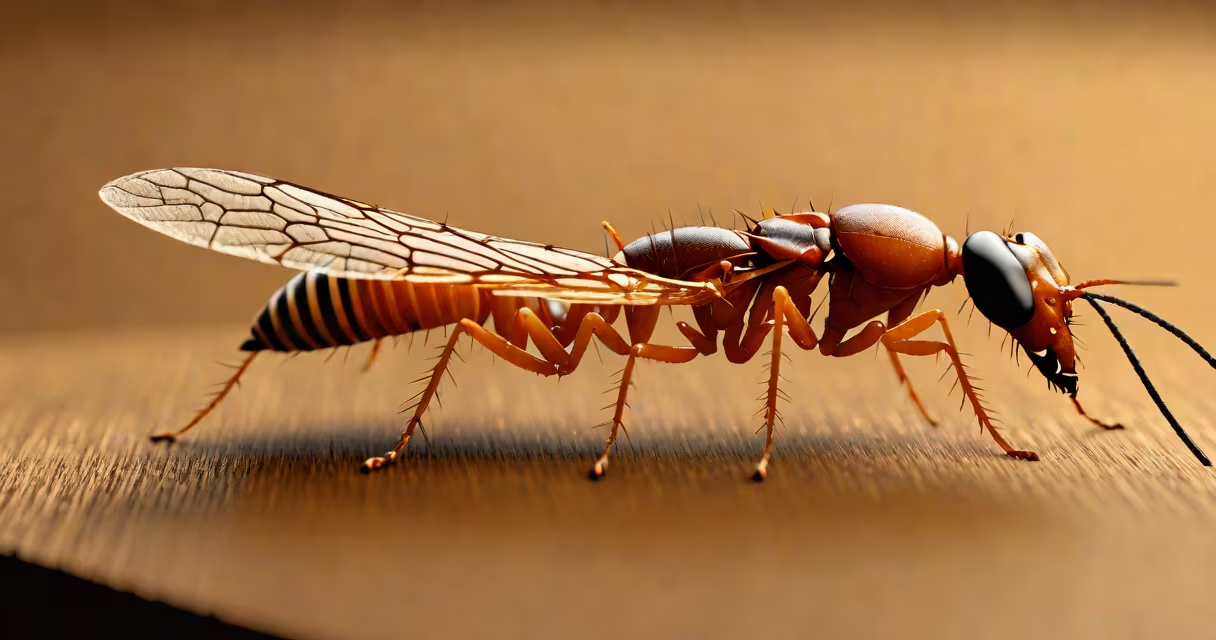
Termites lose their wings after mating flights to form new colonies, a process driven by reproductive biology and colony establishment. This wing shedding is a permanent, adaptive trait that signals the transition from dispersal to colony founding.
Wing loss occurs during or shortly after swarming, when winged reproductive termites-called alates-leave their parent colony to mate and start new ones. Once they land and pair, they shed their wings manually using specialized joints at the base of each wing. This act is irreversible and marks the beginning of their life as a king and queen of a new colony.
The process is not random. Wing shedding is triggered by physical contact and environmental cues such as moisture and darkness. It's a coordinated biological event tied to reproductive readiness. Without wings, the pair can no longer fly, but they gain the ability to dig into wood and begin tunneling-a necessary step for colony development.
Termite alates have a distinct joint called a "wax plug" or "fracture plane" at the base of each wing. This weak point allows the wing to detach cleanly when pressure is applied. The detachment happens through muscular contraction and precise joint mechanics, not by breaking or tearing.
Once detached, the wings fall off completely. There is no regrowth. The wing stubs remain embedded in the exoskeleton and serve no further function. This is different from other insects like ants, which may lose wings through injury but don't have a programmed shedding mechanism.
A study published in *Insectes Sociaux* (2019) analyzed 14 species of subterranean termites and found that wing shedding occurred in 100% of mated pairs within 6 hours of landing. The timing correlates with the onset of nest excavation, confirming that wing loss is a direct preparatory step for colony foundation.
Not all termites swarm at the same time or in the same way. The frequency and timing of swarming vary by species and region. Here's a comparison of common termite types and their wing shedding behaviors:
| Type | Swarming Time | Wing Shedding Timing | Colony Location |
|---|---|---|---|
| Subterranean (Reticulitermes spp.) | Spring, after rain | Within 1-6 hours of landing | Beneath soil or wood |
| Formosan (Coptotermes formosanus) | Summer evenings, high humidity | Immediately upon contact with ground | Wood structures, tree stumps |
| Dampwood (Zootermopsis spp.) | Year-round, depending on climate | After finding a moist cavity | Decaying logs, wet timber |
Each species uses wing loss as a signal to stop dispersal and start building. For example, Formosan termites often swarm in large numbers during thunderstorms. After landing, the alates shed wings and begin searching for crevices in buildings or trees-ideal spots for colony initiation.
Wing loss happens exclusively during the early stages of colony formation. It does not occur in worker or soldier castes-only in reproductive individuals who have left the nest to disperse.
Termites rely on chemical signals (pheromones) to coordinate swarming. When conditions are right-temperature between 20-30°C, humidity above 80%-alates emerge from their natal colony and fly toward light sources. Upon landing, they seek shelter and pair up. The pairing triggers wing shedding, which is believed to reduce energy expenditure and prevent wing damage during digging.
According to the USDA's Forest Service, wingless termites are 40% more efficient at tunneling through wood compared to those still carrying wings. The wings interfere with movement in tight spaces and increase drag. Losing them improves mobility and reduces metabolic cost during the critical early phase of colony development.
Many people assume that wing loss is caused by predators or accidents. But in reality, it's a deliberate, biologically programmed event. Termites do not lose wings due to falling or being stepped on-they actively shed them.
Another myth is that winged termites are more dangerous than wingless ones. This is false. Both forms are equally destructive, but only winged termites are capable of starting new infestations. Once they lose their wings, they cannot fly again, but they can still cause significant structural damage over time.
A third misconception is that wing loss indicates illness. In fact, it's a sign of health and reproductive maturity. A termite that retains its wings after landing may be unable to pair or initiate a colony properly. Wing shedding is a success marker, not a failure.
In 2021, researchers from the University of Florida monitored a Formosan termite swarm in Miami. They captured 127 alates during a single evening event. Within 90 minutes of landing, 118 had shed their wings. Of those, 94 successfully located wooden beams in a residential structure and began excavating tunnels.
One pair was observed digging into a porch support beam. After 18 hours, they had created a 2.3 cm tunnel and laid their first egg. The wings were found nearby, neatly detached at the fracture plane. This confirmed that wing loss precedes tunneling and is essential for colony establishment.
Field observations show that wingless pairs are more likely to survive initial colonization attempts. The absence of wings increases their ability to move through narrow passages and reduces exposure to desiccation. Moisture retention is critical-termites can die within 15 minutes of drying out.
I once inspected a basement in North Carolina where a subterranean termite colony had established under a wooden floor joist. During the inspection, I found dozens of termite alates with broken wings near a vent. But the most telling evidence was a pair of wingless termites inside a small cavity, surrounded by frass (termite droppings).
They were not flying. They were digging. The wings were gone-not torn, not damaged, but cleanly shed. That moment confirmed that wing loss is not an accident-it's a biological imperative. The colony had begun.
Understanding why termites lose their wings reveals how deeply adapted they are to their environment. This behavior helps reproductive individuals focus energy on colony growth rather than flight. It's a trade-off: freedom of movement for long-term survival.
For pest control professionals, recognizing wingless termites in a structure is a red flag. It means a colony has already taken root. Early detection relies on identifying these signs-especially the presence of discarded wings near entry points.