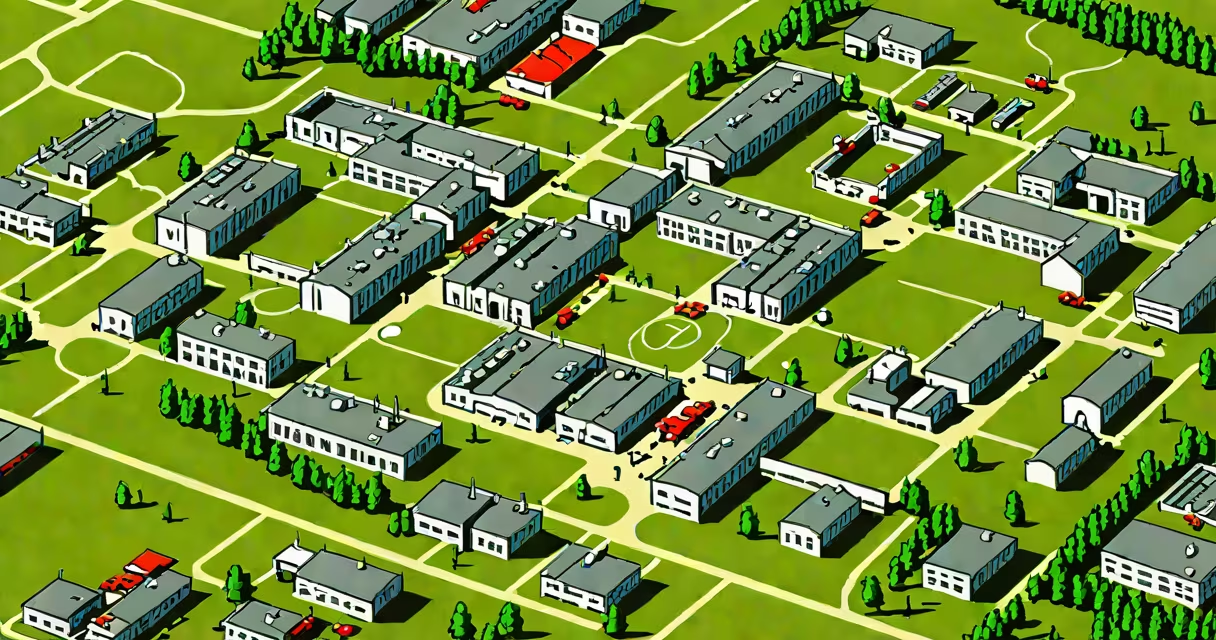
Grafenwoehr Army Base is a U.S. Army installation located in Bavaria, Germany, serving as a central hub for military training, readiness, and joint exercises across Europe. It supports U.S. Army Europe and Africa's mission to maintain combat readiness and strengthen alliances through large-scale maneuvers.
The base hosts the U.S. Army's Joint Multinational Training Command (JMTC), which conducts complex live-fire exercises involving American and allied forces. Its terrain-forests, hills, and open fields-mimics conditions found in Eastern Europe, making it ideal for simulating real-world combat scenarios. The base spans approximately 6,000 hectares and includes multiple training ranges, barracks, maintenance facilities, and command centers.
Operated under U.S. Army Europe and Africa (USAREURAF), Grafenwoehr supports rotational deployments of U.S. Army units, including infantry, armor, and support brigades. It also serves as a staging ground for NATO-led operations and multinational force integration. The base is part of the larger U.S. military presence in Germany, which includes Ramstein Air Base and Heidelberg's military community.
Training at Grafenwoehr Army Base follows a structured cycle based on unit readiness levels. Units arrive for pre-deployment training, conduct live-fire exercises, and participate in command post exercises (CPXs) to test decision-making under pressure. These drills simulate urban warfare, defensive operations, and rapid deployment scenarios.
Each exercise involves coordination between U.S. forces and partner nations such as Germany, Poland, the UK, and France. For example, Exercise Immediate Response 2023 involved over 10,000 troops from 15 countries, with Grafenwoehr as the primary training zone. The event included simulated defense of a contested border region using combined arms tactics.
After each exercise, debriefs analyze performance metrics such as response time, communication effectiveness, and equipment reliability. Data feeds into the Army's After Action Review (AAR) system, which informs future training design and doctrine updates. This feedback loop ensures continuous improvement in operational capability.
Grafenwoehr's infrastructure includes:
Units train in shifts lasting 3-6 weeks, depending on mission requirements. The base operates year-round, with peak activity during spring and autumn months when weather conditions are optimal for field operations.
Some assume Grafenwoehr is solely a training facility for U.S. soldiers. In reality, it is a multinational hub. German Bundeswehr units regularly train alongside Americans, and the base hosts annual bilateral exercises like "Iron Wolf" with Polish forces.
Another misconception is that access is restricted to active-duty personnel only. While entry requires proper authorization, family members of service members, contractors, and certain civilian partners may gain temporary access with clearance. Visitors must register at the main gate and present valid identification.
A lesser-known fact: Grafenwoehr was originally established in 1938 as a German military training site. The U.S. took control after World War II and expanded it during the Cold War. Today, it remains one of the most heavily used training sites in Europe, surpassing 200 exercises since 2000.
While other bases serve specific roles, Grafenwoehr stands out due to its focus on large-scale, joint training. The table below compares key attributes:
| Feature | Grafenwoehr Army Base | Ramstein Air Base (Germany) | Incirlik Air Base (Turkey) |
|---|---|---|---|
| Primary Mission | Ground combat training | Air operations and logistics | Strategic air mobility and surveillance |
| Training Scale | Large-unit maneuvers (up to 10,000 troops) | Supports airfield operations and refueling | Supports aerial reconnaissance and strike missions |
| Host Nation | Germany | Germany | Turkey |
| Exercise Frequency | Quarterly large-scale exercises | Monthly tactical air drills | Biannual strategic deployments |
Unlike Ramstein, which focuses on airpower projection, Grafenwoehr specializes in land-based readiness. Incirlik, though geographically closer to conflict zones, lacks the permanent training infrastructure found at Grafenwoehr.
In 2022, Grafenwoehr hosted Exercise Atlantic Resolve, a 12-day multinational drill involving 4,500 troops from 11 NATO countries. The scenario simulated a coordinated invasion of a Baltic state, requiring rapid deployment of armored units, air support, and cyber defense measures.
U.S. 1st Armored Division conducted a night movement across the base's forested zones, using thermal imaging and GPS-guided navigation. They engaged simulated enemy forces in a series of ambushes and counterattacks. The exercise concluded with a joint command briefing at the JMTC headquarters, where leaders assessed coordination gaps and adjusted future deployment plans.
Data collected showed a 17% improvement in response times compared to the prior year's iteration. This outcome informed changes to how U.S. units integrate with European allies during crisis scenarios.
I attended a training session at Grafenwoehr in 2021 as a civilian observer with a press pass. I watched a company-sized unit conduct a simulated assault on a fortified position. Tanks moved in coordinated waves while infantry advanced under cover. The sound of simulated explosions echoed across the valley, and smoke screens were deployed to mimic battlefield conditions.
What stood out was the precision of timing. Each unit had a designated window for movement, and deviations triggered immediate corrections via radio. The realism of the simulation surprised me-equipment failure simulations, communication breakdowns, and casualty management were all integrated into the drill.
Entry to Grafenwoehr Army Base requires a Department of Defense (DoD) Common Access Card (CAC) or a valid military ID. Civilians must be sponsored by a service member or contractor and registered in advance through the base's visitor portal.
Security screening includes biometric verification and vehicle inspections. All visitors must sign in at the main gate and wear visible badges. Unauthorized entry is prohibited and subject to legal action under U.S. military law.
Grafenwoehr Army Base remains a key part of U.S. military readiness in Europe. Its role extends beyond training-it shapes alliance cohesion, enhances interoperability, and prepares forces for high-intensity conflict. With ongoing investments in simulation technology and infrastructure, the base continues to evolve as a critical node in NATO's eastern defense posture.