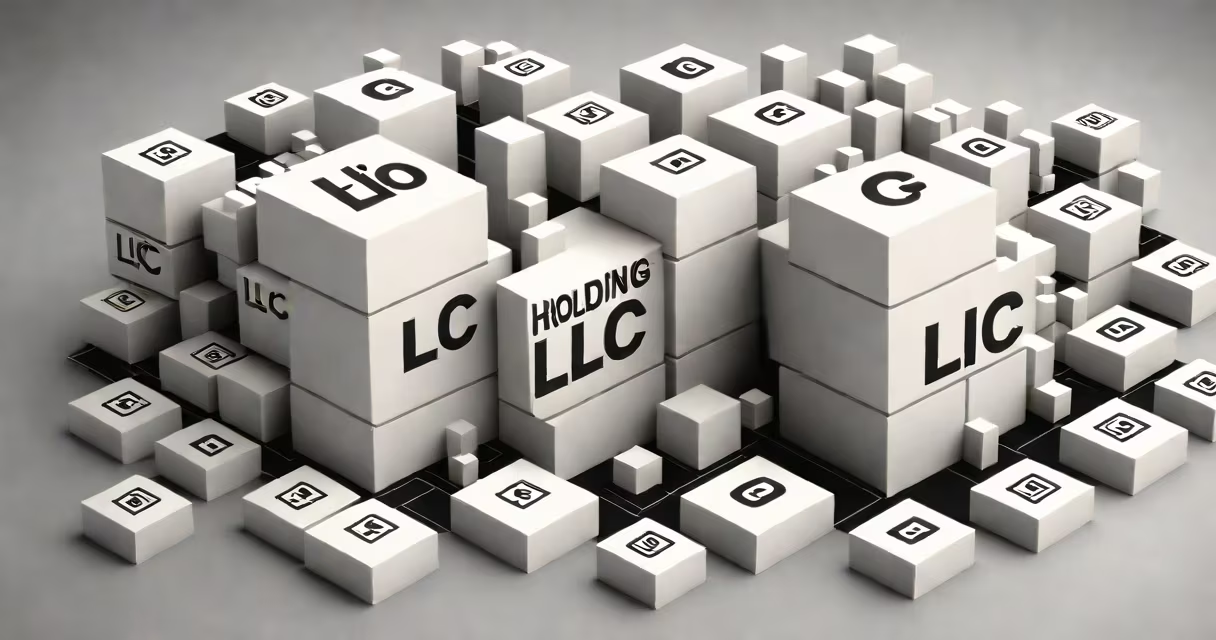
A holding LLC is a limited liability company formed solely to own and manage assets such as real estate, stocks, intellectual property, or other investment vehicles. It does not conduct operations or provide services itself. Instead, it holds ownership stakes in subsidiary companies or direct assets, shielding the owner's personal wealth from liabilities tied to those holdings.
The primary function of a holding LLC is risk isolation. By placing high-value or potentially litigious assets under its ownership, the individual or entity behind it reduces exposure to lawsuits, debt collection, or operational failures in related businesses. This structure is common among investors, real estate developers, and entrepreneurs managing multiple ventures.
According to the IRS, a holding LLC may be taxed as a disregarded entity, partnership, or corporation depending on election and ownership structure. The choice affects reporting, compliance, and tax treatment. For example, a single-member holding LLC reports income on Schedule C of Form 1040 unless electing corporate taxation.
A holding LLC operates by owning assets through direct title or via membership interests in subsidiaries. For example, if an investor owns three rental properties, each property can be titled under a separate holding LLC. If one property faces a tenant lawsuit, only that LLC's assets are at risk-not the others or the individual's personal assets.
This separation allows for targeted financial management. Each holding LLC can have its own bank account, insurance policy, and budget. It also enables easier transfer of ownership. Selling one property doesn't require dissolving the entire portfolio-just transferring membership interest in the relevant holding LLC.
For example, a real estate investor in California forms five holding LLCs-one for each property. Each LLC leases the property to a different tenant. When one tenant defaults and sues, the court can only seize assets within that specific LLC. The investor's personal residence and other properties remain untouched.
Holding LLCs vary based on ownership, tax election, and purpose. The most common configurations include:
| Type | Ownership | Tax Treatment | Use Case |
|---|---|---|---|
| Single-Member | One owner | Disregarded entity (income reported on owner's return) | Individual investor with one or few assets |
| Multi-Member | Two or more owners | Partnership (Form 1065 filed) | Business partners pooling assets |
| Series LLC | Multiple series within one entity | Varies by state; often treated as separate LLCs | Investors with many similar assets (e.g., rental units) |
Some states, including Delaware and Nevada, allow series LLCs-where each "series" functions as a separate legal entity with its own assets and liabilities. This structure reduces formation and maintenance costs compared to creating dozens of standalone LLCs.
Despite their benefits, holding LLCs are not automatically protected from all risks. A court can pierce the corporate veil if the owner commingles funds, fails to maintain records, or uses the LLC to commit fraud. The U.S. Supreme Court affirmed this principle in *Salinas v. United States* (2018), ruling that courts may disregard entity status when proper formalities are ignored.
Many people assume a holding LLC eliminates all liability. That's incorrect. While it limits exposure to specific assets, it does not shield against personal guarantees, fraud, or actions taken outside the entity's scope. For example, signing a lease personally still makes you liable-even if the property is held by an LLC.
Another confusion is equating a holding LLC with an operating LLC. An operating LLC runs a business-like a restaurant or consulting firm. A holding LLC owns assets but does not generate revenue through services or sales. Mixing the two without clear separation undermines liability protection.
Some believe forming a holding LLC requires complex filings. In reality, most states require only a Articles of Organization form and a filing fee ($50-$500). Annual reports and franchise taxes follow, but setup is straightforward. The IRS does not require separate federal registration-only a federal Employer Identification Number (EIN) if the LLC has employees or files returns.
In 2021, a tech entrepreneur in Austin formed a holding LLC called "Skyline Holdings LLC" to manage his portfolio of startup equity. He owned shares in four early-stage companies. Rather than holding them personally, he placed each share set under a separate subsidiary LLC, all owned by Skyline Holdings.
When one startup faced a patent infringement suit, the plaintiff sued Skyline Holdings. Because the subsidiary was properly structured-with separate bank accounts, minutes, and no commingling-the court upheld the LLC's liability shield. The plaintiff recovered nothing beyond the assets in that one subsidiary. The other three startups remained unaffected.
This outcome aligns with guidance from the American Bar Association's Business Law Section, which emphasizes that "formal separation of assets and governance is essential to maintaining the integrity of the holding entity."
As a practical step, if you're considering a holding LLC, ensure each entity maintains its own books, avoids shared credit lines, and files annual reports. Failure to do so weakens the legal barrier between personal and business assets.
A holding LLC is not a magic shield-it's a tool. Used correctly, it protects assets. Used carelessly, it fails. Its strength lies in discipline, documentation, and separation.