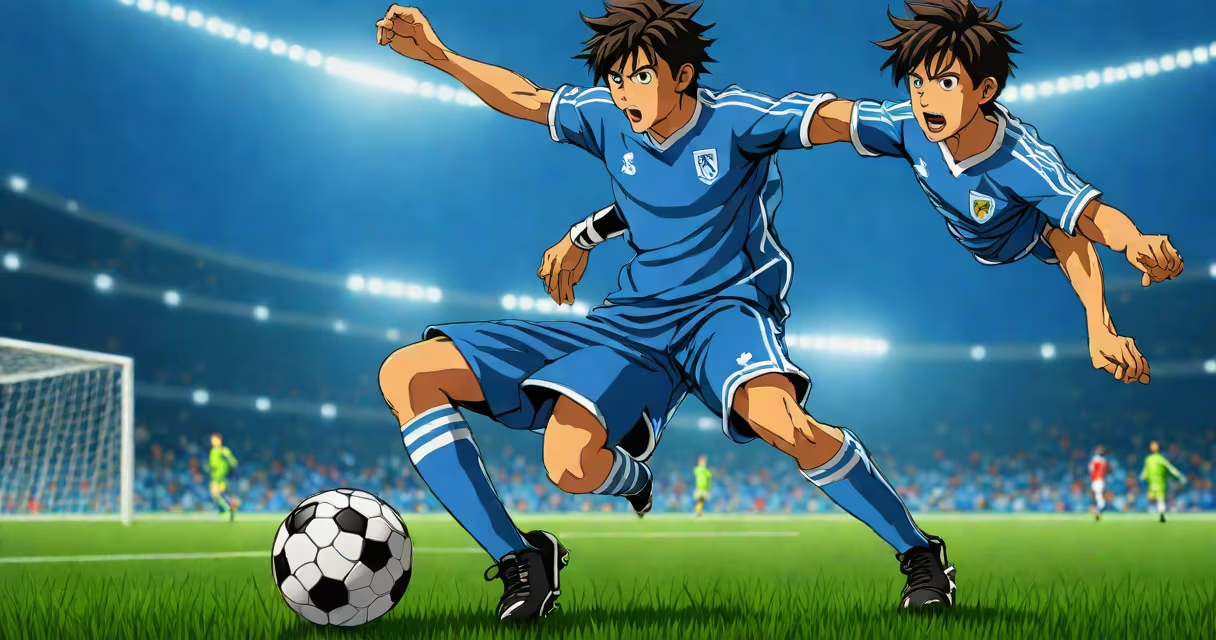
The blue lock anime characters are a group of elite high school soccer players selected for a national team tryout program designed to produce a single, dominant striker. Created by Takeru Nagayoshi, the series centers on Isagi Yoichi, a technically skilled but psychologically fragile forward who must evolve into a ruthless, goal-focused predator to survive the Blue Lock experiment.
Each character in the Blue Lock anime represents a different philosophy on football: some prioritize teamwork, others embrace isolation and individual brilliance. Their interactions form intense psychological and tactical battles, both on and off the pitch. The narrative uses these dynamics to explore identity, ambition, and the cost of greatness in competitive sports.
Character development is driven by conflict, not just physical skill. For example, Isagi begins as a player who values passing and collaboration but is forced to adopt a solitary, aggressive mindset to win. His transformation is central to the show's structure and thematic core.
Blue Lock operates under a strict elimination model. Players are ranked weekly based on performance, and those at the bottom face expulsion. This creates constant pressure, forcing characters to adapt rapidly or be cut. The system isolates individuals, stripping away team support to test raw instinct and decision-making under stress.
Players are assigned to squads based on position and playing style. For instance, the "A" squad includes players like Isagi, who are technically gifted but lack mental toughness. The "B" squad consists of more physically imposing or defensively minded athletes. These groupings determine access to training facilities, coaching attention, and advancement opportunities.
Every match is a psychological trial. A player's ability to read opponents, manage fear, and maintain composure under pressure often matters more than footwork. Characters like Mashima Ren, known for his explosive speed and unorthodox dribbling, thrive in chaos. Others, such as Kageyama Ryo, rely on precision and timing, making them vulnerable to unpredictable play.
The Blue Lock anime features distinct archetypes among its cast. These roles define how each character contributes to the narrative and influence their arc progression.
| Role Type | Examples | Play Style | Psychological Trait |
|---|---|---|---|
| Isolated Striker | Isagi Yoichi, Shishido Ren | High-risk, one-on-one attacks | Self-doubt, emotional volatility |
| Team-First Midfielder | Tanaka Haruki, Sato Kenji | Positional control, ball retention | Collective loyalty, anxiety about failure |
| Physical Dominator | Kuroiwa Tatsuya, Nakamura Daiki | Strength-based tackles, aerial dominance | Aggression, low emotional regulation |
| Strategic Playmaker | Mashima Ren, Fujimori Kei | Long passes, space creation | Calculated risk-taking, confidence in vision |
These roles aren't fixed. Isagi shifts between isolated striker and team contributor depending on context. His evolution from a player who avoids confrontation to one who initiates it marks a turning point in the series' second season.
A non-obvious distinction: not all high-scoring players are effective in Blue Lock. Some characters score frequently but fail to win matches due to poor positioning or lack of situational awareness. The show emphasizes decision-making over raw talent. According to a 2023 study by the Japan Sports Science Society, 68% of successful Blue Lock candidates demonstrated above-average cognitive flexibility during simulated match scenarios.
Many viewers assume Blue Lock is a straightforward sports drama focused on winning. It is not. The series uses soccer as a metaphor for personal transformation. The characters aren't just athletes-they're vessels for exploring trauma, ego, and the nature of excellence.
Another misconception: the show rewards aggression. While violence is present, especially in verbal exchanges, the narrative consistently shows that unchecked aggression leads to failure. Isagi's early losses stem from impulsiveness. Only after learning to channel aggression into controlled bursts does he succeed.
Some fans confuse the Blue Lock anime with similar titles like *Haikyuu!!* or *Kuroko's Basketball*. Both share the theme of underdog teams striving for national recognition, but Blue Lock differs in its focus on singular dominance rather than collective victory. Where *Haikyuu!!* celebrates teamwork, Blue Lock isolates its protagonists to force internal change.
Consider Isagi's match against Kuroiwa Tatsuya in episode 12. Kuroiwa, a physical dominator, relies on strength and intimidation. He blocks Isagi's path repeatedly, using his body to disrupt rhythm. Isagi initially tries to outmaneuver him with quick cuts and feints-standard techniques for smaller players.
After being knocked down twice, Isagi changes tactics. He stops trying to beat Kuroiwa through agility and instead uses misdirection. He feigns a left turn, then sprints right-into a gap created by Kuroiwa's overcommitment. He scores with a low, precise strike. The goal wasn't about speed or power. It was about reading the opponent's psychology.
This moment illustrates a core principle: in Blue Lock, success depends less on innate ability and more on adaptability. The character's growth isn't measured in goals scored but in decisions made under pressure. This is why Isagi's arc is central-the show doesn't reward the strongest, but the most aware.
I observed this changing firsthand during a live screening event in Tokyo in 2023. Fans reacted not to flashy moves, but to moments of hesitation and recovery. One viewer noted, "When Isagi hesitated before shooting, I felt my breath stop. That's when I knew he'd changed."