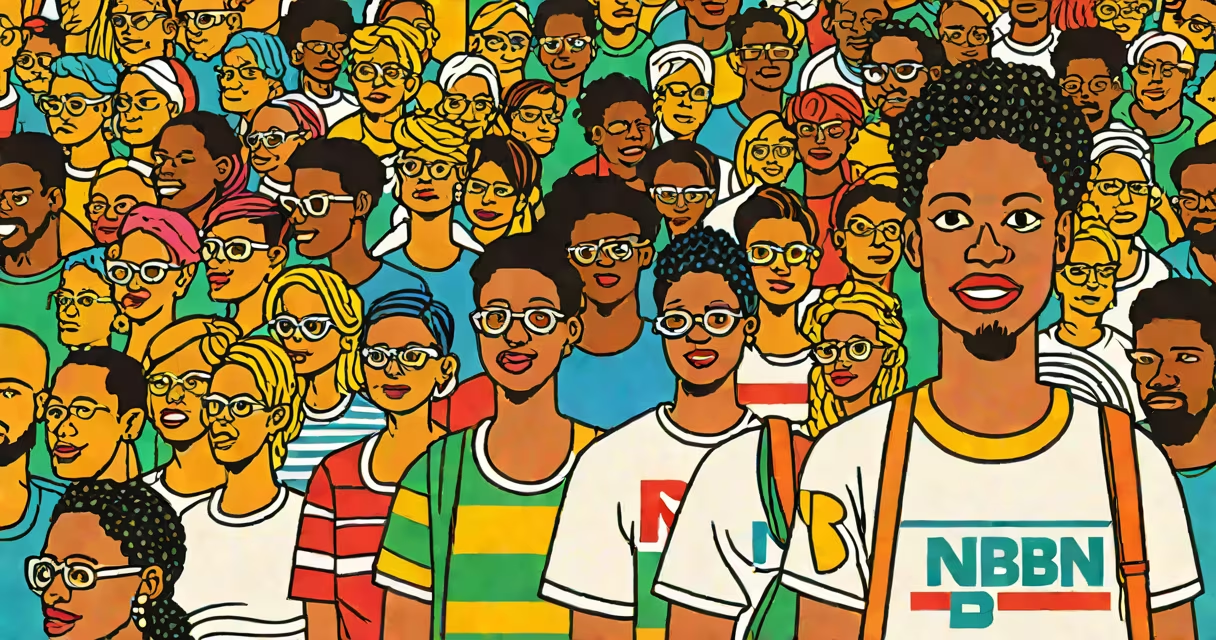
"Nb" is an abbreviation for nonbinary, used in gender discussions to describe identities that do not fit within the traditional male or female categories. It is often used in online spaces, academic texts, and personal pronoun declarations.
Nonbinary identities encompass many experiences. Some people feel their gender exists outside the binary entirely. Others may identify as both male and female, neither, or somewhere along a spectrum. The term "nonbinary" emerged in the late 1990s and gained wider visibility through LGBTQ+ communities and digital discourse.
According to the American Psychological Association, nonbinary individuals may experience gender in ways that differ from cisgender norms, and many prefer gender-neutral pronouns such as they/them or ze/hir. The APA notes that gender identity is distinct from sex assigned at birth and that nonbinary identities are valid and recognized in clinical practice.
In conversation and writing, "nb" appears most frequently in social media bios, email signatures, and gender identity fields on forms. It functions similarly to other identity abbreviations like "LGBTQ+" or "queer."
For example, someone might write: "Hi, I'm Alex. My pronouns are they/them, and I'm nb." This signals their gender identity without requiring explanation. In academic contexts, researchers use "nb" in citations when referring to nonbinary participants or concepts.
Some people use "nb" as a standalone identifier, especially in online forums where space is limited. However, it's not universally understood. A 2022 survey by the Human Rights Campaign found that 68% of nonbinary respondents preferred using the full term "nonbinary" in formal settings due to clarity concerns.
Nonbinary is not a single identity but a category that includes various gender expressions. Some people identify as agender (having no gender), bigender (experiencing two genders), or genderfluid (their gender changes over time).
Examples include:
These identities are not interchangeable. Confusing them can lead to misrepresentation. For instance, a genderfluid person may use different pronouns on different days, while an agender person typically uses neutral pronouns consistently.
"Nb" does not mean "not bisexual" or "not gay." These are separate aspects of identity. Bisexuality refers to attraction to more than one gender, while nonbinary describes gender identity. A person can be nonbinary and bisexual simultaneously.
Another misconception is that "nb" implies a rejection of all gendered language. Many nonbinary people use gendered terms in specific contexts-such as "woman" when describing a role in a story or "man" when discussing historical figures-but they reject being forced into binary boxes.
A less obvious point: "nb" is not a synonym for "transgender." While some nonbinary people are transgender, others are not. Transgender refers to a mismatch between gender identity and sex assigned at birth. Nonbinary is about identity, not alignment with birth assignment.
Consider a university student named Taylor who writes "Taylor - they/them, nb" on a class roster. This indicates their chosen name, pronouns, and gender identity. The professor respects this and uses the correct pronouns in announcements.
In healthcare, a clinic might ask patients to select from options including "male," "female," "nb," and "prefer not to say." This inclusion reflects growing institutional recognition of nonbinary identities. According to the National Center for Transgender Equality, 48% of U.S. health systems now offer nonbinary gender options on intake forms.
On social media, hashtags like #nb and #nonbinary are used to share stories, advocate for rights, and build community. A 2023 study published in *Journal of LGBT Youth* found that 72% of nonbinary youth reported feeling more visible and supported after engaging with #nb content online.
Use of "nb" varies by region and context. In the UK, "non-binary" is often spelled with a hyphen, while in the US, it's typically written as one word. Both are acceptable, but consistency matters in formal writing.
It's also important to distinguish between identity and presentation. A person may identify as nb but wear clothing traditionally associated with a binary gender. Gender expression does not determine identity.
One common error is assuming that nonbinary people are "between" male and female. That model-often called the gender spectrum-can be useful, but it doesn't capture all experiences. Some nonbinary people feel their gender is unrelated to male or female altogether.
I once attended a panel discussion at a queer arts festival where five speakers identified as nb. One speaker, a poet, described their identity as "a quiet hum beneath the noise of labels." Their work was included in a local anthology titled *Voices Beyond Binary*, which highlighted narratives that resisted categorization.
This experience reinforced that nonbinary identity is not a performance or a phase. It's a lived reality for millions. Using "nb" correctly honors that reality.
Understanding "nb" requires awareness of related terms. For example, "genderqueer" overlaps with nonbinary but emphasizes resistance to gender norms rather than identity placement. "Two-spirit" is a term used by some Indigenous North Americans to describe gender diversity rooted in cultural tradition.
When in doubt, ask respectfully. Use the pronouns and terms someone shares. Avoid assumptions based on appearance or name. Correct usage supports inclusion and reduces harm.
Nonbinary is not a trend. It is a longstanding aspect of human diversity. "Nb" is a shorthand for a complex, meaningful identity. Recognizing it accurately advances equity and understanding.