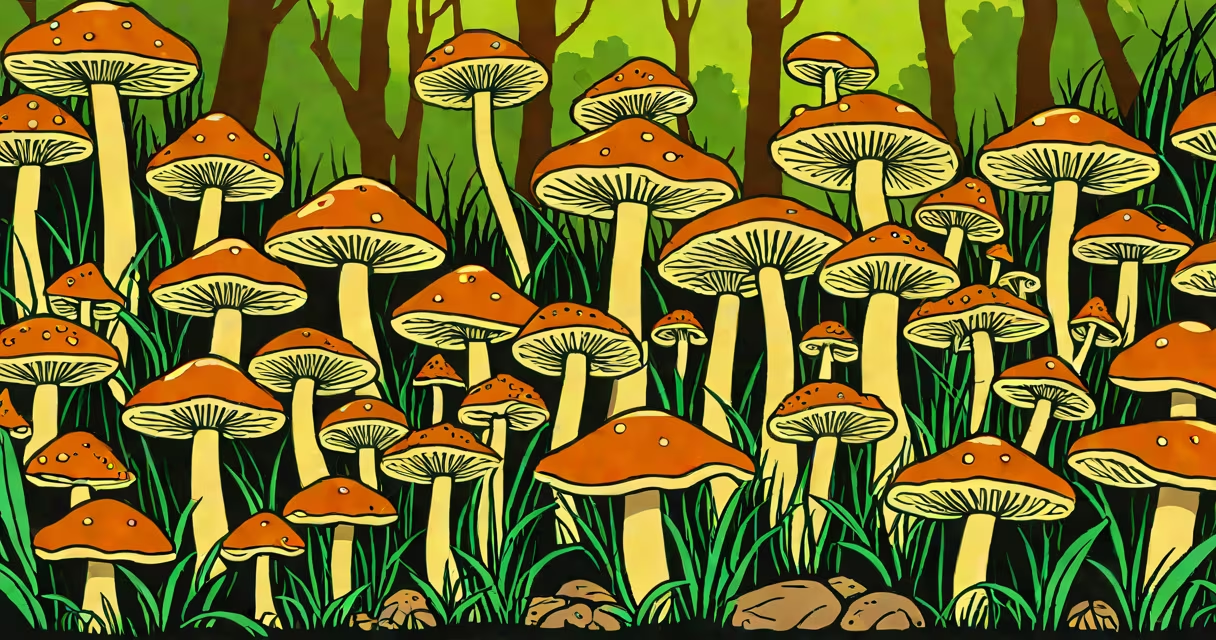
Mushrooms are the fruiting bodies of certain fungi, primarily belonging to the phylum Basidiomycota or Ascomycota. They emerge from underground networks of thread-like hyphae, forming visible structures that release spores for reproduction. Unlike plants, they lack chlorophyll and absorb nutrients from decaying organic matter.
Mushrooms serve critical ecological roles as decomposers, breaking down dead wood, leaf litter, and animal remains. This process recycles carbon and nitrogen into ecosystems. Some species form symbiotic relationships with tree roots-mycorrhizal associations-enhancing nutrient uptake for both partners. Others act as pathogens, infecting insects or plants.
The term "mushroom" often refers to the fleshy, spore-producing structures of macrofungi, though technically all fungi produce such structures. Not all fungi form mushrooms-some, like yeasts and molds, remain microscopic. The most recognizable mushrooms have a cap, stem, and gills or pores beneath the cap where spores develop.
Mushrooms do not photosynthesize. Instead, they secrete enzymes that break down complex organic materials-lignin in wood, cellulose in plant tissue-into simpler compounds they can absorb. This decomposition supports soil health and enables forest regeneration.
Reproduction begins when hyphae from two genetically compatible individuals fuse. This forms a dikaryotic mycelium-a network of cells with two nuclei per cell. Under favorable conditions, this network produces a fruiting body-the mushroom-within days to weeks. Spores released from gills or pores disperse via wind or animals, colonizing new substrates.
A single mycelial network can span acres. In Oregon's Malheur National Forest, a single Armillaria ostoyae fungus covers over 2,000 acres and is estimated to be 2,400 years old. Its mycelium sustains itself by parasitizing nearby trees, demonstrating how mushrooms influence entire ecosystems.
Mushrooms vary widely in appearance, habitat, and edibility. The following table outlines major categories based on taxonomy and use:
| Type | Common Name | Edible? | Habitat | Key Feature |
|---|---|---|---|---|
| Basidiomycota | Button mushroom | Yes | Commercial farms | White cap, gills, cultivated globally |
| Basidiomycota | Chanterelle | Yes | Deciduous forests | Orange-yellow, funnel-shaped, fragrant |
| Ascomycota | Morel | Yes | Fire-damaged woods | Pitted cap, hollow stem, spring harvest |
| Basidiomycota | Death Cap | No | Under oaks | Greenish cap, white gills, deadly toxin |
Among edible species, chanterelles are prized for their fruity aroma and meaty texture. A 2023 study by the University of California, Berkeley, confirmed that wild-harvested chanterelles contain higher levels of vitamin D and B-complex vitamins than store-bought varieties due to sun exposure during growth.
Some mushrooms have psychoactive properties. Psilocybe cubensis contains psilocybin, a compound studied for treating treatment-resistant depression. Clinical trials at Johns Hopkins University show significant symptom reduction in 60% of participants after a single dose, though it remains illegal under federal law.
Culinary applications dominate public awareness. Button mushrooms account for 80% of global mushroom production, grown indoors using pasteurized straw and controlled humidity. In 2022, the U.S. produced 3.2 billion pounds of mushrooms, valued at $1.3 billion, according to the USDA.
Medicinal research focuses on beta-glucans found in Reishi (Ganoderma lucidum) and Turkey Tail (Trametes versicolor). These compounds modulate immune response. A 2021 meta-analysis in *Frontiers in Immunology* found that turkey tail extract improved survival rates in patients with advanced gastric cancer when combined with chemotherapy.
Environmental uses include bioremediation. Oyster mushrooms (Pleurotus ostreatus) degrade polycyclic aromatic hydrocarbons (PAHs) in contaminated soils. In a 2019 field test in Michigan, a 40-acre site reduced PAH levels by 72% over six months using mushroom inoculation.
Many assume all mushrooms are safe to eat. This is false. The death cap (Amanita phalloides) causes 90% of fatal mushroom poisonings worldwide. Symptoms appear 6-12 hours after ingestion-long enough for victims to delay seeking care. One gram of death cap contains enough amatoxin to kill an adult human.
Another myth: mushrooms grow from dirt. Most species grow on organic material-wood, leaves, compost-not soil. For example, shiitake mushrooms (Lentinula edodes) require hardwood logs. Cultivators drill holes into oak or maple logs, insert spawn, then incubate them in shaded, humid environments.
Finally, mushrooms are not plants. They belong to the kingdom Fungi, distinct from Plantae. Their cell walls contain chitin-same material in insect exoskeletons-not cellulose. This difference affects how they metabolize and interact with other organisms.
Understanding what are mushrooms reveals their complexity beyond food. They are ecological engineers, medical candidates, and environmental restorers. With proper identification and respect for their biology, they remain among nature's most versatile organisms.