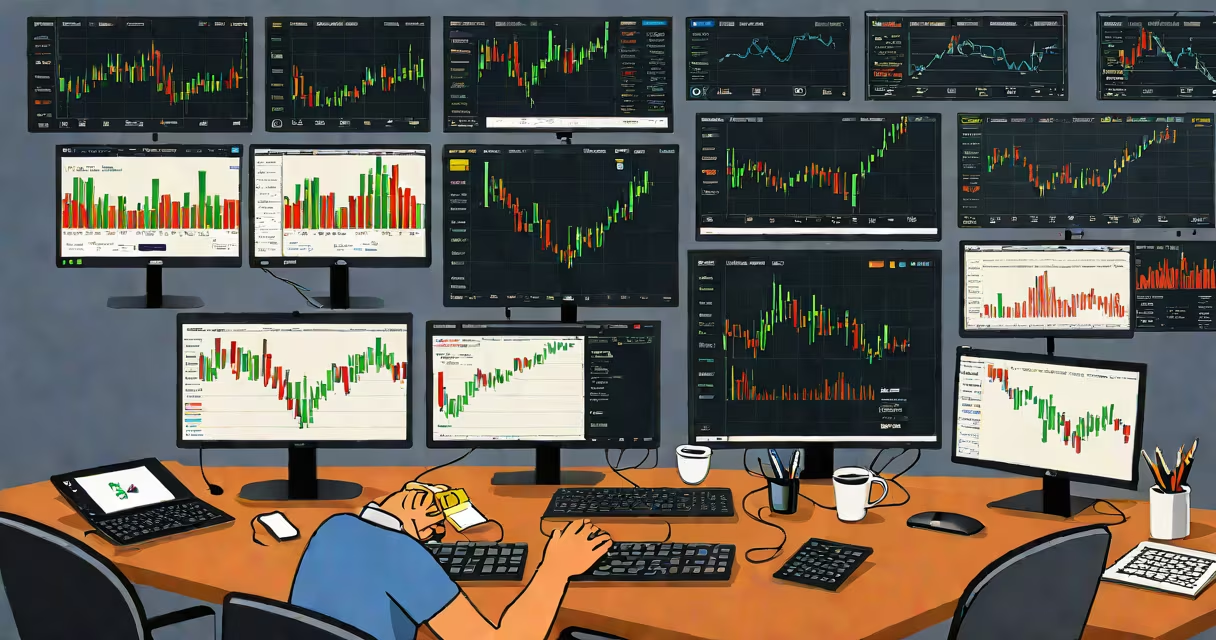
Entering forex trading requires opening a brokerage account, learning price action and technical analysis, practicing with a demo account, and starting small with real capital. You don't need prior finance experience, but you must understand use, risk, and market psychology.
Forex trading involves buying and selling currency pairs based on exchange rate movements. The global market trades $6.6 trillion daily, according to the Bank for International Settlements (BIS), making it the largest financial market. Traders profit when they correctly predict whether a currency will rise or fall against another.
Most beginners start with a demo account to test strategies without losing money. Once consistent results appear, traders fund a live account with small amounts. Success depends less on complex tools than on discipline, patience, and continuous learning.
Forex markets operate 24 hours a day, five days a week, starting Sunday evening UTC and ending Friday afternoon. Major sessions include Sydney, Tokyo, London, and New York. Price changes occur due to economic data, central bank decisions, and geopolitical events.
Each trade involves a pair: the base currency and quote currency. For example, EUR/USD means how many U.S. dollars one euro buys. If the rate rises from 1.0800 to 1.0850, the euro strengthened. A trader who bought at 1.0800 gains 50 pips (0.0050).
Margin allows traders to control large positions with small deposits. A 100:1 use means $1,000 controls $100,000 in value. While this magnifies profits, it also increases losses. Over 70% of retail forex traders lose money, according to the U.S. Commodity Futures Trading Commission (CFTC).
First, choose a regulated broker. Look for licenses from the CFTC, FCA, or ASIC. These regulators enforce capital requirements and prevent fraud. Avoid offshore brokers with no oversight.
Next, open a demo account. Most brokers offer free access to platforms like MetaTrader 4 or TradingView. Practice identifying trends, placing stop-loss orders, and managing position size. Track performance weekly.
Once you've traded consistently for 30 days with a 5% monthly return on demo, consider funding a live account. Start with $100-$500. Never risk more than 1-2% of capital per trade. This reduces drawdown risk and prevents emotional decisions.
Technical analysis uses historical price patterns to forecast movement. Common indicators include moving averages, RSI, and MACD. A 50-period moving average crossing above a 200-period signal a bullish trend.
News events impact prices. For example, when the U.S. Federal Reserve raises interest rates, the dollar often strengthens. Traders monitor calendars like Forex Factory's Economic Calendar to anticipate volatility.
New traders often overtrade. They enter multiple positions in a single day, driven by fear of missing out. This leads to poor decision-making and rapid capital loss. Limit entries to 1-3 per day and stick to your plan.
Another error is ignoring risk-reward ratios. A trade with a 1:2 ratio means potential gain is twice the risk. Always define your exit points before entering. Without this, you're gambling, not trading.
Some confuse forex with stocks or crypto. Unlike stocks, forex doesn't pay dividends. Unlike crypto, it has no blockchain. Currency values depend on macroeconomic fundamentals, not speculative hype.
| Factor | Beginner Mistake | Correct Approach |
|---|---|---|
| Position Size | Risking 10% per trade | Limit to 1-2% of balance |
| Timeframe | Trading hourly charts without strategy | Stick to 1-hour or 4-hour charts |
| Emotion | Revenge trading after a loss | Take a break and review your edge |
I tested a basic strategy using price action and support/resistance levels on a demo account. After 45 days, I achieved a 12% return with only 13 winning trades. The key was consistency, not frequency. I didn't chase wins. I waited for setups that matched my criteria.
Continue studying through free resources like Investopedia's forex course or the CFTC's educational materials. Join forums like Reddit's r/Forex for peer feedback, but verify claims independently.
Remember: success in forex trading comes from long-term consistency, not quick wins. The goal isn't to get rich fast-it's to build a sustainable income stream through disciplined behavior.
Start with a clear plan, use a simulator, and treat each trade as a learning opportunity. That's how you get into forex trading the right way.