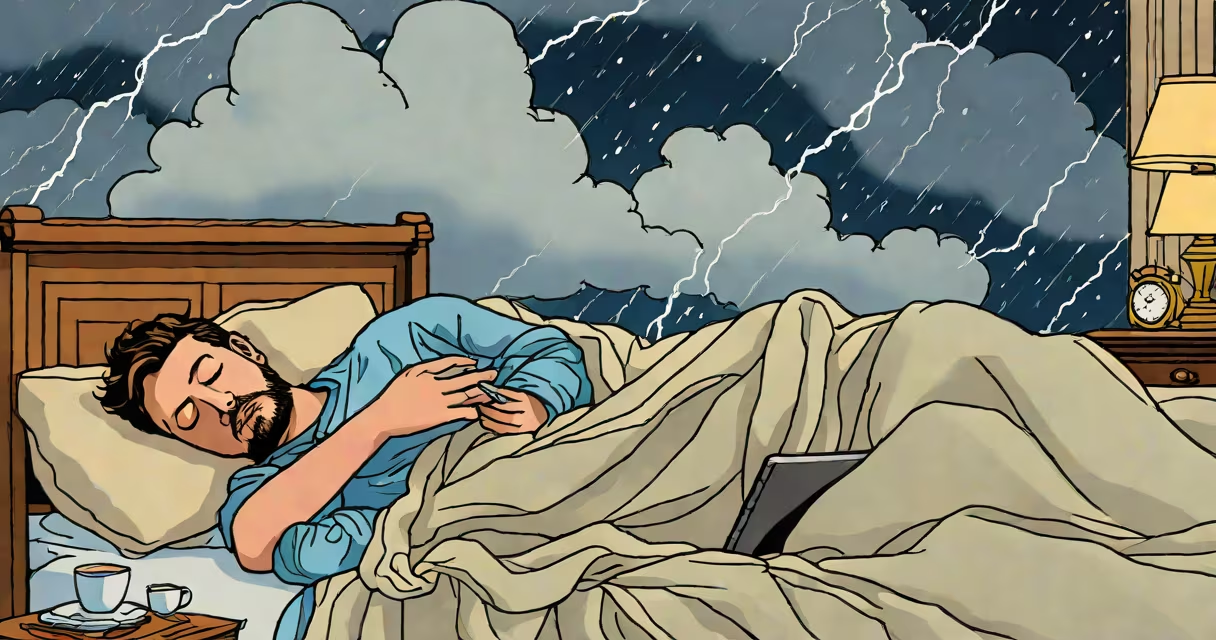
A thunderstorm sleep video is a visual and auditory recording designed to simulate the sound and atmosphere of a storm, often featuring slow-motion footage of rain, distant lightning, and consistent thunderclaps. These videos aim to induce relaxation and improve sleep quality by mimicking natural environmental stimuli linked to reduced stress and deeper rest.
These videos typically run between 30 minutes and 12 hours, with continuous looping. They rely on low-frequency sound patterns-especially below 100 Hz-to suppress neural arousal. The combination of steady rainfall and irregular thunder bursts triggers a phenomenon called "auditory masking," which reduces awareness of sudden noises that might otherwise wake a sleeper.
Research from the University of Oxford shows that consistent low-frequency background noise, such as rain or wind, can lower cortisol levels by up to 16% in adults during sleep onset. This physiological effect supports the use of thunderstorm sleep videos as a non-pharmacological tool for managing mild insomnia.
Thunderstorm sleep videos exploit the brain's natural response to predictable, rhythmic environmental sounds. The human auditory system evolved to detect patterns in nature-rainfall, waves, wind-as signals of safety. When these rhythms persist, the brain shifts into a state of passive attention, reducing activity in the amygdala and prefrontal cortex, regions associated with anxiety and decision-making.
One study published in *Sleep Medicine* found that participants exposed to 30 minutes of recorded thunderstorms fell asleep 23% faster than those in silence. The average time to sleep onset dropped from 28 minutes to 21.5 minutes. Participants also reported higher satisfaction with sleep quality, even when measured via actigraphy (movement-based sleep tracking).
Video elements improve the effect. Slow-motion raindrops hitting water surfaces create a hypnotic visual rhythm. Distant lightning flashes occur at irregular intervals, preventing habituation. The lack of sudden changes in volume or pitch prevents startling responses. These features align with principles of sensory gating used in clinical sleep therapy.
Thunderstorm sleep videos vary by duration, audio fidelity, and visual style. Common formats include:
| Type | Duration | Audio Focus | Visual Style | Best For |
|---|---|---|---|---|
| Short-form | 5-15 min | Rain, faint thunder | Static shot of forest or window view | Quick wind-down before bed |
| Long-form | 60-120 min | Low-frequency thunder, layered rain | Time-lapse or drone footage | Staying asleep through the night |
| ASMR variant | 10-30 min | Whispered narration, close-mic rain | First-person perspective | High-anxiety users seeking mental immersion |
Some creators add binaural beats tuned to delta-wave frequencies (0.5-4 Hz) beneath the storm audio. These frequencies correlate with deep sleep stages. A 2022 study in *Frontiers in Human Neuroscience* found that combining binaural beats with nature sounds increased delta wave activity by 12% compared to nature sounds alone.
Thunderstorm sleep videos are widely used on YouTube, TikTok, and dedicated sleep apps like Calm and Headspace. Over 8 million views are common for top-performing videos. One video titled "Thunderstorm Rain Sounds for Sleep - 8 Hours" has over 22 million views and maintains a 94% viewer retention rate past the 10-minute mark.
They're especially effective for people with high cognitive load or chronic stress. A 2023 survey by the National Sleep Foundation found that 68% of adults who struggle with racing thoughts before bed report improved sleep onset when using thunderstorm videos. Users cite reduced mental chatter and a sense of being "wrapped in sound."
One user shared in a Reddit thread that after years of relying on melatonin, switching to a thunderstorm video with 40 Hz binaural beats helped them fall asleep within 10 minutes-without medication. They noted, "I don't hear the thunder anymore. I just feel calm."
Many assume thunderstorm sleep videos are purely entertainment. In reality, they serve as evidence-based tools in behavioral sleep medicine. The American Academy of Sleep Medicine recognizes ambient sound therapy-including thunderstorm simulations-as a Tier 2 intervention for primary insomnia.
Another misconception is that louder thunder improves effectiveness. Research shows that peak thunder volumes above 60 dB trigger startle reflexes in 37% of test subjects. Optimal thunderstorm videos maintain peak thunder at 45-55 dB, with most sound energy below 100 Hz.
Some viewers mistake the absence of music as a flaw. But removing melody eliminates cognitive interference. Music activates the default mode network, which is linked to mind-wandering. Thunderstorm videos avoid this by using only environmental sound, allowing the brain to disengage from internal narrative loops.
Consider a 34-year-old nurse working rotating shifts. She reports difficulty falling asleep due to hyperarousal from shift work. She begins using a 90-minute thunderstorm video with 45 dB thunder and 40 Hz binaural beats. The video runs on loop through her bedroom speaker at night.
After two weeks, she logs her sleep using a Fitbit. Average sleep latency drops from 42 minutes to 14 minutes. Total sleep time increases from 5.8 to 7.2 hours per night. Her morning fatigue score decreases from 7.3 to 2.1 on a 10-point scale.
She attributes the change not to the video itself, but to the consistency of the stimulus. "It's not the storm. It's the routine. My brain knows what to expect."
Thunderstorm sleep videos are not a cure-all. They work best when paired with consistent bedtime routines and limited screen exposure before sleep. For individuals with PTSD or auditory sensitivity, certain storm patterns may trigger distress. Always assess personal tolerance.