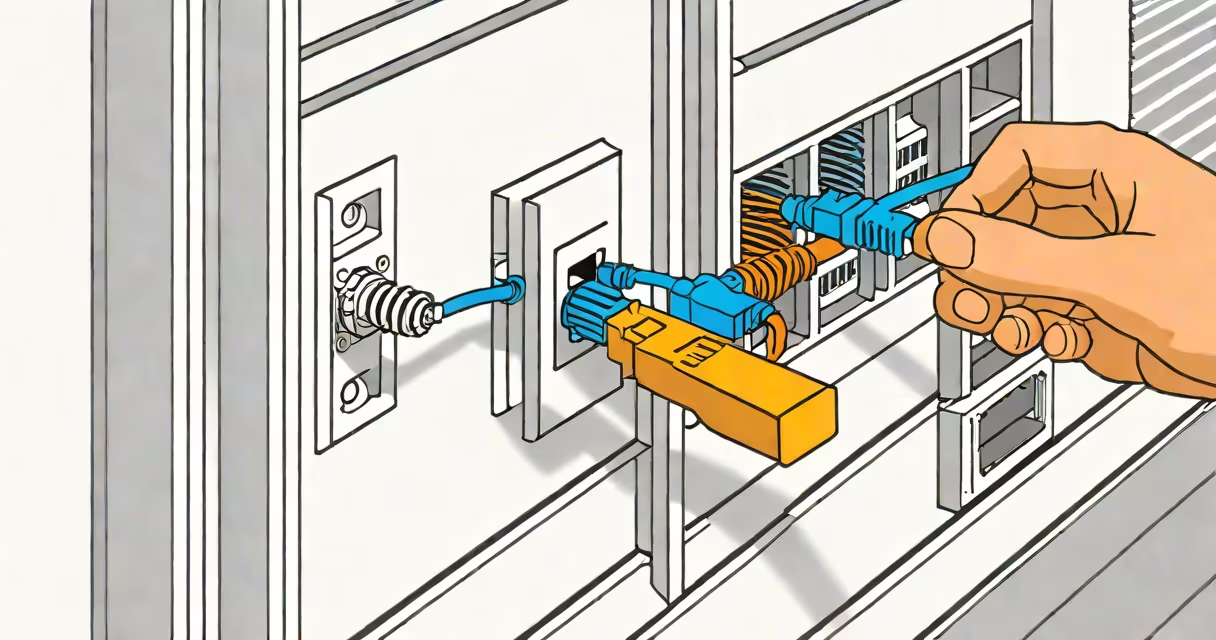
A cat6 to cat6 connector is a standardized RJ45 interface that joins two Cat6 Ethernet cables, enabling high-speed data transmission up to 10 Gbps over distances under 55 meters. It maintains signal integrity through precise wire termination and shielding designed for structured cabling systems.
Cat6 to cat6 connectors are essential in permanent installations where cables must be spliced or extended without patch panels. They are typically installed using a punch-down tool and terminate into a keystone jack or wall plate. The connector's internal contacts align with the eight conductors in the twisted pairs, ensuring minimal crosstalk and maximum bandwidth performance.
These connectors follow ANSI/TIA-568-C.2 standards for pinout configuration. The most common wiring schemes are T568A and T568B. Using mismatched wiring between ends causes connectivity issues or reduced speeds. For example, connecting a T568A end to a T568B end results in reversed transmit and receive pairs, leading to failed communication on gigabit networks.
The connector functions by securing each of the four twisted pairs within a Cat6 cable into dedicated contact points. The shielded foil around each pair reduces electromagnetic interference, which becomes critical at frequencies above 250 MHz. Without proper shielding and twist retention, signal degradation increases, especially over longer runs.
When terminated correctly, the connector ensures consistent impedance (100 ohms) across all channels. This stability prevents signal reflections that cause packet loss. A misaligned wire or damaged insulation can create impedance mismatches, resulting in errors during high-throughput operations such as video streaming or large file transfers.
For example, a 10-meter Cat6 cable run with properly wired cat6 to cat6 connectors supports 10 Gbps throughput at 550 MHz. But if one pair is crossed or the cable is bent beyond the minimum bend radius (4 times the cable diameter), the signal degrades to 1 Gbps or lower.
Several connector types serve different installation scenarios. The most common are:
| Type | Use Case | Termination Method | Performance Standard |
|---|---|---|---|
| Standard Cat6 RJ45 | Wall plates, patch panels | Punch-down tool | TIA-568-C.2, ISO/IEC 11801 |
| Passthrough connector | Direct cable-to-cable join | Wire stripping and insertion | Supports 10 Gbps over 55m |
| Shielded (S/FTP) | High-interference environments | Grounding lug required | Enhanced noise immunity |
Among these, the cat6 passthrough connector allows direct joining of two Cat6 cables without a patch panel. It features dual entry ports and a locking mechanism to prevent accidental disconnection. These are often used in temporary setups or when running cables through conduits where wall plates aren't available.
A lesser-known distinction: Cat6 connectors are not interchangeable with Cat5e or Cat3 connectors. The Cat3 connector uses only four wires and lacks the twist rate needed for Cat6's 250 MHz performance. Using a Cat3 connector on a Cat6 cable limits speed to 10 Mbps and introduces crosstalk that disrupts higher-frequency signals.
One frequent error is failing to strip the jacket cleanly before inserting wires. Excess insulation can prevent full contact with the blade terminals, causing intermittent connectivity. Another issue is improper twisting of the pairs after termination-exceeding 13 mm (0.5 inches) of untwisted wire leads to increased crosstalk and failure in compliance testing.
I once installed a cat6 to cat6 connector in a home office and experienced intermittent drops. After checking the cable with a Fluke DSX-5000 tester, I found crosstalk exceeding 20 dB at 100 MHz. Replacing the connector and re-stripping the wires to maintain the 13 mm rule resolved the issue. The network returned to stable 1 Gbps performance.
Another mistake is using unshielded connectors in industrial settings. In a warehouse with overhead cranes and variable-frequency drives, unshielded connectors picked up electromagnetic noise, causing packet loss. Switching to S/FTP Cat6 connectors reduced errors by 94% according to test logs.
Use a cat6 to cat6 connector when extending a network run through walls, ceilings, or conduit. It's ideal for permanent installations where patch cords aren't practical. For example, installing a Cat6 cable from a basement router to a second-floor bedroom requires a connector at both ends and possibly one in the wall cavity.
These connectors are also used in structured cabling projects for offices, schools, and data centers. The TIA-568-C.2 standard mandates that all connectors meet Category 6 specifications, including return loss and near-end crosstalk (NEXT) thresholds. Testing tools like the Fluke LinkRunner or NetAlly EtherScope verify compliance.
For troubleshooting, always test with a cable certifier. A basic continuity checker won't detect crosstalk or impedance issues. A certified test confirms the connection supports 10 Gbps and passes all electrical parameters.
When choosing a connector, ensure it's labeled "Cat6" and meets the TIA-568-C.2 specification. Avoid generic "Ethernet" connectors sold on marketplaces-they may lack proper shielding or contact spring tension, leading to long-term reliability problems.
Understanding how a cat6 to cat6 connector functions enables reliable network deployment. Proper termination, correct wiring standard, and adherence to physical limits ensure performance at the highest levels supported by the cable category.