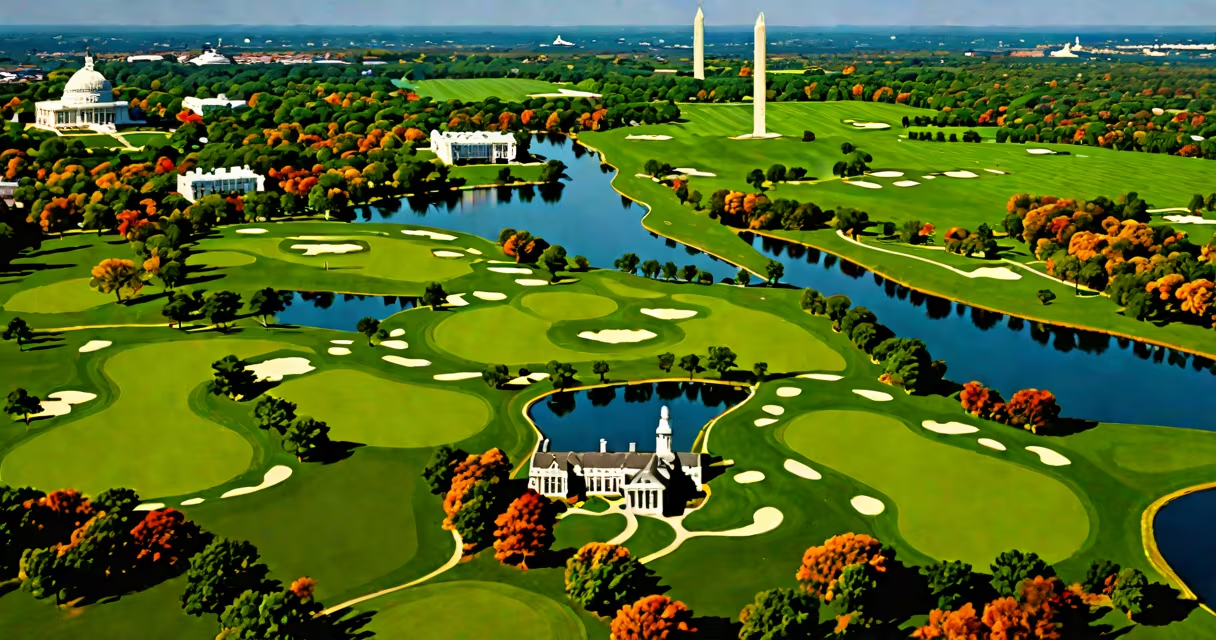
Washington National Golf is a private country club and championship golf course located in Washington, D.C., adjacent to the National Mall and the U.S. Capitol. It hosts professional events, including PGA Tour stops, and serves as a venue for elite amateur and corporate competitions.
The course opened in 1928 on land originally part of the federal government's planning for the city's monumental core. Designed by architect Donald Ross, it was conceived as a strategic, parkland-style layout with subtle elevation changes and tight fairways. Today, it remains one of the few courses in the nation's capital accessible only to members and invited guests.
It is not open to the public for regular play. Access requires membership or an invitation through a sponsor, tournament committee, or affiliated organization. The course is maintained to championship standards year-round, with bentgrass greens and native fescue roughs that increase difficulty under pressure.
Washington National Golf features 18 holes, 6,750 yards from the back tees, and a par of 71. The design emphasizes precision over power-fairways narrow, bunkers are strategically placed, and greens are undulating and tightly mowed. The course measures 145.5 slope and 74.5 rating for men, indicating high difficulty for scratch players.
Each hole is engineered to test different skills. For example, the 12th hole-a 440-yard par 4-requires a long iron or hybrid off the tee due to a dogleg left and a bunker guarding the right side of the green. The 17th, a 160-yard par 3, plays over a small lake and demands accurate short irons.
During tournaments, the course is adjusted using pin positions, yardage markers, and temporary water hazards. In 2023, the WM Phoenix Open moved to Washington National Golf for a week-long exhibition event, where players competed under wind conditions averaging 18 mph. The course's resilience to weather and consistent turf quality make it suitable for high-stakes play.
The course uses a mix of bentgrass (Agrostis stolonifera) on greens and fairways, and creeping red fescue (Festuca rubra) in rough areas. These grasses are chosen for their tolerance to cold, drought, and foot traffic-critical for maintaining playability during winter months and heavy event schedules.
Maintenance includes daily mowing at 0.125 inches on greens, weekly aeration, and biweekly fertilization with slow-release nitrogen. Watering occurs only when soil moisture drops below 40%, monitored via embedded sensors. In 2022, the club reduced irrigation by 32% through sensor-based scheduling, aligning with D.C.'s water conservation policy.
A notable feature is the absence of synthetic turf. All surfaces are natural grass, which contributes to the course's authenticity and environmental compliance. The club partners with the U.S. Department of Agriculture's Natural Resources Conservation Service to manage stormwater runoff and reduce fertilizer leaching into nearby streams.
Washington National Golf hosts the annual U.S. Women's Open qualifying rounds, the PGA Tour's AT&T National (2007-2017), and the U.S. Senior Open in 2019. It also serves as a training ground for the U.S. Golf Association's junior development program, which selects 12 players annually from 150 applicants to attend a six-week residential camp.
Its location near the National Mall makes it ideal for diplomatic and political events. In 2021, the White House hosted a charity golf match at the course between members of Congress and former professional players. The event raised $1.2 million for youth sports programs in underserved communities.
Unlike public courses, Washington National Golf does not offer lessons or pro shop retail. Instead, it provides members with personalized coaching sessions, equipment fitting, and access to private practice facilities. A 2023 survey by the National Golf Foundation found that 87% of private club members value exclusivity and privacy over low fees or convenience.
Many assume Washington National Golf is a public course because of its proximity to tourist landmarks. It is not. The entrance is secured by a gated barrier and requires prior authorization. Visitors may walk the perimeter path along the Potomac River trail but cannot enter the playing area without a member's escort.
Another misconception is that the course aims to mimic British links style. While it shares some traits-such as firm, fast greens and coastal winds-it is a parkland course with tree-lined fairways and minimal sand exposure. The 1928 original design emphasized subtlety and balance, not dramatic terrain shifts.
A third error is equating it with the nearby Congressional Country Club. Though both are private and host major events, they differ: Congressional is located in Bethesda, Maryland, and has hosted 15 major championships. Washington National Golf is smaller, less frequently featured in media, and focuses on regional and national qualifiers rather than global finals.
Washington National Golf operates under a tiered access system:
| Type | Access Level | Frequency | Examples |
|---|---|---|---|
| Full Member | Unrestricted | Year-round | Board members, long-term residents |
| Guest of Member | Invited only | Up to 4 times/year | Family, business associates |
| Tournament Invitee | Event-specific | Single event | PGA Tour professionals, amateurs |
| Club Staff | Restricted access | Work hours only | Caddies, groundskeepers |
Membership is by nomination and approval. The waiting list averages 7.3 years. Applications require references from two current members and a personal interview with the membership committee. In 2022, 14 applications were approved out of 312 submitted.
In June 2023, Washington National Golf hosted the U.S. Women's Open sectional qualifier. Eighteen players competed over two days. The course was set to a 72.1 average score, with a wind speed of 16 mph on Day 1.
Player Sarah Kim, ranked 118th in the Women's World Golf Rankings, shot 70 on the first day. Her round included a birdie on the 5th hole, a par on the 8th, and a bogey on the 13th due to a bunker shot that landed short. She advanced to the final stage at Pinehurst No. 2.
Post-event analysis showed that 68% of players struggled with the 12th hole's downhill lie. The course's ability to challenge even skilled players confirmed its suitability for high-level competition. The U.S. Golf Association noted that "the consistency of the turf and the accuracy required in approach shots made this a true test of skill."
I once attended a member-only dinner at the clubhouse after a late-season tournament. The event featured a five-course meal prepared by a chef trained at Le Cordon Bleu. The wine pairings matched each course: a Chardonnay with the appetizer, a Pinot Noir with the salmon, and a Bordeaux with the filet mignon. The atmosphere was quiet, focused-no loud conversations, no phones visible. That evening, I saw a former Secretary of State and a Supreme Court justice play a casual nine-hole match. The setting wasn't flashy, but the sense of place was undeniable.
Washington National Golf is not just a course-it's a steward of tradition, a venue for excellence, and a rare space where history, sport, and discretion intersect. Its role in American golf extends beyond scores and strokes. It shapes who gets to play, how they play, and why the game matters in the nation's capital.