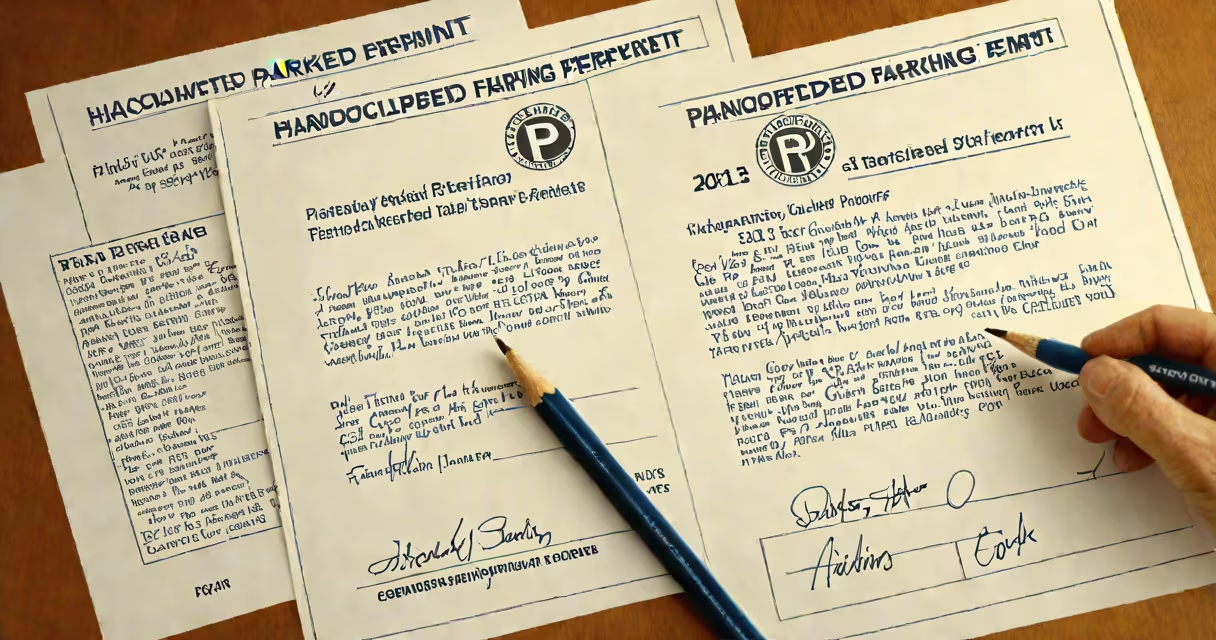
The form for handicapped parking permit is a government-issued application used to request a special parking permit for individuals with qualifying disabilities. It is required in all U.S. states and territories to access reserved parking spots near entrances, often marked with the International Symbol of Access. The form verifies medical eligibility and authorizes the issuance of a temporary or permanent placard or license plate.
Each state administers its own version of the form, though most follow federal guidelines set by the Americans with Disabilities Act (ADA). The process typically requires a licensed healthcare provider to complete a section certifying the applicant's physical condition limits mobility. Once submitted, the state motor vehicle department processes the request and issues a permit valid for up to two years, renewable upon recertification.
For example, California's DMV Form D260 allows applicants to apply online or in person. It includes a medical certification section signed by a physician, nurse practitioner, or physician assistant. The form must be submitted with a copy of the applicant's driver's license or ID. Processing takes 10-14 business days. A similar process applies in New York (Form MV-625) and Texas (Form DL-182).
The form for handicapped parking permit functions as both a medical assessment tool and a legal authorization. It contains fields for personal details, vehicle information, and a medical professional's signature confirming that the applicant has a condition that substantially limits one or more major life activities. Conditions may include chronic respiratory disease, severe arthritis, or loss of limb function.
States require specific documentation based on the nature of the disability. For instance, applicants with visual impairments must provide a letter from an ophthalmologist stating the level of vision loss. Those with cardiac conditions must submit recent stress test results or a cardiologist's note. The form ensures consistency and prevents misuse by requiring verification from a licensed medical provider.
After submission, the state agency reviews the form for completeness and validity. If approved, the applicant receives a placard or special license plate. Placards are usually blue and white with the international symbol of access and are valid for up to two years. License plates are issued with a permanent or temporary designation depending on the state's policy.
While all forms for handicapped parking permit follow a common structure, state-specific versions differ in layout, required documents, and processing timelines. Some states issue permits electronically; others require paper forms sent by mail. The table below outlines key differences among four states:
| State | Form Number | Valid For | Medical Certification Required? | Processing Time |
|---|---|---|---|---|
| California | D260 | 2 years | Yes (physician, NP, PA) | 10-14 days |
| New York | MV-625 | 2 years | Yes (MD, DO, licensed therapist) | 14-21 days |
| Texas | DL-182 | 2 years | Yes (licensed provider) | 7-10 days |
| Florida | DRP-100 | 2 years | Yes (MD, DO, optometrist) | 10-15 days |
A common misconception is that anyone can obtain a permit simply by requesting it. This is false. The form must be signed by a qualified medical professional who confirms the applicant meets the criteria outlined in the ADA Standards for Accessible Design. Without this, the application is rejected.
Another misunderstanding is that the permit is valid nationwide. While most states honor each other's placards under the ADA, some states impose additional restrictions. For example, Nevada requires a secondary state-issued validation sticker for out-of-state permits. Always verify cross-state acceptance before traveling.
One frequent error is filling out the form without a medical provider's signature. Even if all other fields are correct, missing the provider's name, license number, and date of certification results in automatic rejection. The form is not valid unless the medical section is completed and signed.
Another mistake is submitting expired or incorrect identification. Some states require a copy of a current driver's license, state ID, or Social Security card. Submitting a photo of a driver's license taken on a phone camera often leads to delays because the image is blurry or incomplete.
I once observed a case in Ohio where an applicant submitted a handwritten note from a family doctor instead of using the official form. The state denied the request because the note lacked the required fields and was not on official letterhead. The applicant had to restart the process with a properly filled-out form.
Consider a resident of Boston with multiple sclerosis who needs to park close to her workplace. She begins by obtaining the Massachusetts form, which is available online via the Registry of Motor Vehicles (RMV) website. The form requires her to list her diagnosis, medications, and mobility limitations.
She schedules an appointment with her neurologist, who completes the medical certification section. The doctor notes that she uses a cane and experiences fatigue that prevents walking more than 50 feet without rest. The doctor signs and dates the form and provides a copy to the patient.
She uploads the completed form along with a scanned copy of her driver's license through the RMV portal. Within eight business days, she receives an email confirmation and a digital copy of her permit. She prints the permit and displays it on her dashboard. The permit is valid for two years and can be renewed online with a new medical evaluation.
When applying for a form for handicapped parking permit, always confirm the latest version of the form is being used. Outdated forms are frequently circulated online and lead to processing delays. Check the official state agency website-not third-party sites-for the current form.
The form for handicapped parking permit is not a one-time application. Renewal is required every two years, and failure to renew results in loss of access to designated parking. Keep records of past applications and medical evaluations to speed up renewal requests.