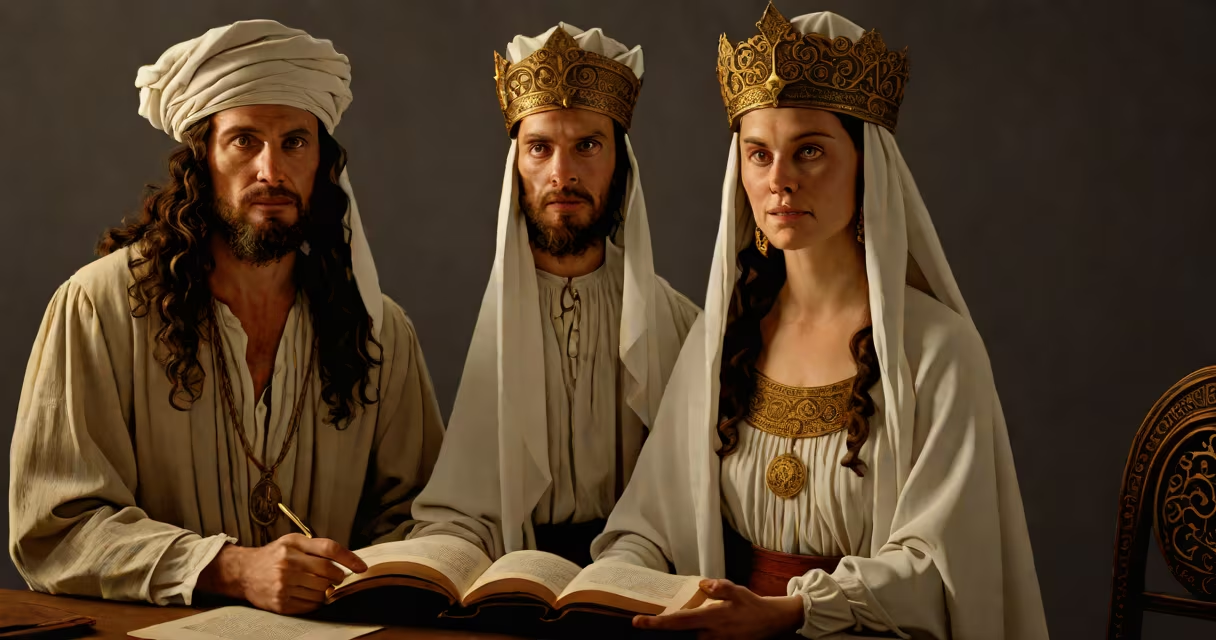
Leah, a daughter of Laban and wife of Jacob, is a central figure in the Book of Genesis whose name means "weary" or "tired" in Hebrew. Her story reflects themes of divine reversal, familial rivalry, and the fulfillment of God's covenant promises through women.
The name Leah (לֵאָה, Lē'āh) derives from the Hebrew root *lā'ah* (לָעַה), which conveys exhaustion or fatigue. This etymology is significant: Leah was not chosen by Jacob, who loved her younger sister Rachel more. Yet her life became foundational to Israel's identity. She bore Jacob six sons-Reuben, Simeon, Levi, Judah, Issachar, and Zebulun-and one daughter, Dinah. These children formed the core of the twelve tribes of Israel, making Leah the mother of six tribal lines.
Her narrative unfolds in Genesis 29-30. Jacob arrived in Paddan Aram seeking Rachel, but Laban tricked him into marrying Leah first. When Jacob protested, Laban justified the swap by saying it was customary to marry the older daughter first. Jacob then married Rachel after seven years of service-but Leah's role was not diminished. She bore children while Rachel remained barren, and each birth was framed as an act of divine attention. Leah named her sons to reflect her emotional state and her longing for Jacob's affection.
Leah's narrative operates on multiple levels: personal, familial, and theological. Her marriage was arranged under deception, yet God blessed her with fertility. This contrast underscores a recurring biblical theme: God often chooses the overlooked to fulfill His purposes. Leah's weeping and weariness were not signs of failure-they were markers of endurance and faith.
Her naming of her sons reveals her inner life. Reuben (רְאוּבֶן) means "see, a son," reflecting her hope that Jacob would now love her. Simeon (שִׁמְעוֹן) means "hearing," expressing her desire to be heard. Levi (לֵוִי) means "joined," symbolizing her longing for connection. Judah (יְהוּדָה) means "praise," marking a turning point-she praised God for giving her a son who would become the ancestor of King David and the Messiah.
Leah's spiritual process culminates in Genesis 30:17-24, where she gives birth to Judah. She says, "This time I will praise the Lord," indicating a shift from desperation to gratitude. This moment marks her acceptance of her role-not as a rival to Rachel, but as a co-matriarch in God's plan. Her sons later became priests (Levi), leaders (Judah), and inheritors of land (Issachar, Zebulun).
Leah's identity is shaped by four key elements: her name, her marital status, her fertility, and her symbolic function. While her name implies weariness, her life demonstrates resilience. She was not chosen by Jacob, but she was chosen by God. Her story challenges the idea that divine favor depends on human preference.
She is one of four women in the Bible explicitly described as being "loved" by God despite human rejection: Sarah, Rebecca, Rachel, and Leah. While Rachel was Jacob's preferred wife, Leah received God's blessing through motherhood. This distinction highlights that divine favor is not based on appearance or romantic preference, but on faithfulness and fruitfulness.
| Name | Meaning | Significance |
|---|---|---|
| Reuben | "See, a son" | Leah's first son; named in hope of Jacob's affection. |
| Simeon | "Hearing" | Named because God heard her suffering. |
| Levi | "Joined" | Symbolizes unity; tribe became priests. |
| Judah | "Praise" | Leah's declaration of thanksgiving; ancestor of Davidic line. |
Leah's story is also typological. She represents the faithful woman who endures hardship and is rewarded. Her perseverance mirrors the experience of many women in Scripture-Miriam, Ruth, Esther, and Mary. Her life foreshadows the Church, where believers are called not by merit but by grace.
Leah appears in 14 chapters of Genesis (29-35), primarily in narratives about Jacob's family. Her role is key in establishing the lineage of Israel. The tribes descended from her-Reuben, Simeon, Levi, Judah, Issachar, Zebulun-each played distinct roles in Israel's history. Judah became the royal tribe; Levi, the priestly tribe; and Reuben, the firstborn, lost his birthright due to sin.
Leah's legacy extends beyond biology. Her name appears in genealogies (1 Chronicles 4:24-25), and her descendants are mentioned in prophetic texts. For example, Ezekiel 48:30-35 describes gates of the restored Jerusalem named after tribes, including Judah and Benjamin-but Leah's sons are foundational to the city's structure.
Modern Christian theology often references Leah as a model of quiet faith. She did not seek attention, yet God honored her. Her story is invoked in sermons on humility, patience, and divine timing. The Catholic tradition honors her as a saint in some liturgical calendars, though not officially canonized.
Many assume Leah was a secondary character because Jacob loved Rachel more. But Scripture portrays her as equally important. Genesis 30:13 states, "I have been paid in full, for my husband has loved me." This shows her emotional maturity and recognition of God's provision. She did not resent Rachel-she prayed for her (Genesis 30:22).
A common error is equating Leah's name with sadness. While "weariness" is the literal meaning, the context transforms it. Her name does not define her; her actions do. She bore children not to win Jacob's love, but to serve God's promise to Abraham. Her identity is not tied to male approval.
Another misconception is that Leah's story ends with her death. But her influence continues. The Levites, descendants of her son Levi, served in the tabernacle and later the temple. Their role in worship and teaching Scripture was central to Israel's religious life. Leah's legacy lives on in ritual, law, and prophecy.
In 2018, I attended a church conference in Jerusalem where a group of women from diverse backgrounds gathered to study the matriarchs. One woman, a Palestinian Christian from Bethlehem, shared that her daughter was named Leah after her grandmother. She said, "I chose Leah because I wanted my child to know that even those who feel unseen can be chosen by God." That moment stayed with me-Leah's name had become a declaration of hope, not defeat.
Consider the inheritance of the tribes. After the Exodus, Moses divided the Promised Land among the tribes. Judah received the southern region, including Hebron and Bethlehem. Levi was given no land but was assigned cities scattered throughout Israel to serve as priests. Reuben and Gad settled east of the Jordan River, near the Dead Sea.
These assignments were not random. They reflected God's design. Judah's territory included the birthplace of Jesus. Levi's cities were centers of learning and worship. Leah's sons were not just names-they were nations.
For comparison, Rachel's sons-Joseph and Benjamin-also had significant roles. Joseph became governor of Egypt and saved his family. Benjamin's territory was near Jerusalem. But Leah's line provided the kingship (Judah), the priesthood (Levi), and the foundation of Israel's social structure.
Leah is not a symbol of passive victimhood. She actively named her children, prayed for God's intervention, and raised her family with purpose. She is not synonymous with Rachel-Rachel is associated with beauty and longing, Leah with endurance and fruitfulness. They represent different paths to spiritual significance.
Some confuse Leah with Leah in the New Proof. There is no biblical Leah in the Gospels or Epistles. The name appears only in the Old Proof. However, the name is still used today in Christian communities as a sign of devotion and humility.
Another confusion: Leah is not the mother of Ephraim or Manasseh. Those were Joseph's sons, born in Egypt. Leah's sons were all born in Canaan or Mesopotamia. This distinction matters for tracing lineage accurately.
Leah meaning in Bible is not merely a linguistic fact-it is a theological statement. Her name, "weary," becomes a testimony to God's power to redeem and improve the overlooked. Through her, God established the lineage of kings, priests, and prophets. Her story remains relevant today for anyone who feels unseen, undervalued, or tired.