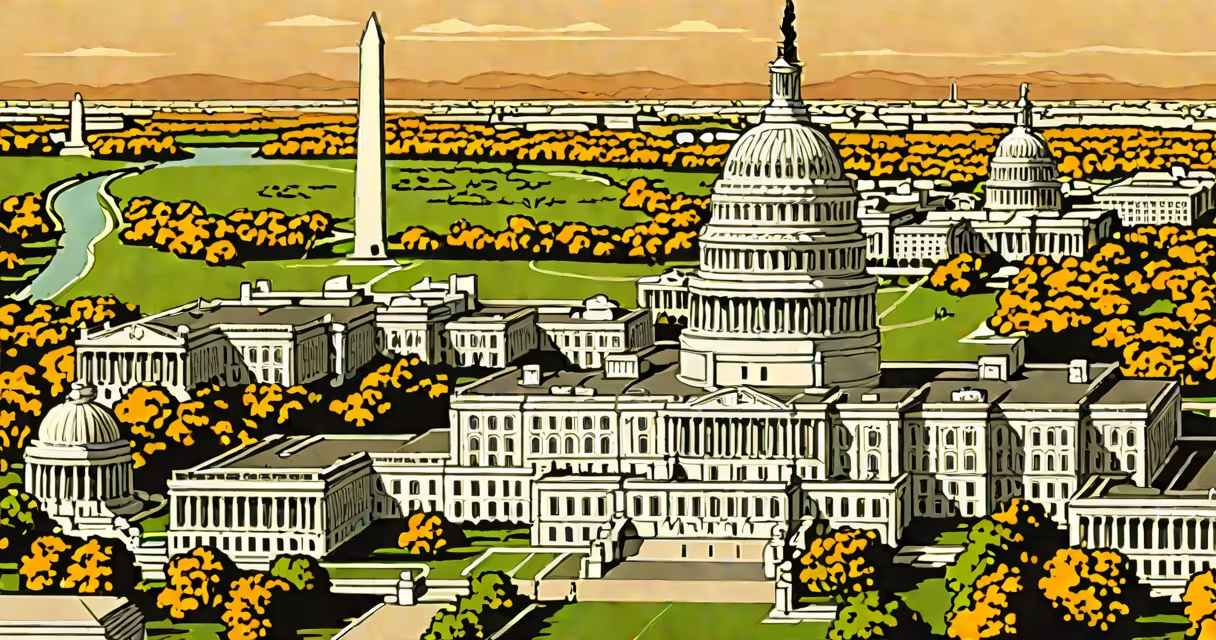
The full form of Washington DC is District of Columbia. It is a federal district, not a state, established by Congress in 1790 to serve as the permanent seat of the U.S. government.
Washington DC was created from land ceded by Maryland and Virginia. The area was chosen by George Washington to be the nation's capital, and the city was designed by Pierre Charles L'Enfant. The name "District of Columbia" honors Christopher Columbus, while "Washington" honors the first U.S. president.
Despite common belief, DC is not a state. It has no voting representation in Congress and cannot elect presidential electors. The District operates under a local government but remains subject to congressional oversight. This structure stems from Article I, Section 8 of the U.S. Constitution, which grants Congress exclusive jurisdiction over the federal district.
Washington DC functions as both a city and a federal administrative center. It houses the White House, the U.S. Capitol, the Supreme Court, and major federal agencies. The city has a mayor and a city council, elected by residents, but Congress retains authority over local laws.
Residents of Washington DC pay federal taxes but lack voting rights in Congress. This led to the D.C. Statehood Movement, advocating for full representation. In 2020, Congress passed the Washington, D.C. Admission Act, which would admit the district as the 51st state, named Washington, D.C. The bill passed the House but stalled in the Senate.
DC's governance model reflects a compromise between national control and local autonomy. The city's charter, approved by Congress, allows for local elections and budget decisions, but Congress can override local legislation. This balance ensures federal authority while allowing civic administration.
Washington DC is composed of four geographic quadrants: Northeast, Northwest, Southeast, and Southwest. These are labeled using compass directions from the U.S. Capitol, which sits at the center of the grid. Streets are numbered and named in a radial pattern, with avenues running north-south and streets east-west.
The city's population is approximately 680,000 people (U.S. Census Bureau, 2022). It spans 68 square miles, making it smaller than many U.S. states. Despite its size, DC hosts over 100 embassies, 150 museums, and 100,000 federal employees.
Unlike states, DC does not have electoral votes in presidential elections. However, the 23rd Amendment to the U.S. Constitution, ratified in 1961, granted the district three electoral votes-equal to the smallest state-but only for presidential elections.
Many assume "DC" stands for "District of Columbia" and that the city is a state. It is not. The term "D.C." is an abbreviation used in addresses and official documents. The correct form is "District of Columbia," though "DC" is widely accepted in informal usage.
A frequent error is writing "Wash. D.C." or "Washington D.C." with a period after "D.C." The proper punctuation uses no periods: "Washington D.C." is incorrect. The correct format is "Washington, D.C." with a comma and no periods in the abbreviation.
Another misconception is that the city's name is derived solely from George Washington. While the city is named in his honor, the "District of Columbia" portion references Christopher Columbus. The name "Columbia" was historically used to refer to the United States, appearing in names like "Columbia University" and "District of Columbia."
| Feature | Washington DC | U.S. State |
|---|---|---|
| Legal Status | Federal district | State |
| Representation in Congress | Non-voting delegate | 2 Senators, multiple Representatives |
| Electoral Votes | 3 (via 23rd Amendment) | Varies by population |
| Statehood | No | Yes |
| Local Government | Mayor and city council | Governor and state legislature |
One non-obvious fact: The District of Columbia was originally planned to be larger. The original plan, laid out by L'Enfant, included areas now part of Virginia. After Virginia withdrew its land donation in 1846, the district lost nearly half its territory. Today, the city is entirely within the boundaries of Maryland.
I once visited the National Archives and saw the original 1790 Act establishing the District of Columbia. The document listed the land ceded by Maryland and Virginia. The handwriting was precise, and the legal language reflected the constitutional intent: to create a neutral site for the federal government, free from state influence.
When referring to the city in formal writing, use "District of Columbia" in full. In casual contexts, "Washington, D.C." is acceptable. Avoid abbreviating to "DC" alone unless context is clear. For example, "I live in DC" is fine in conversation, but "The city of DC is located in the northeast" is imprecise.
Understanding the full form of Washington DC clarifies its unique role in American governance. It is not a state, nor is it a city in the traditional sense. It is a federal district created by law, governed by a mix of local and federal authority.