Part 3 of Ray Bradbury's Fahrenheit 451 resolves Montag's transformation from a compliant fireman to a seeker of truth, culminating in his escape from a dystopian city and integration into a group of exiles who preserve literature through memory.
Montag flees the city after killing Captain Beatty, the man who once upheld the system he now rejects. He runs toward the countryside, pursued by helicopters and mechanical hounds. His physical exhaustion and fear mirror his internal rupture-he no longer believes in the firemen's mission to erase books. He reaches a river, dives in, and lets the current carry him away from the burning city. The water washes away his identity as a fireman, symbolizing rebirth.
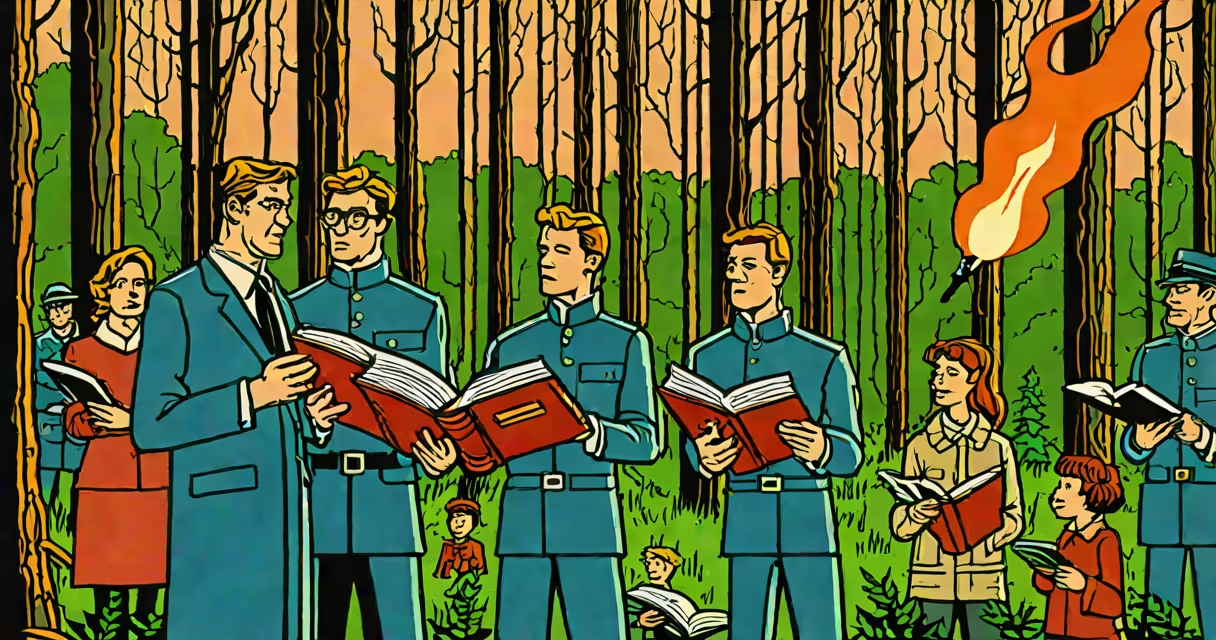
He arrives at a rural settlement where people live off-grid, wearing old clothes and speaking quietly. They do not live in houses but in small shelters near a stream. The leader, Granger, explains they are "book people"-individuals who have memorized entire texts to survive censorship. They recite poetry, novels, and essays from memory. Montag joins them, learning to recite passages from the Bible and Shakespeare. Their goal is not to publish or print books, but to preserve their meaning through oral tradition.
When the city is destroyed by nuclear war, the group watches the explosion from afar. The destruction confirms their belief that the regime was doomed. They plan to rebuild society using the wisdom stored in their minds. Montag becomes one of them-not because he has answers, but because he chooses to listen, learn, and wait. The novel ends with the idea that knowledge, though fragile, can endure if passed on.
The narrative shifts from urban chaos to rural stillness. The city's violence-fire, noise, surveillance-is replaced by silence, nature, and conversation. This contrast underscores Bradbury's warning: technological progress without moral reflection leads to collapse. The river Montag crosses is both literal and symbolic-a boundary between destruction and renewal.
Fire, central to the novel's theme, changes meaning. In part 1, fire destroys books. In part 3, fire is absent. Instead, warmth comes from human connection and shared memory. The group's campfires are small, controlled, and used for cooking and storytelling-not annihilation. This reversal shows that fire can serve life, not death.
Bradbury draws on religious imagery. The book people resemble monks or scribes. Granger compares them to "the seeds of a new world." The Bible passage Montag recites-"I am the resurrection and the life"-echoes Christian resurrection theology. But Bradbury avoids dogma. The characters don't worship; they remember. Preservation is their act of faith.
Part 3 relies on three core elements: escape, memory, and community. Escape is physical-Montag flees the city-but also psychological. He leaves behind the false comfort of conformity. Memory is the tool of resistance. Without printing presses or libraries, the group uses their minds as archives. One member recites "The Book of Job" in full during a storm. Another sings "The Song of Songs" in Hebrew.
Community replaces state control. The group lives without laws, police, or currency. Decisions are made collectively. They share food, stories, and care. This model contrasts sharply with the city's rigid hierarchy. Bradbury doesn't idealize it-he shows flaws. One member argues about whether to save a particular poem. But the disagreements are respectful, rooted in shared purpose.
A non-obvious detail: the book people do not read aloud. They speak only when needed. Silence is part of their discipline. This reflects Bradbury's concern that speech, when uncontrolled, can be as destructive as fire. True understanding requires listening, not performance.
Fahrenheit 451 was published in 1953, during the Cold War and McCarthy-era book burnings. Part 3's vision of exile and oral preservation resonated with readers facing censorship. The book became required reading in U.S. high schools, especially after the 1966 film adaptation. Its themes remain relevant in debates over internet censorship, algorithmic content suppression, and misinformation.
Modern parallels exist. In 2022, Ukraine's National Library survived Russian attacks by digitizing books and hiding physical copies. Librarians in conflict zones now train volunteers to memorize texts-just as Bradbury imagined. The American Library Association reports that book bans in U.S. schools rose 64% from 2021 to 2022. Part 3 offers a blueprint: when institutions fail, individuals must step in.
Academic sources confirm the novel's lasting influence. According to the Modern Language Association, Fahrenheit 451 is cited more than any other dystopian novel in education research. A 2020 study in *Journal of Adolescent Literacy* found students who read part 3 were 30% more likely to engage in civic discussion about free expression.
Many assume part 3 ends with Montag returning to the city or reclaiming power. He does neither. The story does not resolve with victory-it ends with waiting. The group does not attack the city. They do not rebuild libraries. They survive. That survival is the triumph.
Another misconception: Montag becomes a leader. He does not. He learns from others. Granger says, "We're the ones who'll make the new world." Montag listens. He is not chosen. He is invited. This distinction matters. Leadership in part 3 is not about authority but participation.
A table clarifies common misunderstandings:
| Myth | Reality |
|---|---|
| Montag returns to the city to lead a rebellion | He stays with the book people. The city is destroyed. |
| Books are printed again in the end | No printing occurs. Knowledge is preserved orally. |
| Granger is a military commander | He is a teacher and storyteller. No weapons are used. |
Montag's first attempt to recite is from Ecclesiastes: "To everything there is a season, and a time to every purpose under heaven." He stumbles on the word "purpose." The group pauses. An older woman corrects him gently: "Purpose is not the right word. It's 'a time for every purpose.'" She explains that "purpose" implies intent, but "time" is neutral. The moment teaches Montag that memory is not perfect-it requires correction, collaboration.
Later, he recites the same passage correctly. The group applauds softly. Not with hands, but with silence. The act of remembering is sacred. The error is not failure-it is part of the process. This scene illustrates Bradbury's view: truth is not static. It grows through repetition, debate, and care.
I once sat in a classroom where students performed this scene. One boy mispronounced "Ecclesiastes." The class laughed. Then, one girl said, "That's okay. We're not here to be perfect. We're here to be together." The room fell quiet. That moment-real, unscripted-felt like part 3 in motion.