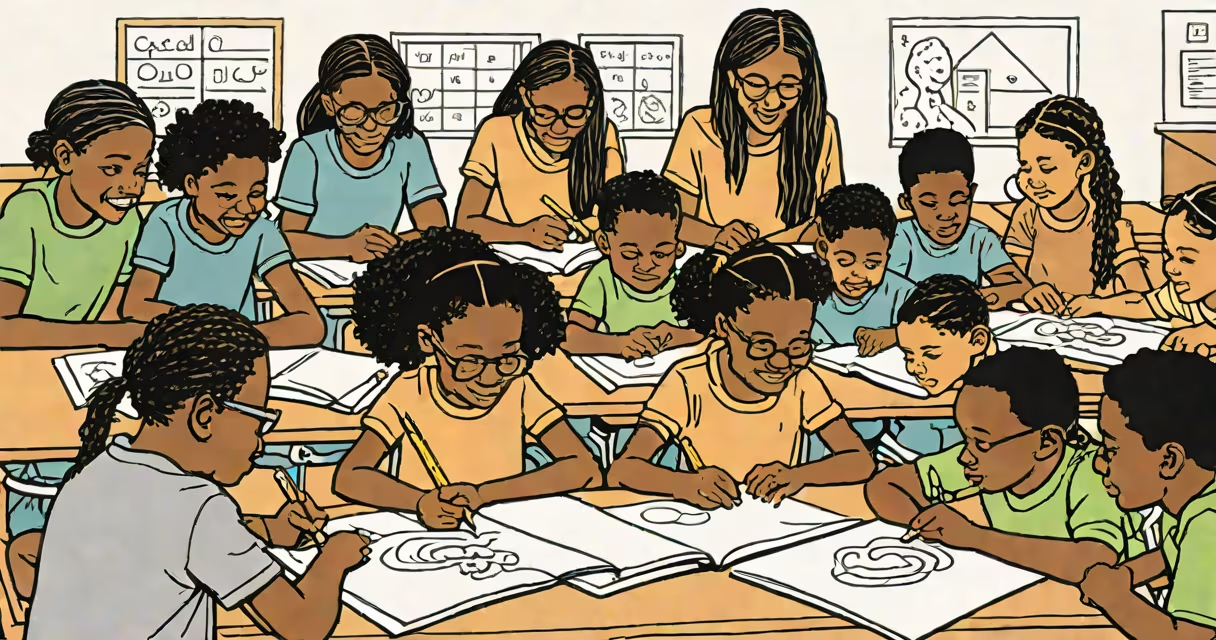
Social and emotional learning (SEL) is a structured approach to teaching students skills in self-awareness, self-management, social awareness, relationship building, and responsible decision-making. These competencies help individuals manage emotions, set goals, show empathy, and make constructive choices in personal and social contexts.
SEL is not a standalone curriculum but a structure embedded into daily instruction and school culture. It begins with recognizing emotions-both one's own and others'-and progresses to applying those insights in real-life situations. For example, a student who feels frustrated during a group task learns to pause, identify the emotion, and communicate their need for a break rather than reacting impulsively.
The Collaborative for Academic, Social, and Emotional Learning (CASEL) defines SEL through five core competencies: self-awareness, self-management, social awareness, relationship skills, and responsible decision-making. These are evidence-based and have been validated across diverse school settings. According to CASEL's research, students who participate in high-quality SEL programs show an 11-point gain in academic achievement compared to peers who do not.
SEL operates through consistent, intentional strategies integrated into classrooms and school environments. Teachers model emotional regulation by naming their own feelings during transitions ("I'm feeling tired, so I'll take a breath before we start"). Students then practice identifying emotions in themselves and others using tools like mood rings, emotion charts, or reflective journals.
Classroom routines reinforce SEL. Morning meetings allow students to share thoughts and feelings in a safe space. Conflict resolution circles teach students to listen actively and respond respectfully. A sixth-grade class in Portland, Oregon, reduced disciplinary referrals by 60% over two years after adopting a daily 15-minute SEL circle focused on perspective-taking and problem-solving.
When implemented well, SEL reduces anxiety and improves focus. A 2021 study published in the journal *Child Development* found that students in SEL-rich classrooms reported lower stress levels and higher engagement. These benefits are especially pronounced for students from low-income backgrounds or those experiencing trauma, where SEL acts as a protective factor against academic disengagement.
While all SEL programs aim to develop emotional and social competencies, they differ in structure and delivery. Programs fall into three broad categories: universal, targeted, and intensive. Universal programs are taught to all students and focus on foundational skills. Targeted programs address specific challenges such as bullying or peer conflict. Intensive programs support students with significant behavioral or emotional needs.
| Type | Focus | Duration | Example |
|---|---|---|---|
| Universal | Whole-class skill-building | Year-long, weekly sessions | Second Step® for grades K-8 |
| Targeted | Small-group intervention | 8-12 weeks, bi-weekly | PATHS (Promoting Alternative Thinking Strategies) |
| Intensive | Individualized support | Long-term, ongoing | Check-in/Check-out program for students with chronic behavioral issues |
A common misconception is that SEL is solely about "feelings" or soft skills. In reality, SEL strengthens cognitive functions like working memory and attention. Research from the University of British Columbia shows that students who engage in regular SEL activities exhibit improved executive function, which directly supports reading comprehension and math problem-solving.
SEL is often mistaken for character education or values-based instruction. While both promote positive behavior, SEL focuses on measurable skills rather than moral lessons. Character education teaches "be kind," while SEL teaches "how to recognize kindness in others and respond appropriately."
Another misunderstanding is that SEL replaces academic rigor. On the contrary, SEL enhances learning. A meta-analysis of 213 studies by Durlak et al. (2011) found that SEL programs led to improved academic performance across subjects, including science and language arts. The effect size was equivalent to moving from the 50th to the 68th percentile in standardized test scores.
Some educators assume SEL requires extensive training or expensive materials. High-impact SEL doesn't require special software. Simple practices like pausing before responding, using "I feel" statements, or practicing active listening can be introduced in under five minutes per day. A middle school in Detroit increased student participation by 40% after teachers began using a 30-second "pause and reflect" routine before group work.
In 2019, New York City public schools launched a citywide SEL initiative. All 1.1 million students received access to SEL curricula aligned with CASEL's structure. By 2022, schools reported a 27% decrease in suspensions and a 19% increase in attendance. Teachers noted that students were better able to go through disagreements and collaborate effectively.
I observed this firsthand during a visit to a rural high school in Iowa. A biology teacher used SEL to manage group dynamics during a project on climate change. She began each session with a brief check-in: "Share one emotion you're carrying into this discussion." Students who had previously avoided speaking up began contributing. One student said, "I didn't think my opinion mattered until I realized someone else felt the same way." This moment wasn't about content-it was about connection.
SEL is not a quick fix. Its benefits compound over time. A longitudinal study tracking students from kindergarten through eighth grade found that those exposed to consistent SEL instruction were less likely to drop out of school and more likely to pursue higher education. The gains persisted even after controlling for socioeconomic status.
For educators seeking to integrate SEL, start small. Use a short introduction to SEL concepts to align staff. Focus on one competency-like self-regulation-before expanding. Track changes in student behavior and academic engagement to measure progress.
Understanding the social and emotional learning definition is the first step toward creating classrooms where students feel seen, heard, and capable. When schools prioritize SEL, they don't just improve behavior-they build resilient learners equipped for life beyond the classroom.