The pros and cons of ancient Greece reflect a civilization that pioneered democracy, philosophy, and art while sustaining slavery, gender inequality, and constant warfare. Its legacy shapes Western thought, yet its societal limits remain stark.
Ancient Greece spanned roughly 800 BCE to 146 BCE, encompassing city-states like Athens and Sparta. These poleis developed distinct political systems, artistic traditions, and military strategies. The term "ancient Greece" refers to this period's cultural and political achievements, not a unified nation-state. Modern understanding draws from archaeological findings, surviving texts, and comparative studies of regional differences.
Key developments include the invention of democratic governance in Athens around 508 BCE, the rise of philosophical schools such as Stoicism and Platonism, and advancements in mathematics and astronomy. Yet these achievements coexisted with systemic exclusions: women, slaves, and metics (resident foreigners) held no political rights. Warfare between city-states was frequent, often ending in devastation.
City-states operated independently, each with its own government, army, and religious practices. Athens emphasized direct democracy-citizen males voted on laws and policies in public assemblies. Sparta focused on military discipline, training boys from age seven in combat and obedience. These models produced different outcomes: Athens led in arts and philosophy, Sparta in battlefield resilience.
Civic participation was limited to free adult male citizens. Women managed households and religious rituals but had no legal standing. Slaves-often captured in war or born into bondage-performed labor in homes, farms, and mines. In Athens, slaves made up nearly half the population. Their absence from records reflects their erasure from historical narratives.
Warfare was endemic. The Peloponnesian War (431-404 BCE) between Athens and Sparta devastated both sides. Athens lost its navy, democracy collapsed, and thousands died from plague and siege. Sparta's victory did not bring peace-factionalism and revolts followed. This cycle shows how internal conflict weakened the entire region.
Democratic innovation emerged in Athens during the 5th century BCE. Citizens gathered in the Ecclesia to debate and vote on legislation. Juries selected by lot judged legal cases. This system influenced later representative democracies, including the United States Constitution. The concept of civic duty-participation as a moral obligation-originated here.
Philosophy flourished under Socrates, Plato, and Aristotle. Plato's Academy (c. 387 BCE) trained thinkers in logic, ethics, and metaphysics. Aristotle taught at the Lyceum and wrote treatises on biology, politics, and rhetoric. His work on syllogistic reasoning became foundational for Western logic. These ideas survived through medieval Islamic scholars and Renaissance Europe.
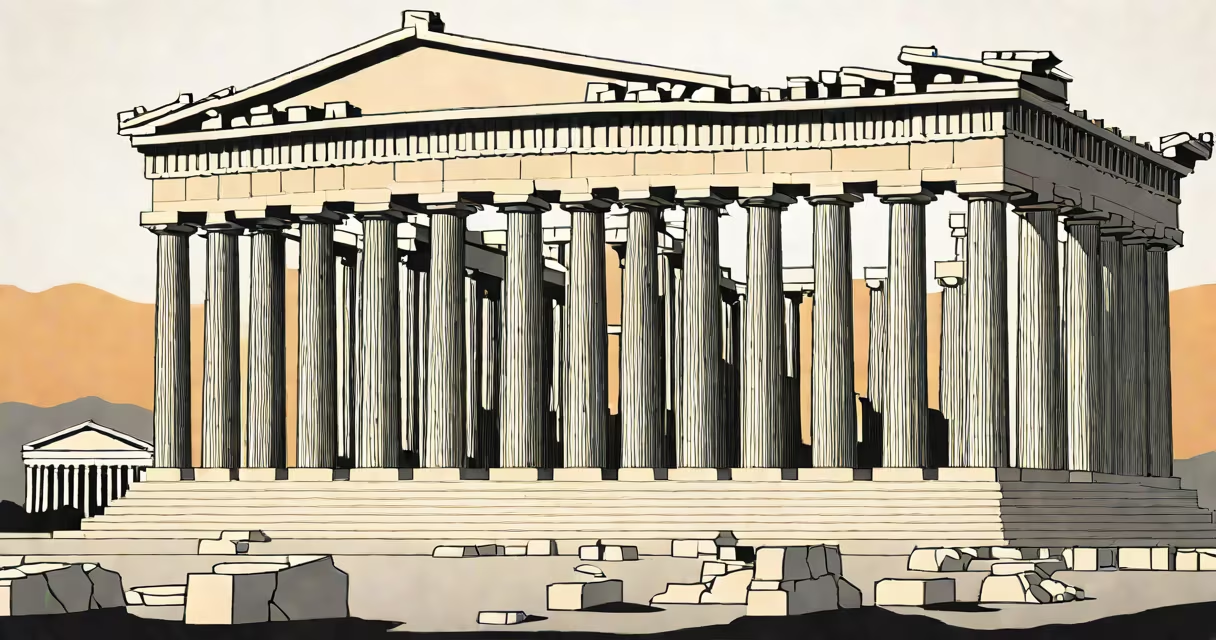
Art and architecture left enduring marks. The Parthenon, built 447-432 BCE, exemplifies Doric design with mathematical precision. Columns follow the golden ratio, enhancing visual harmony. Sculptures like the statue of Zeus at Olympia (c. 435 BCE) combined mythological themes with anatomical accuracy. These works influenced Roman art and later European styles.
Slavery was central to the economy. In Athens, slave labor maintained olive groves, mines, and domestic service. The silver mines at Laurion supplied Athens' navy and funded public projects. Without enslaved labor, the city's military and cultural ambitions would have faltered. Yet this reliance entrenched human exploitation as normal.
Gender roles were rigid. Women married young, typically in their teens, and remained under male guardianship. They could not own property or appear in court. Religious festivals like the Thesmophoria involved women-only rituals, but these were excluded from public life. No female philosophers or statesmen left surviving writings.
Constant warfare drained resources. The Sicilian Expedition (415-413 BCE) saw Athens lose 100 ships and 20,000 soldiers. The retreat from Syracuse ended in mass starvation and surrender. Afterward, Athens fell into civil war and oligarchic coups. Sparta's dominance lasted less than a decade before internal decay set in.
Many assume ancient Greece was a single country. It was not. Over 1,000 independent poleis existed, each with unique customs. The term "Greek" refers to shared language, religion, and cultural identity-not political unity. Wars were often between Greeks, not against external invaders.
Another error is equating Athenian democracy with modern democracy. Athenian democracy excluded women, slaves, and non-citizens. Only ~10% of the population participated. Voting was done by show of hands, not secret ballots. The system relied on luck and chance-juries were chosen by lot, not merit.
Some believe Greek culture was universally peaceful. In reality, violence was routine. The Homeric epics glorified war. Achilles' rage in the *Iliad* reflects warrior values. Temples were built with spoils from battle. Victory was tied to divine favor, not ethical conduct.
| Aspect | Pros | Cons |
|---|---|---|
| Political System | First known democracy; citizen participation in lawmaking | Excluded women, slaves, and non-citizens; prone to mob rule |
| Intellectual Legacy | Birthplace of philosophy, science, and critical thinking | Knowledge limited to elite males; little advancement in applied science |
| Art and Architecture | High aesthetic standards; lasting influence on Western art | Often served religious or state propaganda; ignored marginalized voices |
| Social Structure | Strong civic identity and communal rituals | Systemic exclusion based on gender, class, and citizenship status |
One non-obvious fact: Greek theater was not entertainment-it was a religious ritual. Plays performed during the Dionysia festival honored Dionysus, god of wine and ecstasy. Tragedies explored fate, justice, and divine punishment. Audiences were expected to reflect on moral lessons, not escape reality. The chorus often represented collective conscience or divine will.
I once visited the Theater of Dionysus in Athens. Standing on the stone seats, I watched a performance of *Antigone*. The actor's voice echoed through the stone arches. The play's theme-individual conscience versus state law-resonated deeply. That moment clarified how ancient Greek drama wasn't passive storytelling. It was civic education, delivered through emotion and myth.
Understanding the pros and cons of ancient Greece prevents romanticizing the past. Democracy's roots are valuable-but so is recognizing its exclusions. Modern institutions borrow from Greek models, yet must correct their flaws. The idea of civic virtue remains relevant, but only when expanded to include all people.
For example, the U.S. Supreme Court has cited Athenian democracy in debates on judicial review. But courts also reject blind imitation. Justice Oliver Wendell Holmes Jr. noted in *Abrams v. United States* (1919): "The most stringent protection of free speech would not protect a man in falsely shouting fire in a theatre." This acknowledges that freedom requires limits-a lesson absent in pure Athenian practice.
When analyzing ancient Greece, avoid binary judgments. Its achievements were real. So were its failures. The history of ancient Greece reveals how progress and oppression coexist. To study it is to confront both inspiration and accountability.