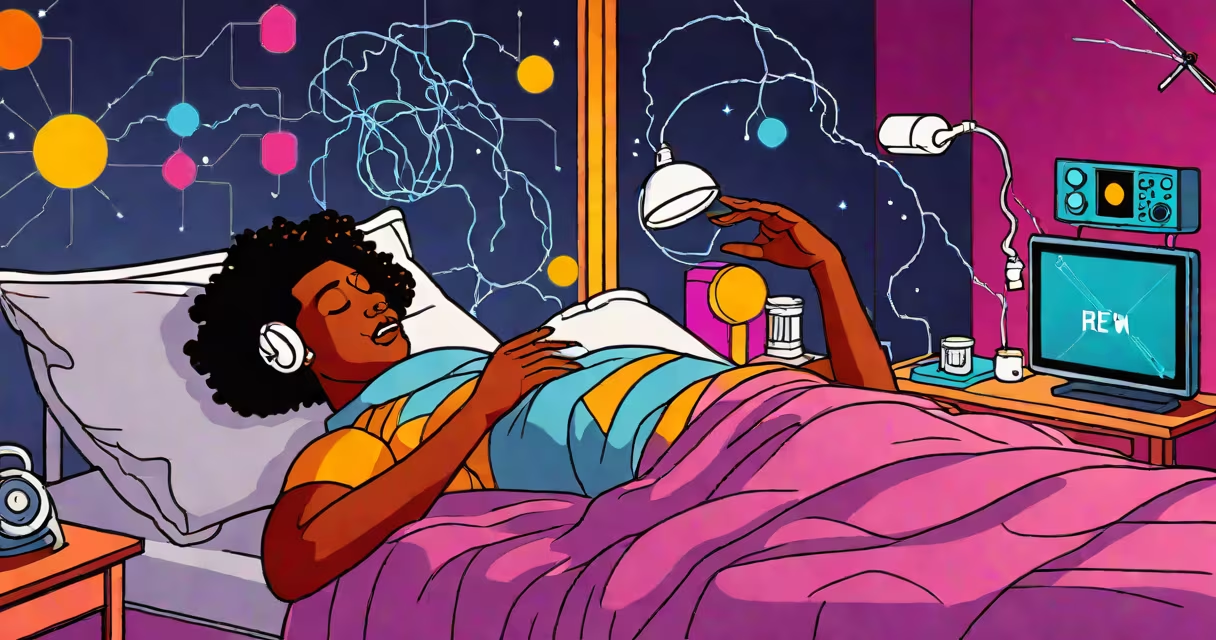
Lucid dreaming occurs when you become aware you're dreaming while still in the dream state, allowing intentional manipulation of dream content. This phenomenon arises during rapid eye movement (REM) sleep, when brain activity mimics wakefulness despite physical immobility.
During REM sleep, the brain's prefrontal cortex-the region responsible for logical reasoning and self-awareness-shows reduced activity. In lucid dreamers, however, this area remains partially active, enabling recognition of the dream state. Neuroimaging studies show increased gamma wave synchronization in the frontal and parietal lobes during lucidity, indicating higher-order cognitive processing.
Not everyone experiences lucid dreams spontaneously. Control develops through consistent mental training, such as reality checks, dream journaling, and mnemonic induction techniques. With practice, individuals can learn to stabilize dreams, alter scenes, or even fly-all within the neural structure of REM sleep.
Lucid dreaming happens when the brain enters a hybrid state: the limbic system generates vivid imagery and emotion typical of REM sleep, while parts of the executive network regain partial function. This creates a window where awareness and intention coexist with dream logic.
Studies using functional MRI show that during lucid dreaming, activity increases in the dorsolateral prefrontal cortex (DLPFC)-a region linked to working memory and decision-making. This activation correlates with the ability to perform tasks like counting or solving puzzles within dreams, proving conscious control is neurologically measurable.
A 2014 study published in *Frontiers in Human Neuroscience* found that participants trained in lucid dreaming showed higher DLPFC activation during REM compared to non-lucid dreamers. The researchers concluded that lucidity reflects a temporary reactivation of waking cognition during sleep.
Control over dreams stems from three interdependent factors: sleep stage timing, neural readiness, and behavioral conditioning. REM sleep typically begins 90 minutes after falling asleep and recurs every 90 minutes, with longer durations in later cycles. This timing makes late-night sleep ideal for lucid dreaming attempts.
The brain's default mode network-involved in self-referential thought-remains active during REM. In lucid dreamers, this network shows stronger connectivity with attentional systems, allowing sustained focus on dream elements. For example, a person may notice they're flying and decide to change direction, altering the dream environment in real time.
Not all dreams allow equal control. Early REM phases often produce fragmented, unstable dreams. As the night progresses, dreams grow longer and more coherent, increasing the likelihood of sustained lucidity. A 2018 study in *Sleep Medicine* reported that 68% of lucid dreams occurred in the final two REM cycles, supporting the role of sleep duration in dream stability.
Many assume lucid dreaming requires supernatural insight or rare brain wiring. In reality, it's a skill accessible to most adults with structured training. The belief that only "special" people can achieve it is a myth. Research confirms that with consistent effort, up to 50% of beginners report their first lucid dream within four weeks.
Another misconception is that lucid dreams are always pleasant or controllable. In fact, some lucid dreams involve fear, confusion, or loss of control-especially when the dreamer lacks training. A 2020 survey in *Dreaming* journal found that 34% of first-time lucid dreamers experienced anxiety, often due to sudden awareness in chaotic dream scenarios.
Lucid dreaming does not mean you can consciously choose what you dream about before sleeping. You cannot force a specific narrative, such as meeting a celebrity or visiting Mars. Instead, control emerges during the dream itself-like steering a car mid-drive rather than selecting the route beforehand.
Dream control varies in intensity and stability. The following table outlines common levels based on frequency, duration, and level of intent:
| Type | Frequency | Duration | Control Level | Example |
|---|---|---|---|---|
| Spontaneous | Rare | Seconds to minutes | Minimal | Realizing you're dreaming mid-fall, then waking |
| Partial | Occasional | 1-5 minutes | Basic | Changing a room's color or summoning a door |
| Stable | Regular with practice | 5-20 minutes | High | Flying for several minutes, interacting with dream characters |
| Advanced | Infrequent | 20+ minutes | Full | Engaging in complex conversations, altering physics |
Each level requires progressively deeper familiarity with sleep cycles and mental discipline. Advanced control is not automatic-it demands ongoing training and self-monitoring.
Consider someone who wants to gain control over their dreams. They begin by tracking nightly dreams in a journal. After two weeks, they notice recurring themes-being chased, falling, or being in school. This pattern signals that their mind is generating consistent dream material.
Next, they start performing reality checks during the day: asking "Am I dreaming?" and testing reality (e.g., looking at a clock twice to see if it changes). These habits transfer into dreams. One evening, while walking, they glance at a watch and see the numbers flip instantly. They realize: "This is a dream."
Upon realizing they're dreaming, they focus on staying calm and visualizing a stable scene-a beach. They walk toward the water, feel the sand, and hear waves. They test control by making a seashell float. It does. They remain lucid for 12 minutes, exploring the environment before waking.
This sequence illustrates how awareness, practiced intention, and environmental cues combine to enable control. The event wasn't random-it was the result of deliberate preparation.
I first achieved a lucid dream during a week-long experiment with sleep hygiene and daily reality checks. On the eighth night, I noticed a familiar hallway in my apartment-but the walls were glowing faint blue. I paused, asked myself, "Could this be a dream?" Then I pinched my arm. It didn't hurt. I realized I was dreaming.
I focused on turning the hallway into a forest. Within seconds, trees replaced the walls. Birds appeared. I walked among them, feeling the breeze. I stayed lucid for 17 minutes before waking. This experience confirmed that dream control is not fantasy-it's a measurable, repeatable state rooted in neuroscience.
Research from the University of Wisconsin-Madison supports this. In a 2016 study, scientists used EEG to detect lucid states in real time. Participants signaled awareness via pre-agreed eye movements. The team confirmed that lucid dreaming involves distinct neural signatures, validating subjective reports with objective data.
People use lucid dreaming for therapy, creativity, and personal growth. Clinical trials show it reduces nightmare frequency in PTSD patients. A 2021 study in *The Lancet Psychiatry* found that 76% of participants with recurrent nightmares experienced significant improvement after eight weeks of lucid dreaming training.
Artists and writers use lucid dreams to explore creative ideas. One musician reported composing a full song in a dream, later transcribing it accurately. The brain's associative networks remain active during REM, enabling novel connections between unrelated concepts.
Some practitioners use lucid dreams for problem-solving. A software engineer described resolving a coding bug during a dream by visualizing code flow and identifying a missing bracket. While not all insights survive waking, the process demonstrates how unconscious thinking can support conscious work.
Understanding why you can control your dreams begins with recognizing that the brain doesn't shut down during sleep. Certain regions stay active, especially during REM. With training, you can strengthen the neural pathways that allow awareness and agency within dreams. This ability isn't magic-it's neuroscience, psychology, and practice combined.