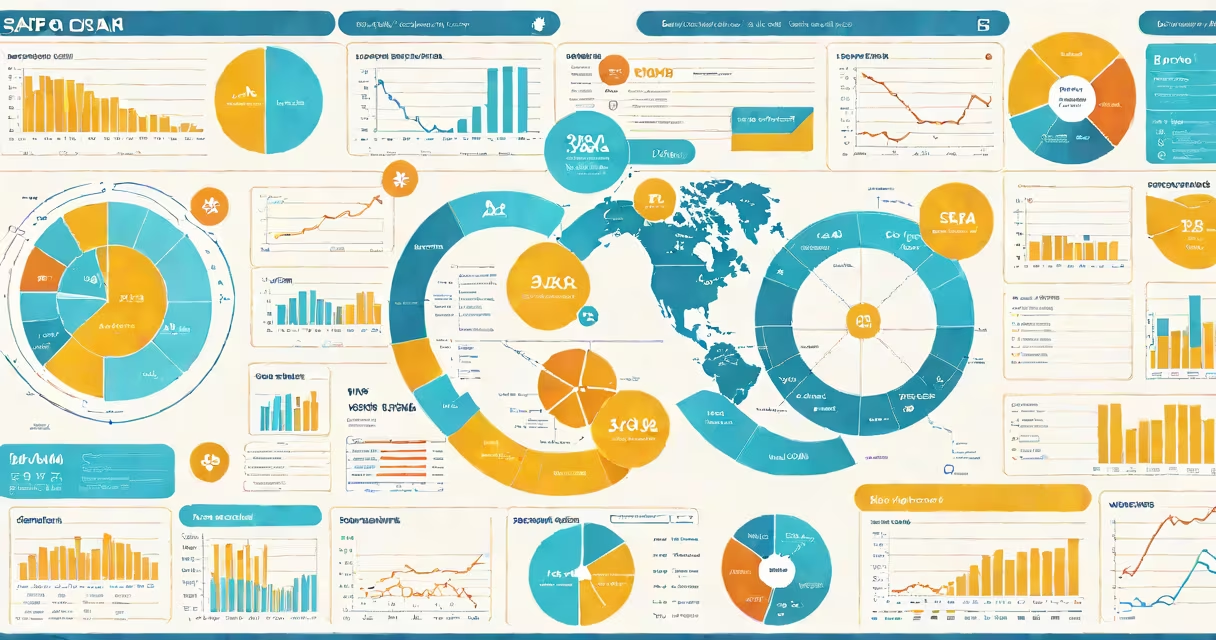
SAP is a complete enterprise resource planning (ERP) system that integrates core business functions such as finance, human resources, supply chain management, and manufacturing into a single unified platform. It enables large organizations to centralize data, automate workflows, and make real-time decisions across departments.
The term ERP refers to software that consolidates business processes into one database-driven system. SAP, originally founded in Germany in 1972, developed the first integrated ERP set designed for multinational corporations. Today, SAP's ERP solutions - including SAP S/4HANA, SAP ECC, and SAP Business ByDesign - are deployed in over 400,000 companies worldwide, according to SAP's official customer reports.
Unlike standalone accounting or inventory tools, SAP ERP connects data across departments. For example, when a sales order is entered, the system automatically updates inventory levels, triggers production scheduling, adjusts financial ledgers, and generates shipping documents. This integration reduces errors and improves response times.
SAP ERP operates on a centralized database architecture where all business transactions are recorded in real time. Every action - from placing an order to paying a vendor - updates master data such as customer records, material master files, and general ledger accounts. This ensures consistency across departments.
The system uses predefined business logic and configurable workflows. For instance, a purchase requisition must go through approval stages based on budget thresholds and user roles. These rules are enforced through role-based access control, which prevents unauthorized changes.
Transactions are processed using standardized business objects. A sales invoice, for example, is created through a series of steps: create a sales order → confirm delivery → post goods issue → generate billing document. Each step triggers automated updates in related modules like FI (Financial Accounting), SD (Sales and Distribution), and MM (Materials Management).
SAP ERP divides functionality into modular components. Each module handles a specific business process and shares data with others via the central database. The most widely used modules include:
| Module | Function | Example Use Case |
|---|---|---|
| FI (Financial Accounting) | Manages general ledger, accounts payable/receivable, asset accounting | Automatically posts monthly depreciation entries for company vehicles |
| CO (Controlling) | Tracks costs, budgets, profitability by product or department | Calculates profit margin for each regional sales team |
| SD (Sales and Distribution) | Handles order-to-cash cycle: sales orders, deliveries, invoicing | Generates shipping labels and tracks delivery status in real time |
| MM (Materials Management) | Manages procurement, inventory, vendor relationships | Reorders raw materials when stock drops below safety threshold |
| PP (Production Planning) | Coordinates production schedules, capacity planning, BOMs | Creates work orders based on forecasted demand for a new product line |
These modules communicate through shared master data. For example, a change in a supplier's bank details in MM automatically reflects in FI when payments are processed. This eliminates duplicate data entry and reduces discrepancies.
Some people assume SAP is only for manufacturing or finance-heavy industries. While SAP originated in industrial automation, its current versions support service businesses, retail, healthcare, and public sector agencies. A hospital using SAP can track patient billing, pharmacy inventory, staff schedules, and equipment maintenance all within one system.
Another misunderstanding is that SAP ERP is purely backend software. Modern SAP systems offer web-based interfaces and mobile apps. Users can approve purchase orders from a smartphone or view real-time sales dashboards on tablets. SAP Fiori, launched in 2014, provides role-based UX designs tailored to different job functions.
A less obvious point: SAP ERP is not a single product. It includes multiple editions. SAP S/4HANA is the latest version, built on an in-memory database (HANA), enabling faster analytics and real-time processing. Older systems like SAP ECC (ECC = Enterprise Central Component) still run in many legacy environments, especially in Europe and Asia.
In 2021, a U.S.-based consumer electronics manufacturer replaced its fragmented IT stack with SAP S/4HANA. Before implementation, the company used separate systems for order entry (sales), inventory tracking (warehouse), payroll (HR), and financial reporting (accounting). Data was manually reconciled weekly, causing delays in month-end close.
After migrating to SAP ERP, the company achieved the following results within six months:
For example, when a shipment delay occurred due to a port strike, the system flagged affected orders automatically. The logistics team rerouted shipments through alternate ports, and customers received updated delivery estimates within two hours - a process that previously took three days.
This case illustrates how SAP ERP isn't just software - it's a business transformation tool. Its value lies not in features alone, but in how it aligns data, processes, and people across complex organizations.
SAP ERP does not operate in isolation. It integrates with external platforms like Google Workspace and Microsoft 365. For example, a sales rep can send a contract proposal from Outlook directly into SAP's SD module, where it becomes a formal sales order. The system then checks credit limits and confirms availability before sending a confirmation email.
Integration with Google Cloud or AWS allows SAP to scale compute resources during peak periods. A retail client running Black Friday campaigns uses SAP ERP hosted on Google Cloud to handle 10x higher transaction volumes without downtime.
SAP supports integration with third-party logistics providers. A food distributor uses SAP ERP to sync warehouse stock levels with a delivery partner's route optimization system. As soon as a truck leaves the facility, GPS data feeds back into SAP to update delivery timelines.
Yes, SAP is a full-featured ERP system. It meets the technical definition: a unified software platform that manages interdependent business processes across departments using shared data. It is not a subset of ERP, nor is it merely a financial system. SAP's design philosophy centers on integration, scalability, and compliance - principles validated by Gartner's Magic Quadrant for ERP, which has ranked SAP among the leaders since 2010.
Organizations choosing SAP ERP gain a system capable of supporting global operations, regulatory reporting (like SOX and GDPR), and continuous process improvement. Whether managing a factory floor or a multinational sales network, SAP delivers operational coherence.