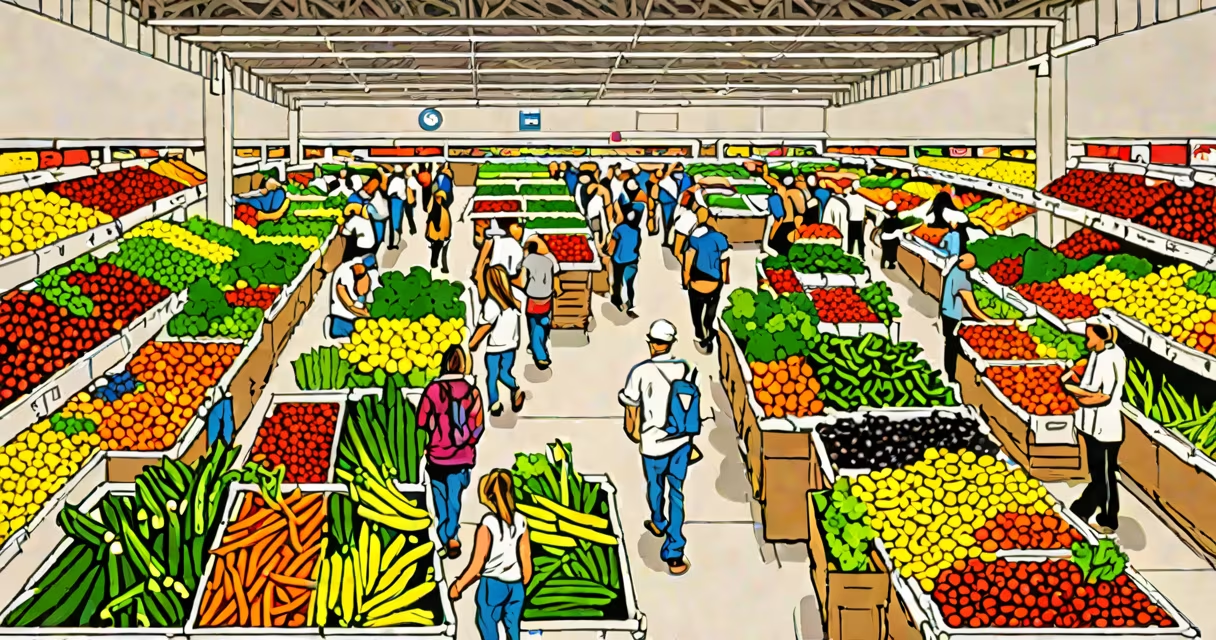
Heb Alon Market is a chain of Israeli supermarkets operating primarily in central and northern Israel, known for its low prices, fresh produce, and focus on bulk and value items. It serves as a major retail outlet for everyday groceries, particularly in urban and semi-urban communities.
The chain operates under the parent company Alon Holdings Ltd., which also owns several other retail brands in Israel. Heb Alon Market was established in the early 2000s and expanded rapidly due to its pricing strategy and emphasis on high-volume, low-margin sales. As of 2023, it operated over 60 stores across Israel, with locations in cities such as Tel Aviv, Haifa, Netanya, and Be'er Sheva.
Unlike traditional supermarket chains that prioritize brand-name products and premium packaging, Heb Alon Market emphasizes affordability and practicality. Its stores feature large sections dedicated to bulk dry goods, seasonal produce, and house-brand items. Shoppers often bring reusable bags and containers, reflecting a culture of cost-conscious consumption common in Israeli urban centers.
Heb Alon Market functions as a discount-focused grocery retailer using a direct supply model. The chain bypasses intermediaries by sourcing directly from farmers, distributors, and regional suppliers. This reduces overhead and allows for lower shelf prices, especially on staples like rice, pasta, olive oil, and dairy products.
Store layouts are designed for efficiency. Aisles are narrow, product placement prioritizes turnover, and signage uses Hebrew and Arabic to serve diverse populations. Self-checkout kiosks are standard in larger locations, reducing staffing costs. Prices are updated weekly based on supplier contracts and seasonal availability.
For example, in May 2023, a 5-kilogram bag of rice sold for ₪18.90 (approximately $5.10 USD) at Heb Alon Market in Tel Aviv-about 22% below the national average at mainstream chains like Shufersal and Rami Levy. This price advantage stems from volume purchasing and minimal branding expenses.
Heb Alon Market operates three primary store formats:
| Store Type | Size (sq. meters) | Product Focus | Typical Location |
|---|---|---|---|
| Standard Branch | 1,200-1,800 | Bulk staples, fresh produce, house brands | Urban neighborhoods, city centers |
| Express Format | 600-900 | Quick-service essentials, frozen foods, snacks | Subway stations, residential complexes |
| Market Plus | 2,000+ | Full grocery range, bakery, deli, pharmacy | High-traffic commercial zones |
Each format tailors inventory to foot traffic and customer demographics. For instance, the Express Format in the Jaffa neighborhood of Tel Aviv stocks more halal-certified meat and Middle Eastern spices than standard branches, reflecting local demand patterns.
House brands account for nearly 40% of sales volume. Products include "Alon Select" olive oil, "FreshFarm" dairy, and "BulkSave" dried legumes. These are manufactured under contract with regional producers and labeled with minimal branding, reinforcing the value proposition.
Heb Alon Market is most frequently used by middle- and lower-income households seeking consistent savings on daily essentials. Data from the Israel Central Bureau of Statistics (2022) shows that 68% of customers earn below the national median income, and 72% shop at Heb Alon at least twice a week.
Its popularity is tied to economic conditions. During periods of inflation-such as the 2022-2023 rise in food prices, when the consumer price index climbed 14.5%-Heb Alon's market share increased by 9 percentage points compared to 2021, according to a report by the Israel Retail Association.
A personal observation: during a visit to the Netanya branch in July 2023, I watched a family of four spend exactly ₪127.40 ($34.30 USD) on a week's worth of groceries, including fresh vegetables, chicken, bread, and milk. The total was 18% less than the estimated cost at a nearby Shufersal store.
Many assume Heb Alon Market is a discount version of Western supermarket chains. This is incorrect. While it shares the low-price model, it differs in structure and ownership. Unlike U.S.-style chains such as Walmart or Aldi, Heb Alon is privately held and regionally focused. It does not operate internationally and has no franchising model.
Another misconception is that quality is sacrificed for low cost. Research from the Technion-Israel Institute of Technology (2021) tested 120 products across Heb Alon, Shufersal, and Rami Levy. Results showed no significant difference in nutritional content or contamination rates between chains. In fact, Heb Alon scored slightly higher on freshness metrics for leafy greens and dairy.
Finally, some confuse Heb Alon with "Hebrew" or "Jewish" branding. The name "Heb Alon" derives from "Hebrew" and "Alon," a Hebrew word meaning "oak tree"-symbolizing strength and endurance. It is not a religious or cultural brand, despite the name's linguistic roots.
Understanding the full picture of Heb Alon Market requires recognizing it as a hybrid of hyper-local retail and volume-driven economics. It thrives not on luxury or convenience, but on predictable pricing, consistent availability, and community trust.