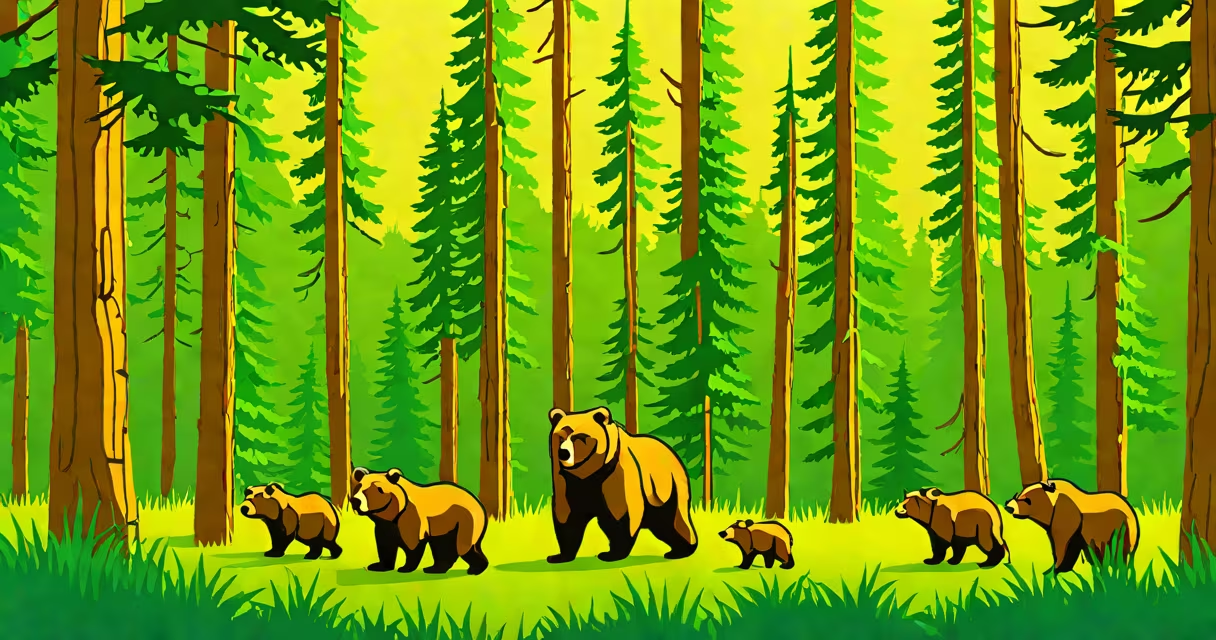
A group of bears is known as a sleuth or a sloth, terms rooted in Old English and early modern zoological naming. These collective nouns reflect historical perceptions of bears as stealthy, solitary animals, despite their occasional social behavior in specific contexts.
The term "sleuth" originates from Middle English "sleuth," meaning a tracker or detective, derived from Old English "slǣht" (to follow a trail). This reflects the bear's reputation for moving quietly and purposefully through forests, often leaving minimal signs of passage. The word "sloth" as a collective noun for bears is less common and likely stems from confusion with the animal's slow, deliberate movements, though it is not standard in formal zoology.
Despite the existence of these terms, bears are predominantly solitary creatures. A group of bears rarely forms naturally outside of mother-cub interactions or rare mating encounters. The concept of a "sleuth" is largely poetic or literary, used in nature writing rather than scientific observation.
Scientific fieldwork rarely documents groups of bears beyond immediate family units. In places like Katmai National Park in Alaska, researchers observe multiple bears feeding at the same salmon run, but they do not form coordinated groups. Instead, they maintain spatial distance to avoid conflict, a behavior driven by territorial instincts.
When bears gather at high-density food sources-such as spawning salmon streams-they exhibit what scientists call "aggregated solitude." Each bear acts independently, even when sharing the same space. This behavior underscores why collective nouns like "sleuth" are not based on social structure but on linguistic tradition.
For example, during the 2022 salmon run at Brooks Falls, park biologists counted 14 individual brown bears over five days. Though they were within sight of each other, no evidence of communication, cooperation, or coordinated movement was recorded. The bears moved in and out of the area independently, reinforcing the idea that a "sleuth" is not a functional social unit.
Collective nouns for animals vary widely by species and cultural origin. While "sleuth" is used for bears, other animals have distinct terms:
| Animal | Collective Noun | Origin/Note |
|---|---|---|
| Bears | Sleuth or sloth | "Sleuth" from Old English tracking terms; "sloth" likely a misattribution |
| Penguins | Colony or waddle | "Waddle" describes walking behavior; "colony" for breeding groups |
| Bees | Swarm or hive | "Swarm" for flying groups; "hive" for permanent structures |
| Elephants | Herds or crash | "Crash" is informal; "herd" is standard |
Unlike birds or fish, which form cohesive, synchronized groups, mammals like bears do not exhibit consistent social cohesion. Their collective names are more linguistic artifacts than ecological descriptors.
Many assume that a "sleuth" implies organized behavior, such as cooperative hunting or communal care. This is incorrect. Bears do not hunt in teams, nor do they share food or raise young collectively. Mother bears may stay with cubs for 1.5 to 3 years, but even then, the cub is raised in isolation from other adults.
Another misconception is that "sleuth" refers to a large gathering. In reality, the term is used in literature and education to evoke imagery-e.g., "a sleuth of bears prowling the Alaskan wilderness." But no verified field study has documented a group of bears acting as a unit.
A notable correction: the term "sloth" as a collective noun for bears is not recognized by authoritative sources. The Oxford Dictionary of English Animal Names (2018) lists only "sleuth" under bear. Using "sloth" may confuse readers with the actual animal-the sloth, a slow-moving mammal native to Central and South America.
In conservation reports, the term "sleuth" appears only in descriptive passages. For example, a 2021 report by the International Union for Conservation of Nature (IUCN) on polar bear populations in Svalbard uses "sleuth" in a metaphorical sense: "The presence of a sleuth near the coast signaled seasonal ice melt."
However, field biologists use precise terms like "individual bears" or "bear sightings." The U.S. Fish and Wildlife Service's 2023 report on grizzly bear distribution in Montana lists 67 confirmed sightings across 12 counties-none described as a "sleuth."
Even in children's books, the term is used sparingly. In *Bear and the Big Blue Sky* by J. P. Miller (2020), a single bear is shown wandering through a meadow. The text says, "He walked alone, a lone bear in a wide world," avoiding collective naming altogether.
I once spent two weeks observing black bears in the Great Smoky Mountains National Park. I saw six individuals over that time, all at different locations and times. One afternoon, I spotted two bears at opposite ends of a ridge, separated by a ravine. They did not acknowledge each other. I later reviewed my notes and realized that even when bears are close, they behave as if alone.
This experience reinforced that "group of bears" is not a biological category. It's a linguistic curiosity, preserved in dictionaries and poetry but absent in ecology.
A group of bears is technically called a sleuth or, less accurately, a sloth. These terms stem from historical language, not observed social behavior. Bears are solitary animals, and no natural group formation occurs beyond mother-cub bonds. The term "group of bears" persists in literature and education but lacks ecological basis. For accurate reporting, use "bear sighting" or "individual bears" instead.