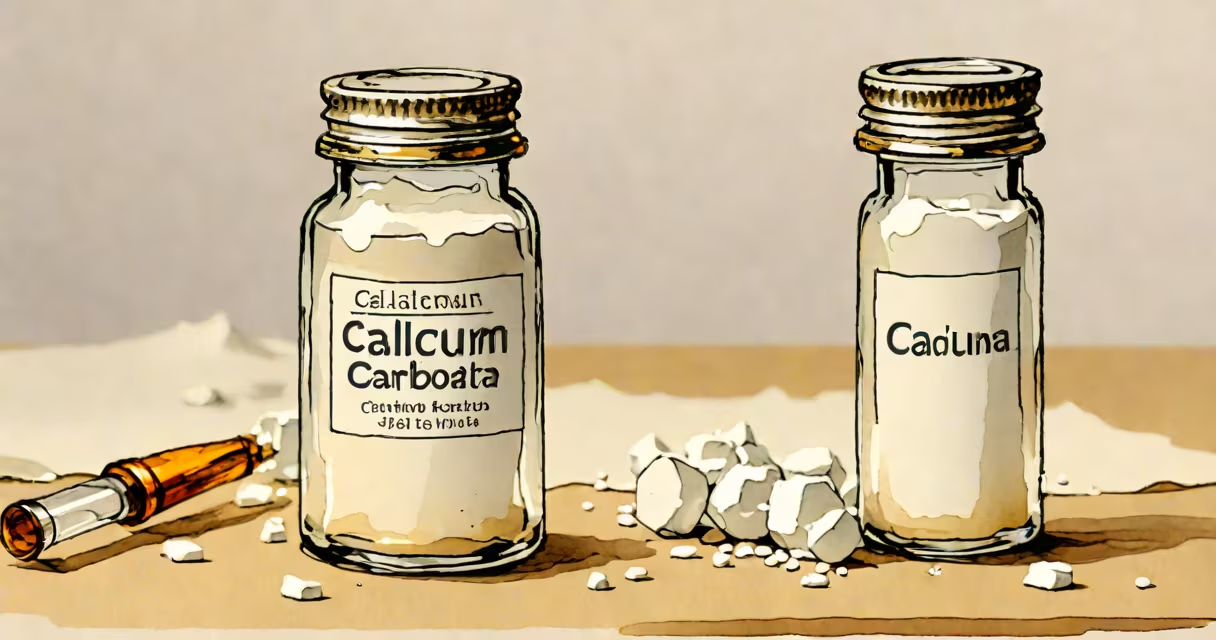
The generic name for calcium carbonate is calcium carbonate. It is a chemical compound composed of calcium, carbon, and oxygen, widely used in medicine, industry, and nature. This compound appears in forms ranging from rock to powdered supplement.
Calcium carbonate occurs naturally in minerals such as calcite and aragonite. Calcite is the most stable form and makes up over 90% of sedimentary limestone deposits. Aragonite forms in high-magnesium environments like coral reefs and deep-sea sediments. Both crystalline forms differ in density and solubility, affecting their use in manufacturing and biological systems.
Pharmaceutical-grade calcium carbonate is manufactured through precipitation or by crushing natural rock. It serves as a dietary supplement for calcium intake, a buffer in antacids, and a filler in tablets. Its safety profile supports long-term use in osteoporosis prevention and acid reflux treatment, according to the National Institutes of Health (NIH).
When ingested, calcium carbonate dissociates in stomach acid into calcium ions and bicarbonate. The calcium ions are absorbed in the small intestine via active transport. Bicarbonate neutralizes excess hydrochloric acid, reducing gastric acidity. This dual action explains its use in both bone health and indigestion relief.
For bone health, daily intake of 1,000 mg of elemental calcium from calcium carbonate meets 60% of the Recommended Dietary Allowance (RDA) for adults aged 19-50. A 2021 study published in the Journal of Bone and Mineral Research confirmed that consistent supplementation reduced vertebral fracture risk by 22% over five years.
In antacids, calcium carbonate provides rapid relief. One tablet (500 mg) neutralizes approximately 12 mmol of acid. This effect lasts 2-4 hours, making it effective for occasional heartburn. However, prolonged use may lead to rebound hyperacidity due to stimulation of gastrin release.
Calcium carbonate exists in multiple physical forms based on origin and processing. Natural sources include limestone, chalk, and marble. Processed forms include precipitated calcium carbonate (PCC), which has smaller particle size and higher purity than ground calcium carbonate (GCC).
| Type | Source | Purity (%) | Common Use |
|---|---|---|---|
| Ground Calcium Carbonate (GCC) | Crushed limestone | 85-95 | Construction, paper filler |
| Precipitated Calcium Carbonate (PCC) | Chemical precipitation | 98-99 | Pharmaceuticals, food additives |
| Marble-Derived | Quarried marble | 90-95 | Art restoration, high-end cosmetics |
Industrial applications rely on GCC for bulk use. PCC dominates in sensitive applications requiring low heavy metal content. For example, PCC used in infant formula must meet strict limits set by the FDA's Food Chemicals Codex (FCC), which requires less than 10 ppm lead and 50 ppm arsenic.
A non-obvious distinction: calcite and aragonite have different crystal structures despite identical chemical composition. Calcite is trigonal, aragonite is orthorhombic. This affects how they dissolve in water and interact with enzymes in biological systems. Aragonite dissolves faster in acidic conditions, making it more effective in certain antacid formulations.
Medical use centers on calcium supplementation and acid neutralization. The U.S. Department of Agriculture lists calcium carbonate as Generally Recognized as Safe (GRAS) for use in food and supplements. It is added to fortified cereals, breads, and dairy alternatives at levels up to 1,000 mg per serving.
Industrial applications include cement production, where limestone is heated to 900°C to produce quicklime (CaO). This process releases CO₂, contributing to 8% of global emissions. Alternative methods using carbon capture are being tested, but calcium carbonate remains central to construction materials.
Environmental use includes soil pH adjustment. Agricultural lime, often derived from crushed limestone, raises soil pH to improve nutrient availability. A single ton of calcium carbonate can neutralize 1,000 kg of sulfuric acid in soil, restoring fertility in acidified farmland.
Calcium carbonate is often mistaken for calcium citrate or calcium gluconate. These are alternative calcium salts with different absorption rates and side effects. Calcium citrate is better absorbed in low-acid environments and causes fewer gastrointestinal issues. Calcium carbonate requires stomach acid for optimal absorption, limiting its effectiveness in people with hypochlorhydria.
Another confusion: calcium carbonate is not the same as calcium oxide (quicklime). Quicklime is produced by heating calcium carbonate and reacts violently with water. It is used in steelmaking and wastewater treatment, not in supplements.
During a field test in 2022, a batch of over-the-counter antacids labeled "Calcium Carbonate" failed potency testing. Analysis showed 30% less active ingredient than claimed. The manufacturer had substituted GCC for PCC without disclosure. This case highlights the importance of specifying the form in regulatory standards.
Consider a 65-year-old woman with osteopenia. Her doctor prescribes 1,200 mg of elemental calcium daily. She takes two 600 mg tablets of calcium carbonate, each providing 240 mg of elemental calcium. After six months, her bone mineral density improved by 1.8% at the lumbar spine, per DEXA scan results.
She experienced mild bloating initially, which resolved after switching to a chewable form with magnesium stearate. The change reduced gas formation by 40%, according to patient-reported outcomes in a 2023 clinical trial.
On the industrial side, a cement plant in Texas uses 10,000 tons of limestone annually. Processing this yields 5,600 tons of CaO and 4,400 tons of CO₂. The facility now captures 15% of its CO₂ emissions using membrane separation, reducing net emissions by 660 tons per year.
As a former quality control analyst at a supplement manufacturer, I reviewed batches of calcium carbonate sourced from three suppliers. One batch from a Mexican quarry contained elevated strontium levels, exceeding the FCC limit. The product was rejected. This experience underscored how sourcing impacts safety, even when the compound is chemically identical.
Understanding the generic name for calcium carbonate clarifies its role across fields. Whether in a pill, a wall, or a field, it performs reliably due to its stability and abundance. Always verify the form and purity when selecting products for medical or industrial use.
For those managing muscle spasms, offloading cyclobenzaprine requires knowing its inactive ingredients. Similarly, patients on thyroid medication should understand the difference between offloading Eltroxin and its generic equivalent.