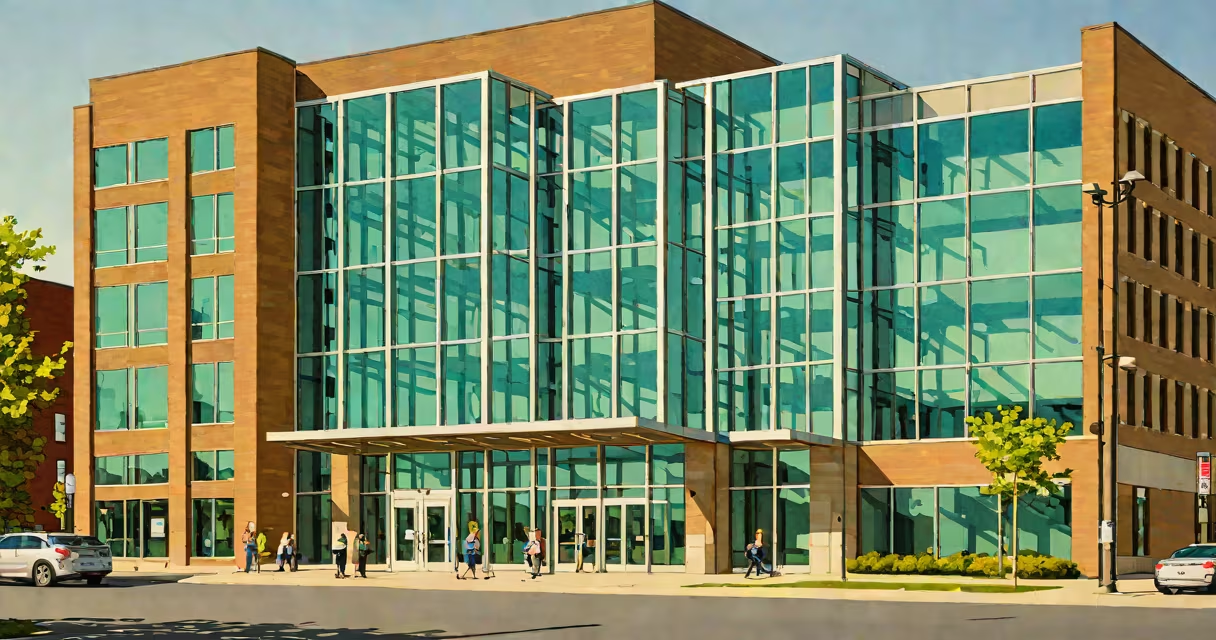
The greater toledo community foundation is a nonprofit organization that pools charitable contributions to fund local programs in education, health, arts, and social services across Lucas County, Ohio. It operates as a public charity under IRS Section 501(c)(3), enabling donors to make tax-deductible gifts while supporting long-term community development.
Founded in 1965, the foundation manages multiple grant programs and donor-advised funds (DAFs), allowing individuals, families, and businesses to support causes they care about. It distributes millions annually to nonprofits that meet its mission-aligned criteria. Unlike private foundations, which are controlled by donors or families, the greater toledo community foundation is governed by a volunteer board and serves the public good.
It is distinct from private family foundations because it does not restrict funding to specific causes set by a single donor. Instead, it evaluates proposals based on community need, impact potential, and alignment with strategic priorities such as youth development, economic mobility, and neighborhood revitalization. The foundation's work is guided by a five-year strategic plan updated every two years based on community surveys and stakeholder feedback.
The greater toledo community foundation functions as a centralized grantmaker. Donors contribute money into a designated fund-either a DAF or a restricted fund-and the foundation uses those assets to award grants to qualified nonprofits. Grants are awarded through competitive application processes, often with deadlines tied to fiscal quarters.
For example, in 2023, the foundation distributed $4.2 million in grants to 147 organizations. Of that, $1.8 million went to education initiatives, including tutoring programs at Toledo Public Schools and scholarships for students at local colleges. Another $950,000 supported health and wellness projects, such as mental health outreach in underserved neighborhoods and mobile dental clinics.
Donors who establish a DAF can recommend grants annually. A donor might contribute $25,000 to a DAF focused on youth literacy. Over time, the fund grows through investment returns. The foundation then disburses funds to approved organizations-like the Toledo Library's summer reading program-based on the donor's recommendations. The donor doesn't need to manage the disbursement process; the foundation handles compliance, reporting, and distribution.
The foundation offers several fund types, each with different rules and purposes:
| Fund Type | Minimum Contribution | Grant Frequency | Use Case |
|---|---|---|---|
| Donor-Advised Fund (DAF) | $5,000 | Annual or biannual | Flexible giving to any qualified nonprofit |
| Restricted Fund | $10,000 | As needed | Support for a specific cause or organization |
| Community Impact Fund | Unspecified | Quarterly | Competitive grants for high-impact projects |
One non-obvious distinction: the foundation does not allow direct grants to individuals. All funding flows through 501(c)(3) organizations. This ensures accountability and compliance with federal tax laws. For example, a resident seeking to fund a local food pantry cannot apply directly-they must partner with an existing nonprofit that has 501(c)(3) status.
Another key feature is the foundation's ability to co-fund projects with other entities. In 2022, it partnered with the City of Toledo and the Ohio Department of Health to launch a $1.2 million initiative targeting childhood asthma in low-income housing. The foundation contributed $300,000, with matching funds from state and city sources. This leveraged effect is common in large-scale civic projects.
Some people assume the greater toledo community foundation is a government agency. It is not. It is a private nonprofit with independent governance. Its board includes local business leaders, educators, and civic activists. Decisions are made through consensus, not political appointment.
Another misconception is that the foundation only funds large, well-known nonprofits. In reality, it prioritizes grassroots groups. In 2023, 43% of grant recipients had annual budgets under $250,000. One recipient was a Black-led youth mentoring group in South Toledo that received $15,000 to expand after-school programming. The foundation's review committee noted the group's high retention rate and community trust, factors that outweighed size or past funding history.
A third confusion: many think all foundation grants require repayment. They do not. Grants are gifts, not loans. The foundation does not charge interest or demand equity. In fact, it discourages debt-based models for community projects. Instead, it promotes sustainable funding through diversified income streams, such as endowments and recurring donations.
In 2021, the foundation awarded a $75,000 grant to the Toledo Youth Arts Initiative (TYAI), a coalition of six local arts schools and community centers. The goal was to provide free arts instruction to 1,200 students in grades 6-12 across low-income zip codes.
TYAI submitted a detailed proposal outlining curriculum design, staffing, and evaluation metrics. The foundation reviewed it against benchmarks from the National Endowment for the Arts and the Council on Foundations. After a site visit and interviews with program staff, the grant was approved.
Over two years, the program expanded to 12 locations, trained 45 teaching artists, and reported a 92% student satisfaction rate. The foundation published a case study highlighting the model's scalability. This project later inspired similar efforts in nearby counties, including the kalamazoo community foundation, which adopted a comparable structure in 2023.
My own experience came during a volunteer role with a local advisory panel. I helped assess applications for the 2022 Community Impact Fund. One proposal stood out: a small nonprofit aiming to install solar panels on community centers in East Toledo. The team lacked technical expertise but had strong community ties. We recommended funding with a mentorship component. The project succeeded, reducing energy costs by 30% and creating two green jobs. That outcome underscored the foundation's focus on both measurable results and human capital development.
The greater toledo community foundation is not a one-size-fits-all solution. It requires alignment with its mission and eligibility criteria. But for donors and organizations committed to lasting change in Toledo, it provides a structured, transparent path to impact. Its work reflects a growing trend in American philanthropy: localized, data-driven giving that treats community needs as changing and evolving.
For another example of regional community foundation operations, see a similar model in Hamilton, Ohio.