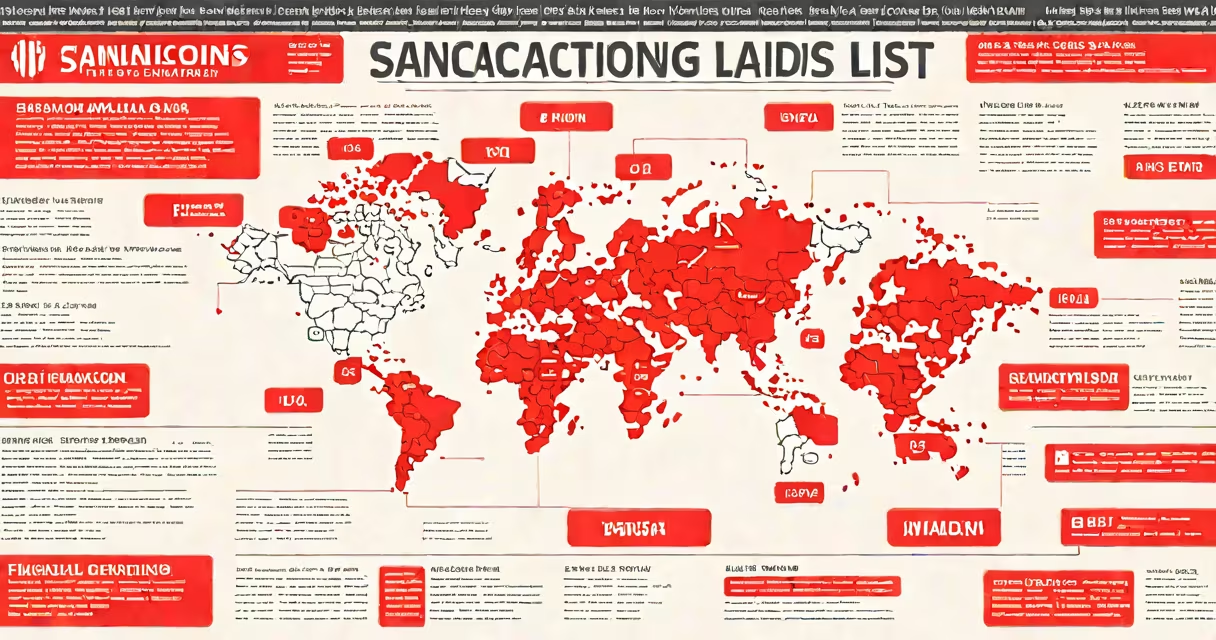
A financial sanctions list is a government-maintained database of individuals, organizations, and countries restricted from engaging in financial transactions due to national security, foreign policy, or terrorism concerns. These lists enforce economic penalties by blocking access to global financial systems.
The primary purpose of a financial sanctions list is to limit the ability of designated parties to move money, trade goods, or access credit. Countries and international bodies such as the United Nations, European Union, and U.S. Department of Treasury maintain these lists. Financial institutions must screen all customer interactions against them to avoid legal exposure.
For example, the U.S. Office of Foreign Assets Control (OFAC) maintains the Specially Designated Nationals and Blocked Persons List (SDN List), which includes over 10,000 entries as of 2023. Any entity or individual on this list has their assets frozen and U.S.-based financial institutions are prohibited from conducting business with them.
When a person or organization appears on a financial sanctions list, their name, identifier, and associated details are added to a centralized database. Financial institutions use automated software to match names, addresses, and account numbers against these databases during onboarding, transaction processing, and ongoing monitoring.
If a match occurs, the institution must halt the transaction, report the incident to regulators, and often freeze funds. This process is known as "sanctions screening." Failure to comply can result in fines exceeding $1 million per violation, according to OFAC enforcement records.
Screening tools use fuzzy matching algorithms to catch variations in spelling, alternate names, or transliterations. For instance, "Al-Qaida" may appear as "Al Qaida," "Al-Qa'ida," or "القاعدة." Modern systems detect these variants with 98% accuracy, reducing false positives while maintaining compliance.
Multiple authoritative bodies issue financial sanctions lists. The most widely referenced include:
| List Name | Issuing Authority | Scope | Use Case |
|---|---|---|---|
| SDN List | U.S. OFAC | Individuals, groups, and entities linked to terrorism, narcotics trafficking, or weapons proliferation | U.S. financial institutions must block transactions involving SDN-listed parties |
| Consolidated List | United Nations Security Council | Global focus: terrorism, nuclear proliferation, conflict zones | Used by member states to implement UN-mandated sanctions |
| EU Consolidated Financial Sanctions List | European Union | Entities involved in human rights abuses, cyberattacks, or destabilizing activities in Europe's neighborhood | Required for EU-based banks and financial firms |
| UK Sanctions List | UK HM Treasury | Individuals and entities tied to Russian aggression, corruption, or destabilization | Enforced by UK financial institutions and export control agencies |
Each list uses unique identifiers. For example, OFAC assigns a unique ID number to each entry on the SDN List. A bank might verify a customer named "Mohammed Ahmed Al-Farouq" by cross-checking his passport number, date of birth, and nationality against the list's metadata.
Non-governmental sources also exist. Some private firms compile secondary watchlists based on public data, but these are not legally binding. Only official government lists carry enforcement power.
Many assume that being on a financial sanctions list means someone is guilty of a crime. That's incorrect. Listing is a policy tool, not a judicial verdict. A person may be added due to association, geography, or political alignment-not proven wrongdoing.
Another misconception is that only large banks need to monitor these lists. In reality, fintech startups, payment processors, and even cryptocurrency exchanges must perform screening. In 2022, a U.S.-based crypto wallet provider was fined $1.5 million for failing to screen users against OFAC's SDN List.
One overlooked detail: sanctions lists are changing. An entity can be added or removed without public notice. For example, in March 2023, OFAC added a Belarusian state-owned airline to the SDN List after a military flight was linked to a drone strike. The change took effect immediately, requiring instant updates across all financial systems.
Consider a U.S. bank receiving a wire transfer request from a client in Dubai to a recipient in Kyiv. The sender's name is "Ivan Petrov." The recipient's name is "Dmitry Kovalenko."
Before processing, the bank runs both names through OFAC's SDN List using a screening engine. The system flags "Dmitry Kovalenko" because he matches a known alias of a Russian military contractor sanctioned under Executive Order 13224. The system returns a 96% confidence match based on name, date of birth, and address.
The bank halts the transaction, files a report with OFAC, and notifies the client. Without screening, the bank could have violated U.S. law and faced a fine of up to $250,000 per violation.
This scenario illustrates why financial institutions rely on real-time, rule-based screening. Manual checks are too slow and error-prone. Automated systems reduce risk and ensure consistency across thousands of daily transactions.
Being listed doesn't just affect finances-it impacts reputation. A company found to have processed payments for a sanctioned party may lose trust among clients, investors, and partners. In 2021, a Swiss bank was forced to close its Asia operations after a regulator discovered it had routed funds through shell companies tied to a sanctioned Iranian entity.
Compliance is not optional. According to the Financial Action Task Force (FATF), all member countries must implement effective sanctions regimes. FATF guidelines require institutions to conduct ongoing monitoring, not just initial screening. This means checking customers periodically-even after onboarding-to catch changes in status.
I've personally reviewed compliance logs from a mid-sized U.S. credit union that missed a match on a Syrian refugee's name due to a typo in the database. The error led to a delayed investigation and a $400,000 penalty. The lesson: even small mistakes in data handling can trigger major consequences.
Understanding the financial sanctions list is essential for anyone working in finance, compliance, or international trade. These lists are not static. They evolve with geopolitical events, and institutions must adapt quickly to stay compliant.
The financial sanctions list serves as a critical enforcement mechanism in global economic policy. Its proper use protects national interests, prevents illicit financing, and supports international stability.