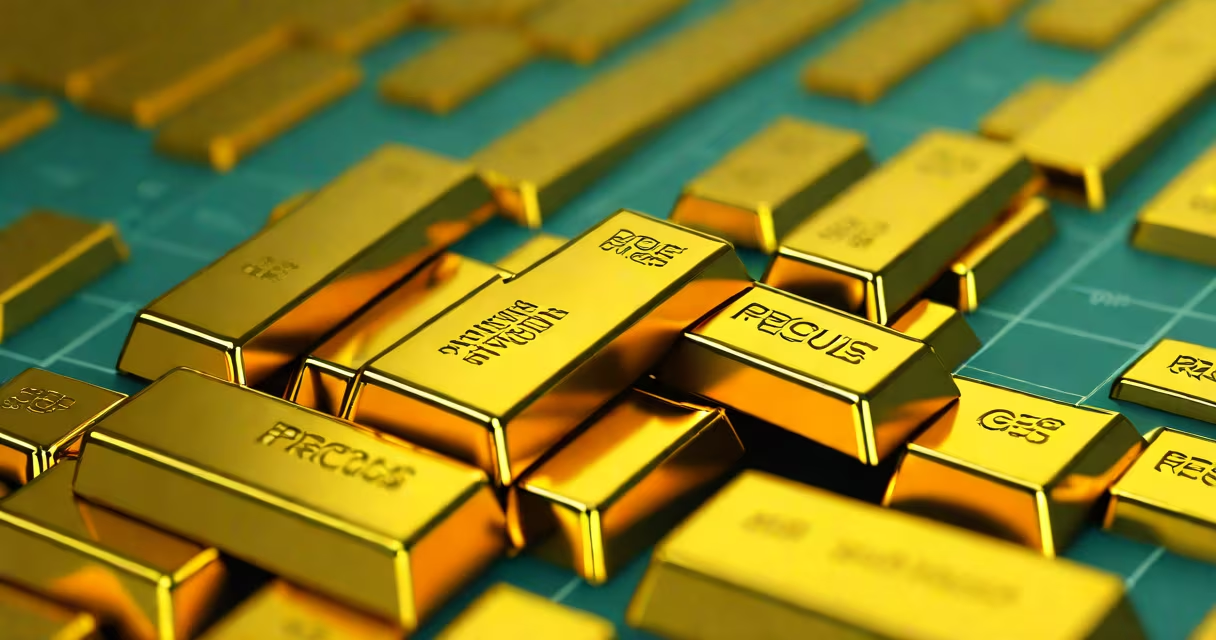
A precious metals index fund is a pooled investment vehicle that tracks the performance of physical metals like gold, silver, platinum, and palladium. It offers exposure to commodity prices without owning the actual metal. These funds trade like stocks and are often structured as exchange-traded funds (ETFs).
These funds are designed to mirror the price movements of specific precious metals or a basket of them. They don't generate dividends or interest. Instead, their value rises and falls based on global supply, demand, inflation expectations, and currency fluctuations. Investors use them to hedge against economic uncertainty, inflation, or currency devaluation.
The most common form is an ETF-like the SPDR Gold Shares (GLD) or iShares Silver Trust (SLV)-that holds physical metal in secure vaults. The fund's net asset value (NAV) is calculated daily based on the spot price of the underlying metal. For example, GLD holds over 100 metric tons of gold bullion stored in London and New York vaults, with each share representing a fraction of that total.
When you buy shares in a precious metals index fund, you're purchasing a claim on a portion of the underlying metal. The fund manager buys and stores the physical metal, then issues shares backed by it. Daily trading occurs on major exchanges like the NYSE or Nasdaq, allowing investors to buy and sell throughout the day at market prices.
Fees are typically low-around 0.15% to 0.40% annually-but they reduce long-term returns. For example, a $10,000 investment in GLD with a 0.40% annual fee loses $40 in fees per year, even if the gold price stays flat. This cost is deducted automatically from the fund's assets.
Unlike stocks, precious metals index funds don't pay dividends. Their return comes solely from price appreciation. If gold rises from $1,800 to $2,000 per ounce, the fund's share price increases accordingly. A 10% rise in gold translates to roughly a 10% gain in the fund's NAV, minus fees and transaction costs.
There are several categories of precious metals index funds, each targeting different metals or strategies:
| Type | Underlying Metal(s) | Example Fund | Annual Fee | Key Feature |
|---|---|---|---|---|
| Single-metal ETF | Gold only | SPDR Gold Shares (GLD) | 0.40% | Backed by physical gold; high liquidity |
| Single-metal ETF | Silver only | iShares Silver Trust (SLV) | 0.50% | Tracks spot silver price; large volume traded |
| Basket ETF | Gold, silver, platinum, palladium | VanEck Rare Earths & Precious Metals ETF (REMX) | 0.65% | Includes industrial metals used in tech and green energy |
| Commodity futures-based fund | Gold via futures contracts | ProShares Ultra Gold (UGLD) | 1.00% | Uses leveraged futures; not suitable for long-term holding |
Not all funds hold physical metal. Some use derivatives like futures contracts. These can amplify gains and losses. UGLD, for example, uses 2x use on gold futures. Over a year, it may underperform or outperform the actual gold price due to compounding effects. In 2022, while gold rose 11%, UGLD dropped 28% due to roll yield and volatility.
Another distinction: some funds are physically backed, others are synthetic. Physically backed funds like GLD have audited holdings. Synthetic funds rely on contracts and counterparty risk. According to the World Gold Council, 90% of major gold ETFs are backed by physical gold stored in regulated vaults, reducing fraud risk.
Investors turn to precious metals index funds during periods of inflation or financial instability. When central banks print money, currency values erode. Gold historically preserves purchasing power. During the 2020 pandemic, gold prices rose 25% as global stimulus programs fueled inflation fears. GLD gained 23% between March and December 2020.
They also serve as diversifiers. A 2023 study by Morningstar found that adding 5% to 10% in gold to a 60/40 stock-bond portfolio reduced maximum drawdowns by 12% during market crashes. This effect is strongest when equities fall and safe-haven demand spikes.
One non-obvious fact: precious metals index funds don't always move with the metal price. Due to tracking error, fees, and market timing, the fund's share price can deviate slightly from the spot price. In 2021, SLV traded at a 0.8% premium to its NAV for several days due to high demand and limited supply of shares. This gap closed when arbitrageurs stepped in.
Many assume precious metals index funds are "safe" investments. That's incorrect. While they act as hedges, they don't guarantee returns. From 2011 to 2019, gold declined 22% in nominal terms. In 2013, GLD lost 28% in a single year. The metal doesn't produce income, so prolonged stagnation leads to negative real returns after inflation.
Another mistake is confusing these funds with mining stocks. A precious metals index fund tracks the metal itself. Mining company stocks track profits, operations, and geopolitical risk. In 2020, while gold rose 25%, the S&P 500 Gold Miners Index fell 32%. The correlation between metal prices and miner earnings is weak.
I've personally held GLD through two recessions. In 2008, it dropped 30% in six months. But it recovered and doubled by 2011. The lesson: these funds are volatile. They work best as long-term hedges, not speculative plays.
Unlike individual stocks or mutual funds, precious metals index funds don't reflect company performance. They don't benefit from growth, innovation, or management decisions. Their value depends entirely on commodity markets. You can't analyze a balance sheet or earnings report to predict their movement.
For context, compare a precious metals index fund to a broad stock index fund. The S&P 500 has returned 10% annually since 1950. Gold has returned 7.3% annually since 1971, according to Bloomberg data. However, gold's volatility is higher-standard deviation of 15% versus 13% for the S&P 500. This makes it less predictable over short timeframes.
Suppose you invest $5,000 in GLD at $50 per share. You buy 100 shares. After one year, gold rises 10% to $55 per share. Your shares are now worth $5,500. But you paid $20 in trading fees and $20 in annual expense ratio ($5,000 × 0.40%). Net profit: $460, or 9.2% return.
If you had invested in a mining stock like Newmont Corporation (NEM), which owns gold mines, you'd have received dividends and benefited from operational efficiency. But NEM fell 40% in 2022 due to rising production costs and lower gold prices. The metal fund outperformed the stock in that year.
Use precious metals index funds when you want exposure to metals without storage, insurance, or theft risk. Use mining stocks when you want use to metal prices and potential dividend income. Both have roles in a diversified portfolio.
Understanding the difference between a precious metals index fund and a commodity-focused ETF is essential. The term "precious metals index fund" includes both physical-backed ETFs and derivative-based funds. Always check the fund's prospectus to confirm whether it holds actual metal or uses futures.