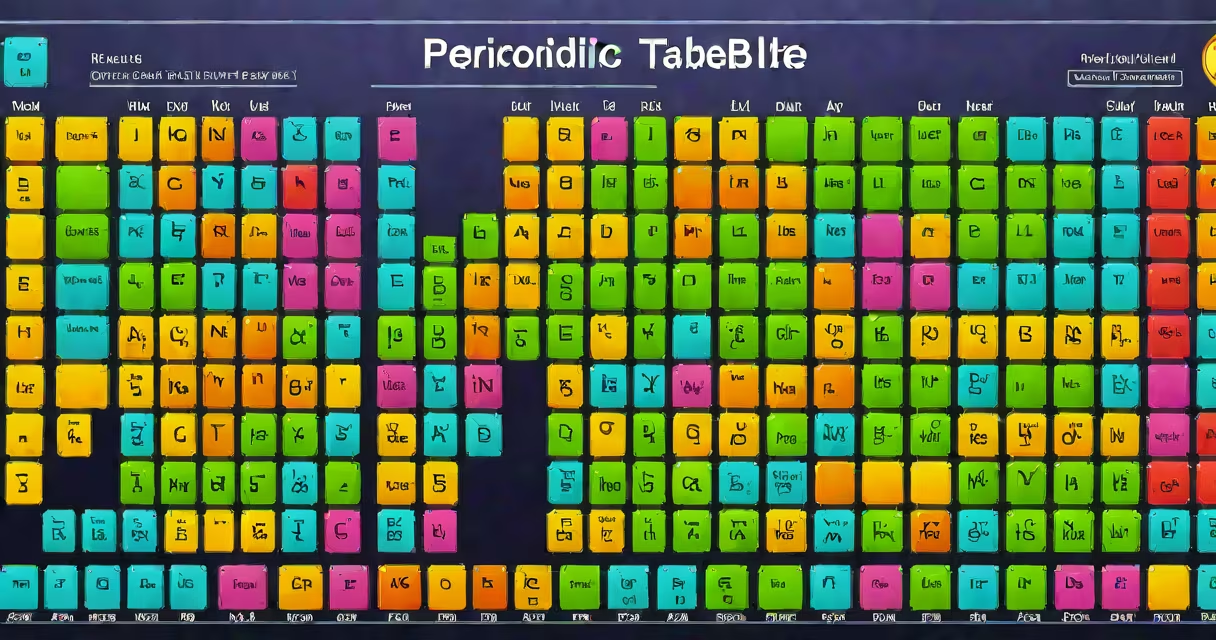
A fill in periodic table game is a digital or printable activity where players identify and place chemical elements into their correct positions on the periodic table based on atomic number, symbol, or name. These games test recall of element locations and reinforce foundational chemistry knowledge.
Players typically receive a blank or partially filled periodic table and must enter the correct element symbol or name in each cell. Some versions offer hints, time limits, or scoring systems. The goal is accuracy and speed across all 118 known elements.
These games are widely used in classrooms, science fairs, and online learning platforms to build familiarity with the structure of the periodic table. They're especially effective for memorizing element symbols and understanding periodic trends like electronegativity and ionization energy.
Each round presents a grid with empty cells corresponding to element positions. Players type the symbol (e.g., Fe for iron) or name (e.g., oxygen) into the correct box. The system validates entries instantly and highlights errors.
Games often include progressive difficulty levels. Early stages focus on common elements (hydrogen, carbon, nitrogen), while later rounds introduce less familiar ones like rhenium (Re) or einsteinium (Es). Some versions use drag-and-drop interfaces or flashcard-style pop-ups.
Scoring varies. Some count correct entries per minute; others track total completion time or percentage accuracy. High scores may enable advanced modes or leaderboards.
Fill in periodic table games come in several formats, each suited to different learning environments:
| Type | Best For | Example Format |
|---|---|---|
| Timed Quiz | Speed drills and competition | 60-second countdown, score = correct entries |
| Drag-and-Drop | Visual learners and touch devices | Elements appear as tiles; users drag to correct spot |
| Flashcard Mode | Memory retention and repetition | Random element appears; player types symbol or name |
| Blank Table Challenge | Full recall practice | Entire table starts empty; complete in one session |
Some apps integrate gamification features like badges for completing groups (e.g., "noble gases" or "transition metals") or streaks for daily play. Others generate randomized tables to prevent rote memorization.
One non-obvious feature: many high-quality games use color-coded zones to show families (alkali metals, halogens, lanthanides). This visual scaffolding supports pattern recognition beyond rote memory.
Teachers assign fill in periodic table games during unit reviews or as warm-up activities. A 2021 study published in the Journal of Chemical Education found students who practiced with interactive periodic table tools scored 23% higher on element identification quizzes than those using static worksheets.
Students preparing for AP Chemistry, SAT Subject Tests, or college entrance exams use these games to build speed and confidence. The American Chemical Society notes that consistent exposure to element placement improves long-term retention of atomic properties.
For hobbyists and science enthusiasts, these games serve as mental workouts. I once played a version on a tablet during a train ride and completed the full table in 8 minutes-just under the 10-minute benchmark many educators recommend for mastery.
Many assume the game requires knowing all 118 elements by heart. That's not true. Most versions allow partial completion and track progress. You don't need to finish in one go.
Another misconception: the game is purely about memorization. While recall is central, good designs emphasize context. For example, placing calcium (Ca) in group 2 reinforces its classification as an alkaline earth metal. This connects symbol entry to conceptual understanding.
Some players confuse element position with atomic mass. The periodic table arranges elements by increasing atomic number-not mass. For example, tellurium (Te, atomic number 52) appears before iodine (I, atomic number 53), even though tellurium has a higher average atomic mass.
Correcting this error is part of the learning process. A well-designed game flags such mistakes and explains the role of atomic number in organizing the table.
Consider a student named Maria preparing for her chemistry midterm. She uses a free web-based fill in periodic table game with a timer and feedback. Her goal: complete the table in under 15 minutes.
She starts with the first row: hydrogen (H), helium (He). She knows these. Next, lithium (Li), beryllium (Be), boron (B), carbon (C), nitrogen (N), oxygen (O), fluorine (F), neon (Ne). All correct.
At element 19, potassium (K), she hesitates. She remembers K is in group 1, period 4. She types "K" and the game confirms it. She continues, relying on patterns: group 1 = alkali metals, group 17 = halogens.
When she reaches the actinide series (elements 89-103), she slows. These are less familiar. She uses the game's hint function to reveal the first few: actinium (Ac), thorium (Th), protactinium (Pa).
After 12 minutes and 47 seconds, she finishes. The game shows 118 entries, 116 correct. Two errors: she typed "Pt" for platinum (correct symbol) but placed it in the wrong row. The system flags it and suggests checking the periodic trend.
She reviews the error, realizes platinum is in period 6, group 10. She corrects it manually. Her final score: 98.3% accuracy. She repeats the game the next day and reduces her time to 10 minutes.
This outcome reflects research from the National Science Teaching Association: spaced repetition with immediate feedback boosts retention by up to 40% compared to passive review.