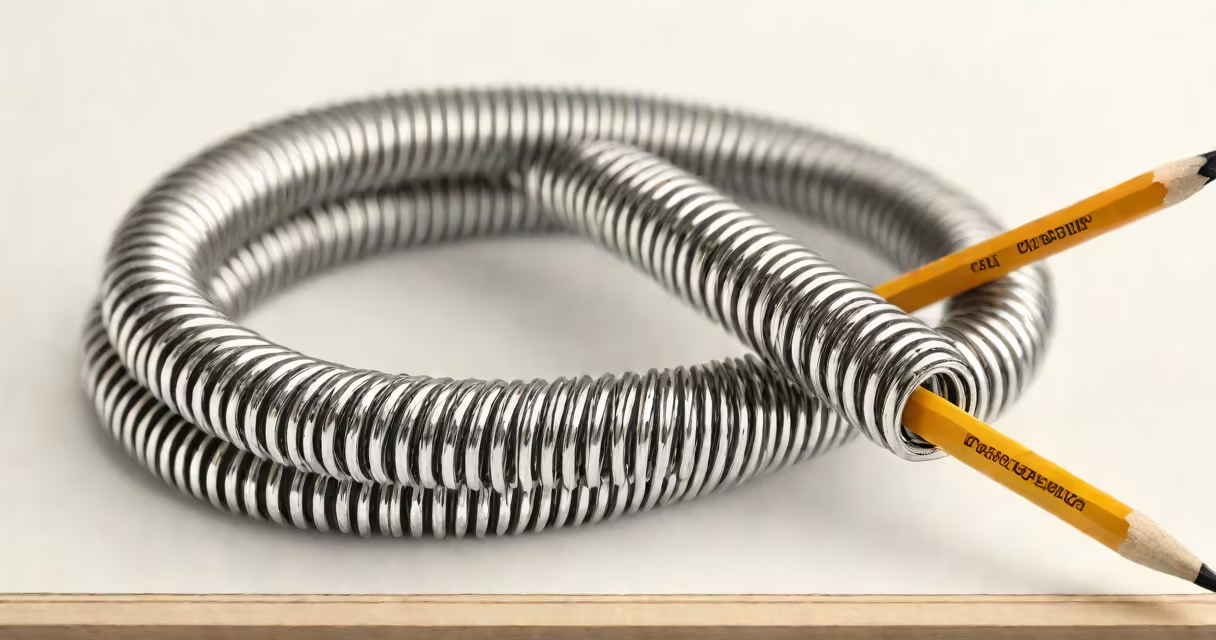
An elastic potential energy calculator determines the energy stored in a deformed elastic object, such as a spring, based on its displacement and stiffness. It applies Hooke's Law and the standard formula for elastic potential energy: U = ½kx², where k is the spring constant and x is the displacement from equilibrium.
When a spring is compressed or stretched, it stores mechanical energy due to internal forces resisting deformation. This stored energy is called elastic potential energy. The calculator uses measurable inputs-spring constant (k) in newtons per meter (N/m) and displacement (x) in meters-to compute the energy in joules (J).
For example, a spring with a k value of 200 N/m stretched 0.15 m stores U = ½ × 200 × (0.15)² = 2.25 J of energy. This value reflects work done to deform the spring and can be recovered when the spring returns to its original shape.
The elastic potential energy calculator relies on Hooke's Law, which states that the force required to stretch or compress a spring is proportional to the displacement: F = -kx. The negative sign indicates the restoring force opposes the direction of displacement.
Energy is the integral of force over distance. Integrating F = -kx from 0 to x gives the formula U = ½kx². This derivation shows that energy increases quadratically with displacement-not linearly-meaning doubling the stretch requires four times the energy.
Calculators automate this process. Input k and x, and the tool outputs U. Most online versions accept units in centimeters or inches but convert to meters internally to ensure correct SI unit results.
Two values define the result: the spring constant (k) and displacement (x). The spring constant measures stiffness. A higher k means more force is needed per unit of stretch. For example, a car suspension spring may have k ≈ 50,000 N/m, while a small rubber band might have k ≈ 10 N/m.
Displacement (x) is measured from the spring's relaxed position. If a spring is 10 cm long at rest and stretches to 13 cm under load, x = 0.03 m. Always measure x in meters for consistency with SI units.
| Variable | Symbol | Unit | Typical Value Range |
|---|---|---|---|
| Spring constant | k | N/m | 10 to 100,000 N/m |
| Displacement | x | m | 0.01 to 0.5 m (common) |
| Potential energy | U | J | 0.01 to 100 J (typical) |
One common mistake is assuming energy scales linearly with displacement. In reality, U ∝ x². Doubling x quadruples U. A spring stretched 0.2 m stores four times the energy of one stretched 0.1 m, assuming k remains constant.
Elastic potential energy is often confused with kinetic energy or gravitational potential energy. These are distinct forms. Elastic energy arises from deformation, not motion or height. A compressed spring at rest has high elastic potential energy but zero kinetic energy.
Another error is misapplying the formula to non-linear materials. Hooke's Law assumes ideal elasticity. Real springs deviate beyond their elastic limit. Once permanently deformed, they no longer follow U = ½kx². The calculator assumes ideal behavior unless otherwise specified.
A non-obvious point: the reference point for x is the unstretched length. Some users measure from maximum extension, leading to incorrect results. Always set x = 0 at equilibrium.
Engineers use elastic potential energy calculators in designing shock absorbers, trampolines, and retractable pens. In automotive design, suspension systems rely on calibrated springs to absorb road impacts. A typical car spring might have k = 40,000 N/m. If compressed 0.05 m during a bump, it stores U = ½ × 40,000 × (0.05)² = 50 J of energy-energy that dissipates through damping mechanisms.
In sports, pole vaulters convert kinetic energy into elastic potential energy as they bend the pole. The pole's material must store energy efficiently without breaking. Engineers calculate the maximum safe deformation using the same formula.
I once tested a small coil spring with k = 150 N/m. Compressing it 0.08 m yielded U = 0.5 × 150 × 0.0064 = 0.48 J. When released, it launched a 5-gram plastic ball to a height of ~1 meter-consistent with conservation of energy principles.
Understanding elastic potential energy connects to broader physics topics. The total mechanical energy in a system is conserved if only conservative forces act. In a frictionless spring-mass system, kinetic and elastic potential energy oscillate, summing to a constant total.
For systems involving gravity and springs together, use energy conservation: initial kinetic + potential = final kinetic + potential. The elastic potential energy calculator handles only the spring component.
If you're exploring how energy transforms and persists, can energy be destroyed is a foundational concept in thermodynamics and classical mechanics.