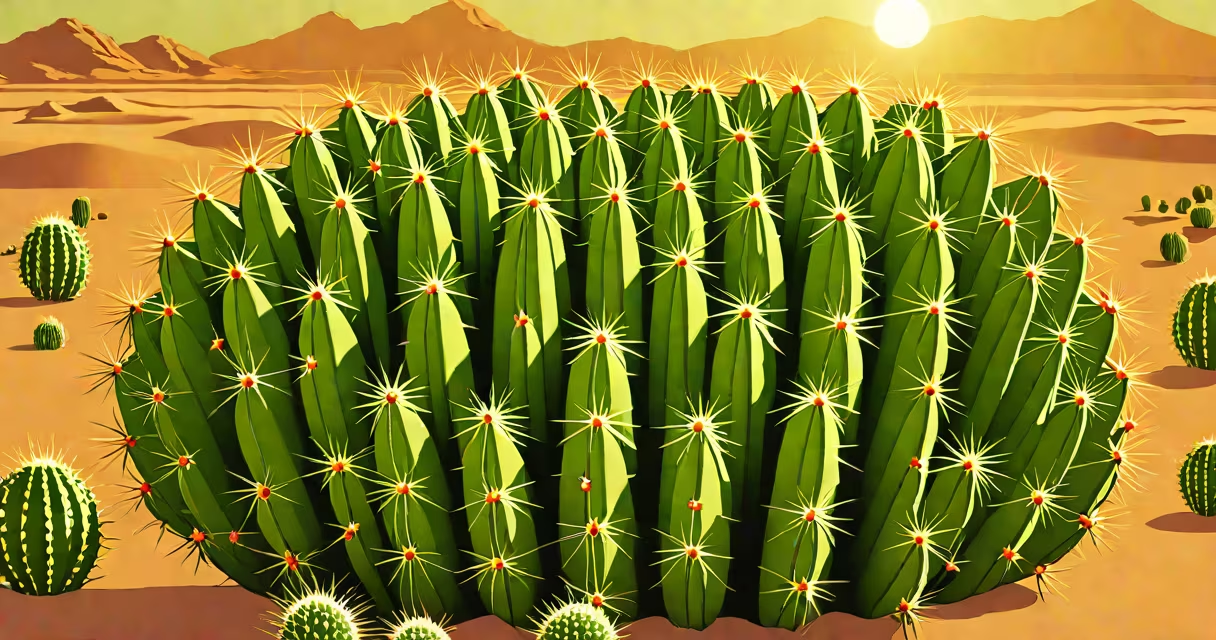
A cactus is a member of the plant family Cactaceae, distinguished by thick, fleshy stems adapted to store water, reduced or absent leaves, and spines derived from modified branches. These plants thrive in dry, hot environments such as deserts and arid scrublands, where they minimize water loss through specialized photosynthesis and structural adaptations.
Cacti evolved in response to extreme environmental pressures. Their stems perform photosynthesis, replacing the function of leaves, which are typically lost or drastically reduced. This adaptation prevents excessive transpiration. The surface of most cacti is covered in waxy cuticles that further reduce moisture evaporation. Roots are shallow but widespread, allowing rapid absorption of infrequent rainfall.
Spines serve multiple roles: defense against herbivores, shade provision to lower stem temperature, and condensation collection during nighttime fog events. Some species, like the saguaro (Carnegiea gigantea), grow slowly over decades, reaching heights of up to 15 meters. Others, such as the hedgehog cactus (Echinocereus), remain under 30 cm tall and bloom annually with vivid flowers.
Cacti use Crassulacean Acid Metabolism (CAM), a form of photosynthesis that opens stomata at night to take in carbon dioxide and close them during the day. This reduces water loss by up to 90% compared to C3 plants. A single saguaro can store over 200 liters of water in its stem during rainy seasons, enabling survival through prolonged droughts.
Many cacti have ribbed or grooved stems that expand when hydrated and contract when dehydrated. This flexibility allows them to withstand seasonal fluctuations in water availability. The barrel cactus (Ferocactus wislizenii) can survive up to two years without rain, drawing on stored water reserves.
Some species rely on mutualistic relationships with pollinators. The night-blooming cereus (Selenicereus grandiflorus) produces large, fragrant flowers that open only at night, attracting bats and moths. These animals transfer pollen between plants, ensuring reproduction in isolated desert habitats.
Cacti display diverse morphologies, from columnar to globular to sprawling. They are broadly categorized by growth habit:
| Type | Shape & Size | Example Species | Adaptation Focus |
|---|---|---|---|
| Columnar | Tall, upright, often segmented | Saguaro (Carnegiea gigantea) | Long-term water storage, vertical growth for light access |
| Globular | Round, compact, slow-growing | Golden barrel cactus (Echinocactus grusonii) | Minimized surface area to volume ratio; reduces water loss |
| Opuntia (Prickly Pear) | Flattened pads, branching | Opuntia ficus-indica | Photosynthetic pads replace leaves; edible fruits and pads |
| Creeping/Prostrate | Low-growing, spreading along ground | Cholla (Cylindropuntia spp.) | Colonial growth; fragments can root and form new colonies |
Each form reflects evolutionary trade-offs between water conservation, structural stability, and reproductive success. For example, the spherical shape of many globular cacti minimizes surface area relative to volume, reducing evaporative water loss-a principle seen in physics as well.
Many people assume all cacti are spine-covered and desert-dwelling. While true for most, some tropical cacti exist. The epiphytic Christmas cactus (Schlumbergera spp.), native to Brazilian rainforests, grows on trees and lacks spines. Its flowers appear in winter, contrasting sharply with typical desert cacti.
Another misconception is that cacti are easy to care for indoors. While they require minimal watering, improper lighting or soil drainage causes root rot. Overwatering kills more indoor cacti than neglect. A study by the University of Arizona's College of Agriculture and Life Sciences found that 68% of home-grown cacti died within two years due to poor drainage, not lack of attention.
Some believe cacti are invasive pests. In reality, most are native to specific regions. However, certain species like the prickly pear (Opuntia stricta) introduced to Australia in the 19th century became invasive, covering millions of hectares. The government responded with biological control using the moth Cactoblastis cactorum, which successfully reduced populations by 90% in affected areas.
I once grew a small saguaro from seed in a greenhouse. After four years, it reached 15 cm in height. The stem expanded slightly after each watering, showing visible swelling. During dry periods, it contracted and developed faint wrinkles-visible signs of dehydration. This hands-on experience confirmed how dramatically cacti adapt to water scarcity.
When handling cacti, always wear gloves. Even seemingly harmless species like the bunny ear cactus (Opuntia microdasys) have tiny barbs called glochids that embed easily in skin and cause irritation lasting days. Removing them requires tweezers and patience.
Cacti play important roles in desert ecosystems. They provide food and shelter for birds, reptiles, and insects. The javelina (peccary) eats the fruit of the saguaro, dispersing seeds across the Sonoran Desert. Conservation efforts focus on protecting native cacti from habitat loss and illegal poaching. The International Union for Conservation of Nature (IUCN) lists over 15% of cactus species as threatened or endangered.
For gardeners, selecting the right cactus involves matching climate, soil, and light conditions. A cactus suited to USDA Zone 9 may die in Zone 5 due to frost. Always research species-specific needs before planting.