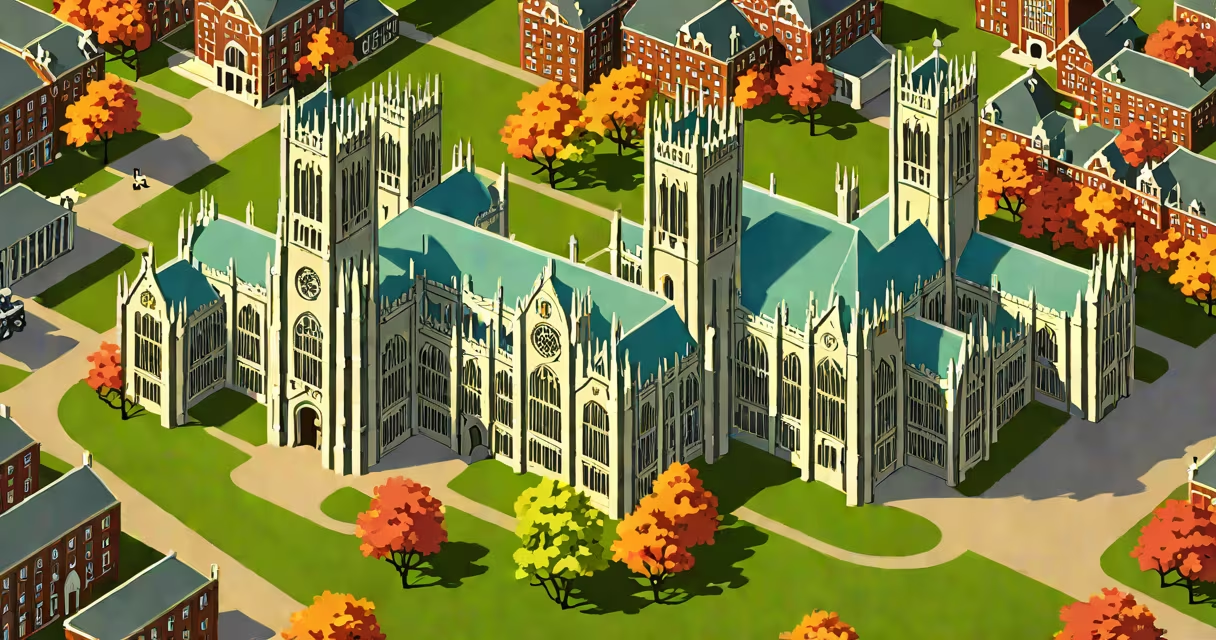
Catholic ivy league schools are institutions that combine the academic prestige of the Ivy League with formal Catholic identity, typically rooted in Jesuit, Benedictine, or other Catholic traditions. These schools maintain rigorous admissions standards, high research output, and long-standing reputations-but also uphold faith-based missions, values, and often require religious coursework.
Only a few schools qualify as both Catholic and Ivy League in public perception and institutional alignment. The term "Catholic Ivy League" is not an official designation but reflects a subset of elite universities with deep Catholic roots., none of the eight traditional Ivy League schools-Harvard, Yale, Princeton, Columbia, Brown, Cornell, Penn, and Dartmouth-are officially Catholic. However, several Catholic institutions have comparable academic standing and historical influence.
Among these, Fordham University stands out as the most frequently cited Catholic institution with Ivy League-level recognition. Founded in 1841 by the Society of Jesus, Fordham is located in New York City and consistently ranks among the top national universities in U.S. News & World Report. Its law school, business school, and liberal arts programs attract students from elite feeder schools nationwide. While Fordham is not a member of the Ivy League, its academic rigor and selective admissions mirror those of the group.
Catholic ivy league schools operate under dual mandates: academic excellence and spiritual formation. They maintain accreditation from the Middle States Commission on Higher Education and often hold additional approval from the Association of American Universities. Their governance structures typically include a board of trustees with significant lay and religious leadership, ensuring balance between secular academic goals and Catholic doctrine.
For example, Fordham requires all undergraduate students to complete a four-course sequence in theology and ethics, including courses on Christian thought, moral reasoning, and social justice. This requirement reflects the university's commitment to forming "men and women for others," a Jesuit ideal emphasized since the 19th century. Such curricular expectations are rare in secular Ivy League institutions, where philosophy and religion are elective subjects.
Admissions at these schools remain highly competitive. Fordham's acceptance rate was 37% in 2023, with median SAT scores around 1400 and ACT scores near 31. Students admitted often come from private high schools with strong college counseling programs. The university also offers need-based financial aid covering up to 100% of tuition for qualifying families, a feature shared with many Ivy League schools.
Catholic ivy league schools fall into distinct categories based on their religious order and institutional mission. The most common affiliations are Jesuit (founded by Ignatius of Loyola), Benedictine (following St. Benedict's Rule), and diocesan (directly overseen by a bishop).
| Institution | Religious Affiliation | Founded | Undergraduate Enrollment | Notable Feature |
|---|---|---|---|---|
| Fordham University | Jesuit | 1841 | 12,000 | Top-ranked in regional rankings; strong pre-law and pre-med pipelines |
| Georgetown University | Jesuit | 1789 | 10,500 | Home to the Edmund A. Walsh School of Foreign Service; ranked #26 nationally |
| University of San Diego | Lasallian (De La Salle Brothers) | 1949 | 8,000 | High faculty-student ratio; strong focus on service learning |
| Marquette University | Jesuit | 1881 | 11,000 | Located in Milwaukee; top-tier engineering program |
While Georgetown University is sometimes compared to Ivy League schools due to its location, academic reputation, and selectivity, it is not formally part of the Ivy League. Still, it shares many traits: a 9.4% acceptance rate in 2023, a 97% graduation rate within six years, and a large alumni network in government and diplomacy. Its School of Foreign Service is widely regarded as one of the nation's premier international relations programs.
A frequent misunderstanding is that Catholic ivy league schools are less academically demanding than their secular counterparts. This is false. Fordham and Georgetown both rank in the top 30 nationally for research output and faculty awards. According to the National Science Foundation, Fordham received $42 million in federal research funding in 2022-comparable to smaller Ivies like Brown and Dartmouth.
Another misconception is that religious affiliation restricts academic freedom. In reality, Catholic institutions adhere to the Church's teaching on matters of faith but allow wide latitude in scholarly inquiry. For example, Fordham's Department of Philosophy hosts annual conferences on secular ethics and political theory, featuring speakers from Harvard, Stanford, and Oxford. The university's academic freedom policy explicitly protects faculty from censorship on non-doctrinal topics.
No Catholic ivy league school is a member of the Ivy League athletic conference. The Ivy League is a sports consortium, not an academic one. Georgetown competes in the Big East Conference, while Fordham plays in the Patriot League. This distinction matters: being a Catholic ivy league school does not imply participation in the Ivy League's athletic or administrative structure.
Consider Maria, a high school senior from Chicago with a 3.9 GPA and a 1480 SAT score. She applies to Fordham University through early decision. Her application includes a personal essay reflecting on her family's immigration story and her involvement in a youth mentorship program. She also submits a letter from her parish priest attesting to her commitment to service, a value emphasized in Jesuit education.
She is accepted with a merit scholarship covering 60% of tuition. During orientation, she enrolls in "The Meaning of Life" course, a required first-year seminar exploring philosophical and theological perspectives on human purpose. Over four years, she majors in sociology, completes a semester abroad in Rome, and participates in a summer internship at a nonprofit focused on refugee resettlement-experiences aligned with Fordham's mission of social justice.
After graduation, she earns a master's degree in public policy from the University of Pennsylvania, a traditional Ivy League school. Her Catholic ivy league background gave her access to a network of ethical leadership, community engagement, and interdisciplinary thinking-skills valued in both public and private sectors.
When comparing Catholic ivy league schools to their secular peers, the difference lies not in quality but in context. These institutions offer the same academic rigor, research opportunities, and career outcomes as top-tier schools-but with a structure centered on values, service, and intellectual humility. As the Association of Catholic Colleges and Universities notes, "The Catholic mission is not a constraint on excellence-it is a compass."