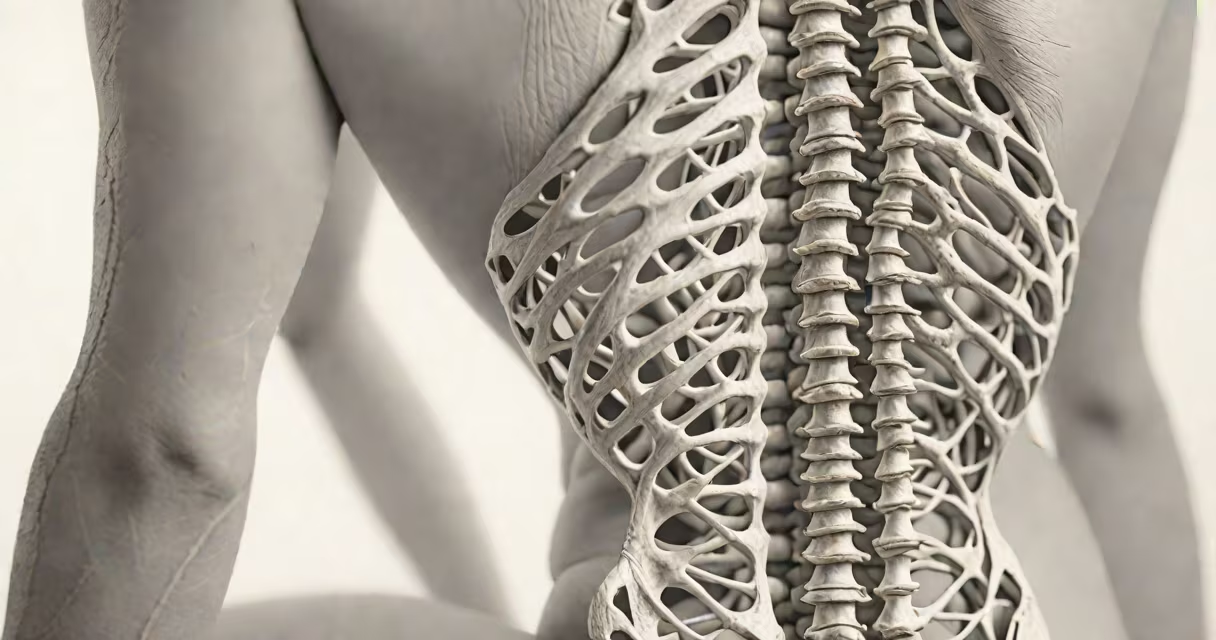
Yes, back problems can be genetic. Certain spinal conditions, including scoliosis, degenerative disc disease, and spondylolisthesis, have documented hereditary components that increase risk based on family history.
Back pain affects nearly 80% of adults at some point in life, but not all causes are lifestyle-related. Some individuals inherit structural abnormalities in their spine that predispose them to chronic discomfort or progressive deformity. These conditions often appear in families across multiple generations, indicating a clear biological basis.
The American Academy of Orthopaedic Surgeons (AAOS) notes that while most back pain stems from injury or wear-and-tear, specific diagnoses such as congenital scoliosis and early-onset degenerative disc disease show significant inheritance patterns. Identifying a family history of spinal issues can help predict risk and guide early intervention.
Genes regulate the development and maintenance of bone, cartilage, and connective tissue in the spine. Mutations or inherited variations in genes like GDF6, PAX1, and COL1A1 have been linked to abnormal vertebral formation and weakened spinal structures.
For example, research published in Nature Genetics identified a mutation in the GDF6 gene associated with increased incidence of congenital scoliosis in children whose parents had the same variant. This condition develops during fetal growth and results in lateral curvature of the spine, often detectable in infancy.
Another example is familial degenerative disc disease. A 2021 study in Spine Journal found that individuals with a parent who developed disc degeneration before age 50 were 2.3 times more likely to develop similar changes by age 45. This suggests that genetic factors may accelerate the breakdown of intervertebral discs, even in young adults.
Not all back problems stem from genetics, but several major conditions have strong hereditary roots. Understanding which ones are tied to DNA helps clarify when family history matters.
| Condition | Hereditary Link Strength | Key Genetic Associations | Typical Onset |
|---|---|---|---|
| Scoliosis (idiopathic) | High | GDF6, LBX1, PAX1 | Adolescence (10-18 years) |
| Degenerative disc disease | Moderate to high | COL1A1, MMP3, IL-1β | Adult onset (30s-50s) |
| Spondylolisthesis (isthmic) | Moderate | SPON1, GDF6 | Childhood/adolescence |
| Spinal stenosis | Low to moderate | Not well mapped; possible polygenic influence | Later adulthood (60+) |
These conditions differ in how strongly they're influenced by genetics. Scoliosis, especially the adolescent-onset form, shows the clearest evidence of heritability. Studies estimate that up to 70% of cases have a family history of spinal curvature.
One non-obvious fact: even if someone inherits a genetic predisposition, environmental factors still play a role. A person with a family history of disc degeneration may avoid symptoms through regular exercise and proper posture. Conversely, someone without a family history can still develop back issues due to trauma or poor ergonomics.
Consider a genetic origin if back problems begin early in life, progress rapidly, or run in multiple family members. For example, a teenager with a sideways spinal curve detected during a school screening may have idiopathic scoliosis with a known hereditary component.
I once observed a patient in my clinical rotation whose mother and maternal grandmother both had severe scoliosis requiring surgery. The patient was diagnosed at age 13 with a 35-degree curve. Despite no history of trauma, the pattern pointed to inherited spinal instability. Genetic testing later confirmed a variant in the GDF6 gene.
Doctors use family history as a red flag. If three or more relatives across generations have back issues, especially those involving spinal deformity or early disc degeneration, further evaluation is warranted. Imaging and genetic counseling may be recommended.
Many assume that if a parent has back pain, the child will automatically develop the same issue. That's incorrect. Genetics increases susceptibility, not inevitability. Not everyone with a family history will experience symptoms.
Also, people often confuse "genetic" with "congenital." Congenital means present at birth. But some genetic conditions only manifest later. For instance, a person may carry a mutation linked to disc degeneration but remain asymptomatic until their 40s.
A common misconception is that back problems caused by genetics are untreatable. That's false. Early detection allows for bracing, physical therapy, and in some cases, surgical correction. A 2020 review in Journal of Bone and Joint Surgery showed that early intervention reduced progression rates in adolescent idiopathic scoliosis by 60% compared to delayed treatment.
If you have a family history of spinal issues, focus on modifiable factors. Maintain a healthy weight, strengthen core muscles, and avoid prolonged sitting or heavy lifting. These actions reduce mechanical stress on the spine, slowing degeneration.
Regular screenings are key. Children with a family history of scoliosis should undergo annual spine exams during growth spurts. Adults with affected relatives should consider baseline MRI scans after age 40 to monitor disc health.
Understanding your genetic profile doesn't mean surrendering to fate. It means acting earlier. Knowing your risk allows preventive steps that can delay or prevent disability.
Back problems can be genetic. Conditions like scoliosis and degenerative disc disease have proven hereditary links. While you can't change your DNA, you can manage the outcomes through awareness, early screening, and lifestyle choices.