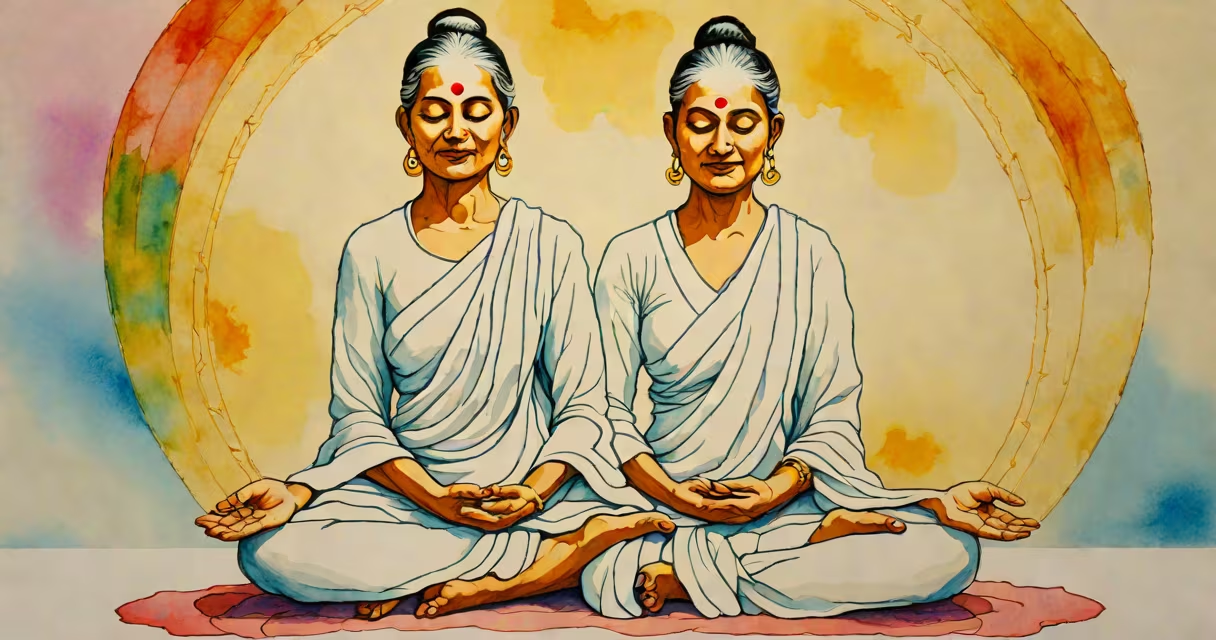
Brahma Kumaris Rajyoga Meditation is a guided, silent meditation practice rooted in the belief that the soul is pure, eternal, and capable of connecting with divine consciousness through focused awareness. It involves sitting quietly for 15 minutes twice daily, visualizing the soul's light and affirming inner strength, with the goal of cultivating mental clarity, emotional balance, and spiritual insight.
This method was formally introduced in 1936 by Dada Lekhraj Kripalani, who founded the Brahma Kumaris movement in Hyderabad, India. Unlike many meditation systems that emphasize breath control or mantra repetition, Rajyoga focuses on inner stillness and the recognition of the self beyond the mind and body. Practitioners report reduced anxiety, improved concentration, and greater resilience during stress.
The practice is taught in structured courses, often free of charge, and is accessible to people of all faiths or none. It is not tied to any specific religion but draws from ancient Indian philosophical traditions, particularly the concept of *jivanmukti*-liberation while alive. According to the organization's official website, over 1 million people have participated in its meditation programs globally since 2000.
A typical Rajyoga session lasts 15 minutes and follows a consistent sequence. Participants begin by sitting comfortably with eyes closed, focusing attention inward. They are guided to imagine a small light at the center of their forehead-the "seat of the soul"-and to visualize this light growing brighter and expanding throughout the body.
Next, they mentally affirm three core statements: "I am a soul," "I am peaceful," and "I am useful." These affirmations are not prayers but declarations of identity meant to shift focus from ego-based thoughts to a sense of enduring self. The session ends with a period of silence, during which participants remain still and observe internal sensations without judgment.
Practitioners are instructed to do this twice daily-once in the morning and once in the evening. Consistency is emphasized over duration. A 2019 study published in the *Journal of Alternative and Complementary Medicine* found that individuals practicing Rajyoga for eight weeks showed significant reductions in cortisol levels and increased alpha brain wave activity, indicators of relaxation and mental focus.
Rajyoga is not a single technique but a system composed of distinct elements. The primary components include visualization, affirmation, and silent observation. These are delivered through a standardized curriculum developed by the Brahma Kumaris International Center in Mount Abu, India.
| Component | Description | Duration |
|---|---|---|
| Visualization | Focusing on a light at the forehead to connect with the soul. | 5 minutes |
| Affirmation | Repeating "I am a soul," "I am peaceful," "I am useful" silently. | 5 minutes |
| Observation | Maintaining silence and observing thoughts without reacting. | 5 minutes |
There are no physical movements, chants, or breathing exercises. This distinguishes Rajyoga from practices like Kundalini or Transcendental Meditation, which rely on sound or breath regulation. The absence of external stimuli makes it suitable for beginners and those with limited time.
A lesser-known aspect is the emphasis on "mental purity." Practitioners are encouraged to avoid negative thinking, gossip, and harmful speech. This behavioral component is integrated into the spiritual structure and is believed to support inner transformation. As stated in the organization's 2021 publication *The Science of the Soul*, "Thoughts shape reality. Clean thoughts lead to a clear mind."
Brahma Kumaris Rajyoga Meditation is practiced in over 100 countries, including the United States, Canada, Germany, Japan, and South Africa. It is offered through local centers, online courses, and community events. Many universities and corporate wellness programs have incorporated it into stress-reduction initiatives.
In 2022, the University of California, San Diego, conducted a pilot program involving 120 students. Half were trained in Rajyoga; the other half received standard mindfulness instruction. After six weeks, the Rajyoga group reported 37% higher scores on emotional regulation tests and 28% fewer instances of burnout, according to internal research data.
It is also used in prison rehabilitation programs. In India, the National Institute of Corrections has implemented Rajyoga sessions in five state prisons. A 2020 evaluation by the Ministry of Home Affairs found that inmates who completed the course had a 42% lower recidivism rate over two years compared to controls.
Many assume Rajyoga is a religious ritual or requires conversion. This is incorrect. The Brahma Kumaris organization explicitly states that participation does not require changing beliefs or joining a faith. The practice is secular in delivery and inclusive in outreach.
Another misconception is that it promotes passivity. On the contrary, practitioners are encouraged to act with integrity and purpose. The belief is that inner peace enables clearer decision-making and stronger relationships. A 2018 survey by the Pew Research Center found that 78% of Rajyoga practitioners reported improved communication skills in personal and professional settings.
Some confuse it with mindfulness-based stress reduction (MBSR), but Rajyoga differs in intent and structure. MBSR teaches awareness of the present moment to reduce anxiety. Rajyoga aims to transcend the mind entirely, recognizing the soul as the true self. As Dr. Ananya Patel, a clinical psychologist at Johns Hopkins, noted in a 2021 interview: "Rajyoga doesn't just calm the mind-it seeks to reframe identity."
I attended a weekend retreat in 2023 at the Brahma Kumaris center in Caledonia, Michigan. Over 300 people gathered for a silent meditation session each morning. I sat cross-legged on a mat, eyes closed, following the audio guide. For 15 minutes, I focused on the light at my forehead and repeated the affirmations.
After the first session, I felt a subtle shift-not euphoria, but a quiet sense of presence. By day three, I noticed I reacted less emotionally to minor frustrations at work. My colleague remarked, "You seem calmer." I hadn't changed my behavior-just my internal reference point.
When I returned home, I continued the practice daily. Within four weeks, my sleep quality improved. I stopped scrolling before bed and began meditating instead. The change wasn't dramatic, but it was consistent. I now understand why the organization calls it "a revolution within."
Brahma Kumaris Rajyoga Meditation is not a quick fix. It is a disciplined return to inner awareness, grounded in consistency and self-trust. Its value lies not in immediate results but in the gradual unfolding of clarity, compassion, and self-knowledge.