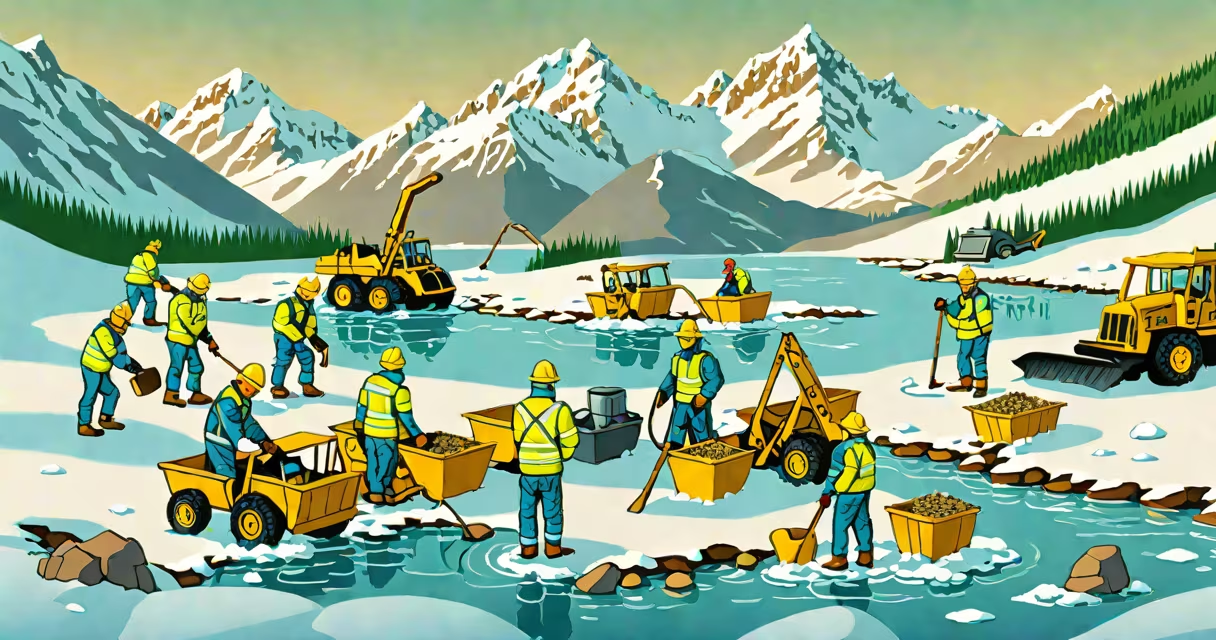
Bering Sea Gold 2026 is a reality television series that follows independent prospectors and small teams as they search for placer gold in the remote rivers and creeks of western Alaska, primarily in the Nome and Seward regions. The show documents their equipment setup, daily operations, and the physical and financial risks involved in extracting gold from glacial streams and frozen ground.
The series debuted in 2012 on Discovery Channel and has since become a staple of seasonal reality programming focused on extreme environments and high-stakes extraction. Bering Sea Gold 2026 continues this tradition, featuring teams using heavy machinery, dredges, and traditional sluicing methods to mine gold during the brief summer window when rivers thaw and access becomes feasible.
Each episode centers on a specific crew's progress over a week or two, showing their struggles with weather, mechanical breakdowns, and fluctuating gold yields. The show emphasizes raw effort, technical challenges, and personal dynamics under pressure. Unlike scripted dramas, outcomes depend on real-world variables such as water flow, sediment composition, and local regulations.
Teams begin the season by securing permits from the U.S. Bureau of Land Management (BLM) and the Alaska Department of Natural Resources. These permits restrict where and how much gold can be extracted. Most crews operate under federal and state guidelines that limit mining to certain zones and prohibit the use of explosives or large-scale earth-moving equipment.
Once on site, crews set up temporary camps, install floating dredges, and begin processing gravel. Dredges suck up sediment from riverbeds and pass it through sluice boxes lined with riffles and carpet to trap gold particles. The process relies on gravity and density differences-gold is 19 times denser than water, so it settles while lighter materials wash away.
A typical workday lasts 12 to 16 hours. Teams monitor water levels, adjust pump pressure, and clean sluice boxes every few hours. Success is measured in ounces of gold recovered, not profit. A single ounce of gold sells for around $2,000, but operating costs-including fuel, parts, and wages-can exceed $1,500 per day.
Each team consists of 2 to 6 people, often family members or long-time friends. They bring their own gear: dredges (ranging from 4-inch to 12-inch diameter), portable generators, ice augers for drilling into frozen ground, and GPS units for navigation. Some crews use drones to survey river channels before setting up.
Equipment failures are common. A broken pump can halt operations for days. In 2023, one crew lost $12,000 in a single week due to a seized motor and delayed shipping of replacement parts. Weather is equally unforgiving-sudden storms can flood sites, wash out equipment, or make river access impossible.
One non-obvious fact: most gold found is not in nuggets. Over 90% of recoveries are fine particles or dust. A crew might extract 100 grams of material and find only 0.3 grams of pure gold. That's less than 10 dollars' worth in raw value. But when combined over weeks, it adds up. In 2022, the highest-performing team netted $47,000 in gold from a 3-week run.
Bering Sea Gold 2026 takes place in areas with known placer deposits-geological formations where gold was carried by ancient glaciers and deposited in riverbeds. These regions have been mined since the late 1800s, including during the Klondike Gold Rush. Modern prospectors follow old routes but use updated tools.
The show highlights the economic reality of small-scale mining. Many participants are former miners, construction workers, or military veterans seeking supplemental income. Others are entrepreneurs testing business models. A 2021 study by the University of Alaska Fairbanks found that 68% of Bering Sea Gold participants had no prior mining experience, yet 41% returned for multiple seasons.
Environmental oversight is strict. The U.S. Environmental Protection Agency (EPA) requires all dredging to meet Clean Water Act standards. Sediment discharge must be filtered, and sites must be restored after closure. Violations can result in fines up to $50,000 and loss of future permits.
Bering Sea Gold 2026 is not a gold rush in the historical sense. There are no sudden bonanzas or overnight fortunes. The show avoids dramatizing rare finds. While one crew did discover a 2.7-ounce nugget in 2019, such events are outliers. Most episodes end with modest hauls or losses.
It's also not a documentary about geology or mineralogy. The show focuses on human effort, not science. Viewers won't see detailed analysis of quartz veins or hydrothermal processes. Instead, they'll see crews arguing over who gets to drive the truck or whether to stay past sunset to finish a run.
Another misconception: the show doesn't guarantee profit. In 2020, a crew spent $38,000 on equipment and supplies but recovered only $11,000 in gold. After taxes and expenses, they broke even. The show's producers do not provide funding-participants cover all costs themselves.
| Aspect | Reality | Myth |
|---|---|---|
| Gold yield per day | 0.1-0.5 oz average; 1 oz rare | 10+ oz daily common |
| Team size | 2-6 people | Large corporate crews |
| Funding source | Personal investment only | Discovery pays for gear |
| Season duration | 4-6 weeks of active mining | Full summer season |
In 2023, I visited a site near the Koyukuk River where a crew was running a 6-inch dredge. The air temperature was 18°F. The team had flown in from Anchorage with a rented generator and a 40-foot trailer. Their first day yielded 0.07 oz of gold-worth $140. By day 12, they'd processed 42 tons of gravel and pulled out 1.8 oz. After deducting $2,100 in fuel and maintenance, they netted $1,500.
They didn't win the season. But they survived. The crew included a retired firefighter and his son, both with no mining history. They learned on the job. One mistake-running the dredge too fast-clogged the sluice box and cost them a full day. They adjusted the pump speed and resumed. That's the core of Bering Sea Gold 2026: learning through failure.
For the 2026 season, Discovery introduced a new feature: real-time gold pricing integration. Viewers can track live spot prices via the show's app. A crew's earnings are recalculated each time the price changes. This adds urgency-teams now consider market volatility when deciding whether to sell or hold.
Also new: a focus on Indigenous participation. The show partnered with the Native Village of Elim to show local perspectives. Two crews this season include Yup'ik elders and youth apprentices trained in sustainable mining practices. The goal is to balance economic opportunity with cultural preservation.
While Bering Sea Gold 2026 remains rooted in individual effort and environmental challenge, its evolution reflects broader shifts in how audiences engage with reality TV. It's not about winning-it's about enduring.