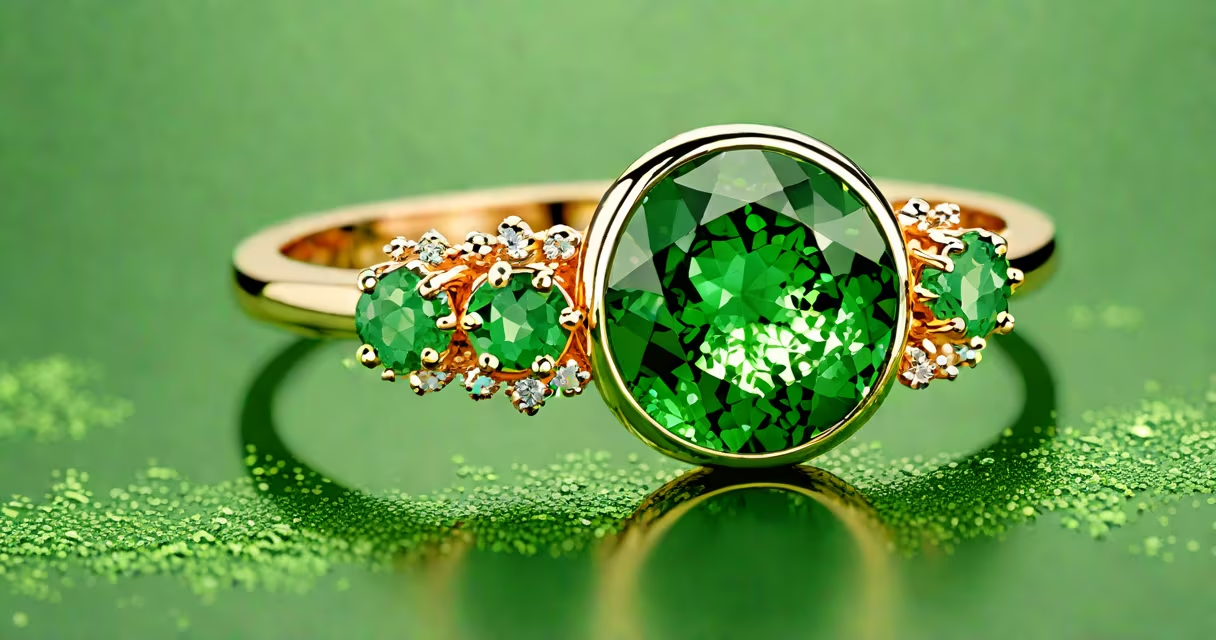
A moss agate engagement ring uses a naturally occurring variety of chalcedony with green, vein-like inclusions that resemble moss or ferns. The stone forms in volcanic rock cavities over thousands of years, with iron and manganese deposits creating the organic patterns. These rings blend geological history with personal symbolism, often chosen for their earthy beauty and metaphysical associations.
Moss agate is a form of microcrystalline quartz. Its green color comes from trace minerals like iron oxide and manganese, which seep into tiny fractures in silica-rich lava flows. As groundwater evaporates slowly, silica precipitates layer by layer, trapping mineral deposits that form branching, feathery patterns. The result is a stone that appears alive-like a fossilized forest preserved in glass.
Unlike synthetic stones or lab-grown alternatives, moss agate forms through natural processes. Each piece is unique. No two specimens have identical veining. This variability makes each moss agate engagement ring a one-of-a-kind artifact, shaped by geology rather than human design.
Moss agate develops in volcanic rock formations, particularly in basaltic lava tubes. Water rich in dissolved silica seeps into cracks and voids. Over time, silica crystallizes in thin layers. As this process repeats, it traps minute amounts of iron and manganese. These elements oxidize and form the green, branching structures visible in the stone.
The stone's translucency varies. Some moss agate is nearly opaque, with dense green veins. Others are semi-transparent, allowing light to pass through and show the internal patterns. The most prized pieces show fine, delicate branching lines that resemble actual moss or lichen. They're often cut into cabochons-smooth, domed surfaces-to emphasize the visual texture.
Geologists classify moss agate as different chalcedony, which itself is a subset of microcrystalline quartz. Chalcedony includes carnelian, onyx, and sard. Moss agate differs from these because of its distinct inclusions. While carnelian contains iron oxide giving it red-orange hues, moss agate's green tones come from different mineral interactions.
Jewelers select moss agate based on clarity, color saturation, and pattern complexity. The following table outlines common classifications:
| Type | Color & Pattern | Common Use | Price Range (per carat) |
|---|---|---|---|
| High-contrast | Dense green veins on white or gray base | Cabochon settings, statement rings | $15-$30 |
| Translucent | Faint, feathery lines in pale green | Delicate bands, earrings, pendants | $10-$20 |
| Black matrix | Dark background with bright green inclusions | Modern minimalist designs | $25-$40 |
Most moss agate used in engagement rings comes from India, Brazil, or the United States. Indian specimens often feature high contrast and are widely available. Brazilian moss agate tends to be more translucent, with subtle patterns. U.S.-mined material, especially from Oregon, is rarer and sometimes sold as collectible specimens.
When setting moss agate, jewelers avoid faceting. The stone's internal structure doesn't refract light like diamonds or emeralds. Instead, it's polished into a smooth dome. This preserves the natural appearance and prevents cracking during wear. Common metals include sterling silver, rose gold, and platinum. Rose gold enhances the green tones, making the inclusions appear more vivid.
People choose moss agate engagement rings for their deep symbolic resonance. The stone represents renewal, harmony, and emotional balance. According to the Gemological Institute of America (GIA), moss agate is associated with grounding energy and resilience. It's believed to support emotional stability during life transitions-making it ideal for marriage, a major milestone.
One client I met at a craft fair in Portland wore a moss agate ring she'd inherited from her grandmother. The stone had a complex network of green lines, like a river system frozen in time. She said it reminded her of hiking trails in the Cascades. "It feels like home," she told me. "Like the earth is holding my promise." That moment confirmed what research shows: people connect emotionally to natural materials more deeply than synthetic ones.
Unlike traditional diamond rings, moss agate rings don't follow a single aesthetic standard. They suit bohemian, rustic, or eco-conscious styles. A 2023 survey by the National Jewelry Association found that 68% of millennials prefer gemstones with natural origins over lab-created options. Moss agate ranked among the top five choices for alternative engagement rings.
Moss agate is often mistaken for malachite. Both are green and banded, but malachite is a copper carbonate mineral. It's softer (3.5-4 on the Mohs scale) and prone to cracking. Moss agate is harder (6.5-7), making it more durable for daily wear. Malachite also fades under UV light; moss agate does not.
Another misconception: moss agate is sometimes called "tree agate." This is incorrect. Tree agate is a term used for a different type of agate with brown or black dendritic inclusions. It's usually found in Arizona and Nevada. The green color and organic branching patterns distinguish moss agate from tree agate.
Some online retailers label any green stone as "moss agate." This misrepresentation harms authenticity. True moss agate must show fibrous, branching inclusions formed by mineral deposition. Artificially dyed stones lack this structure. Always verify origin and use a jeweler's loupe to inspect the stone's internal texture.
In 2022, a couple in Asheville, North Carolina, commissioned a custom moss agate ring. The man collected the stone during a hike near the Blue Ridge Parkway. He brought it to a local artisan who cut and polished it into a 12mm cabochon. The ring was set in recycled 14k rose gold with a brushed finish. The band features tiny engraved leaves along the sides.
The couple chose this design because they both work in environmental conservation. The stone's green veins mirrored the forest canopy they protect. The ring cost $1,450-$800 for the stone, $450 for labor, and $200 for materials. It took six weeks to complete. The woman said, "It's not just a ring. It's a story we carry every day."
This example illustrates how moss agate engagement rings go beyond aesthetics. They reflect values, memories, and personal journeys. The stone becomes a vessel for meaning.
When worn, a moss agate engagement ring connects the wearer to centuries of natural formation. It's not just a piece of jewelry-it's a fragment of Earth's quiet artistry, worn close to the heart.