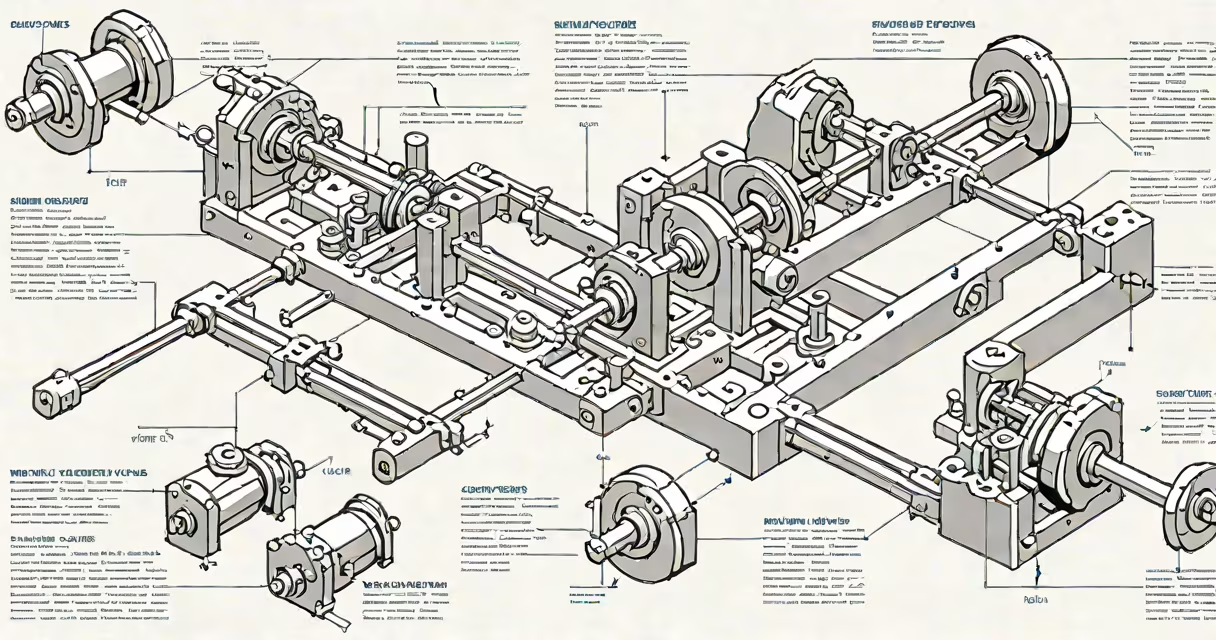
Basic mechanical engg is the study of forces, motion, energy transfer, and material behavior in physical systems, forming the foundation for designing and analyzing machines, structures, and mechanical processes. It applies physics and mathematics to solve practical problems involving movement, strength, and efficiency.
This field emerged from centuries of observation and experimentation, evolving into a structured discipline during the Industrial Revolution. Today, it underpins everything from car engines to elevators and robotic arms. Engineers use basic mechanical engg to predict how objects will behave under load, how systems will move, and how to improve performance while minimizing failure risk.
At its core, basic mechanical engg models real-world interactions using equations derived from Newton's laws of motion and conservation principles. These models quantify how forces affect bodies at rest or in motion, how energy transforms between forms, and how materials respond to stress.
For example, when a bridge supports traffic, engineers calculate the internal stresses in beams using static equilibrium equations. They verify that the maximum stress remains below the yield strength of steel to prevent permanent deformation. This process relies on precise measurements and known material properties.
A key concept is free-body diagrams-visual tools that isolate an object and show all external forces acting on it. By drawing these, engineers can apply ΣF = 0 for static systems or ΣF = ma for accelerating ones. These steps turn vague intuition into testable predictions.
Basic mechanical engg rests on several interdependent domains. The most essential are statics, dynamics, thermodynamics, materials science, and fluid mechanics. Each addresses a different aspect of mechanical behavior.
| Domain | Focus | Real-World Application |
|---|---|---|
| Statics | Forces in stationary systems | Designing building supports |
| Dynamics | Forces causing motion | Calculating car acceleration |
| Thermodynamics | Heat and work conversion | Optimizing engine efficiency |
| Materials Science | Strength, elasticity, fatigue | Selecting steel grades for gears |
| Fluid Mechanics | Flow of liquids and gases | Designing water pumps |
These areas are not isolated. A piston engine combines dynamics (moving parts), thermodynamics (fuel combustion), materials science (cylinder wear), and fluid mechanics (air intake flow). Success depends on integrating all aspects correctly.
Basic mechanical engg enables the design of safe, efficient, and reliable systems. It appears in manufacturing, automotive development, HVAC systems, robotics, and aerospace. Without it, complex machinery would fail unpredictably.
Consider a bicycle chain drive. Engineers analyze the tension in the chain using statics. They model how torque transfers from pedals to rear wheel via sprockets. They select chain material based on tensile strength and fatigue resistance. They ensure the gear ratio provides enough speed and power for hill climbing. All these decisions rely on basic mechanical engg principles.
One non-obvious fact: many failures stem not from incorrect math, but from poor assumptions. For example, assuming a bolt will fail by shear when it actually fails by bending due to misalignment. Correct modeling requires understanding both geometry and loading direction.
Basic mechanical engg is often confused with advanced topics like finite element analysis (FEA) or computational fluid dynamics (CFD). While those tools build on basic principles, they are specialized extensions. You don't need FEA to understand why a shelf collapses under weight-it's a statics problem.
Another misconception is that mechanical engg is purely theoretical. In reality, it demands hands-on testing. I once built a small-scale wind turbine for a student project. Calculations predicted 12 watts output at 5 m/s wind speed. Actual tests yielded only 6 watts. The difference came from unaccounted friction in the bearing and air turbulence near the ground. Theory guided the design, but real-world validation was essential.
Some assume that all mechanical systems require high precision. But many succeed with tolerance. A washing machine agitator operates reliably despite loose fits and variable loads. The design uses damping and inertia to absorb irregular forces. This shows that simplicity and robustness often outperform complexity.
Let's walk through a real calculation. Suppose a worker uses a 1.5-meter crowbar to lift a 300 kg rock. The fulcrum is placed 0.3 meters from the rock. What force must the worker apply at the far end?
Use the principle of moments: torque balance around the fulcrum. Torque = force × distance from pivot.
Let F be the applied force. The resisting torque is:
300 kg × 9.81 m/s² × 0.3 m = 882.9 N·mThe applied torque must equal this:
F × 1.2 m = 882.9 N·mSolve for F:
F = 882.9 / 1.2 ≈ 735.75 NThe worker must apply roughly 736 newtons-about 75 kg of force. This is manageable with proper use.
This example shows how basic mechanical engg turns a physical task into a solvable equation. It reveals trade-offs: longer levers reduce required effort but demand more space. Design choices depend on context.
Understanding basic mechanical engg allows you to assess whether a machine will function as intended. It's not just for engineers. Anyone involved in construction, maintenance, or product design benefits from grasping these ideas. For deeper exploration, what does mechanical mean in broader contexts like systems integration or automation.