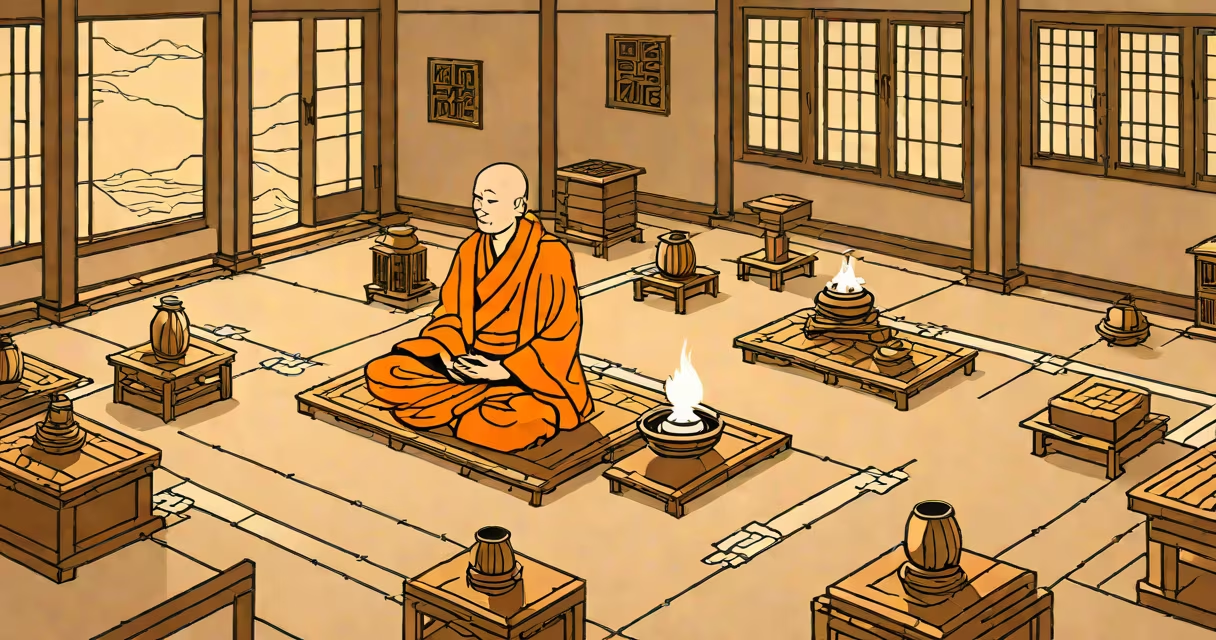
Zen Buddhism is a school of Mahayana Buddhism that emphasizes direct experience of enlightenment through seated meditation (zazen), disciplined inquiry into paradoxical statements (koans), and mindful living in the present moment. Rooted in ancient Indian Buddhist traditions but shaped by Chinese Chan and Japanese cultural values, it prioritizes practice over scripture.
Zen emerged in China around the 6th century CE as Chan Buddhism, later spreading to Japan in the 12th century. The term "Zen" derives from the Sanskrit word *dhyāna*, meaning meditation. Unlike many religious paths that rely on ritual or doctrinal study, Zen teaches that awakening arises not from belief but from sustained attention and embodied awareness. This focus on immediate insight distinguishes it from other forms of Buddhism.
The practice begins with sitting in stillness-zazen-typically in a formal posture such as lotus or half-lotus. Practitioners sit with spine upright, eyes slightly open, focused on the breath. This posture is not merely physical; it embodies alert surrender. Over time, the mind settles, and habitual thinking patterns dissolve. As D.T. Suzuki, a leading 20th-century scholar of Zen, wrote, "The essential point of Zen is to see one's true nature."
Zen operates on the principle that enlightenment cannot be described-it can only be realized. Words fail because they create separation between subject and object. Instead, Zen uses methods designed to break conceptual thinking. The most common is the koan: a paradoxical riddle posed by a teacher. For example, "What is the sound of one hand clapping?" or "Does a dog have Buddha-nature?" These are not puzzles to solve logically. They are tools to exhaust the rational mind and open space for intuitive understanding.
When a student encounters a koan, they do not analyze it. They carry it throughout daily life-while walking, eating, working. The goal is not to find an answer but to stop seeking one. In this state, insight may arise unexpectedly. A famous anecdote involves the monk Joshu, who was asked whether a dog has Buddha-nature. His response: "Mu." This single syllable defies logic and becomes a doorway to non-dual awareness.
Another key element is the role of the teacher-student relationship. In Zen, transmission happens not through lectures but through direct interaction. Teachers observe students' posture, breathing, and responses during meditation. They may strike a student with a bamboo stick (a kyosaku) to correct drowsiness or distraction. This physical feedback reinforces presence and discipline. As the 13th-century Japanese master Eisai wrote, "The way of Zen is not taught-it is lived."
Zen practice centers on three pillars: zazen (seated meditation), kinhin (walking meditation), and daily work (samu). These are not optional extras-they form the structure of monastic and lay life alike.
| Practice | Description | Duration & Frequency | Example Setting |
|---|---|---|---|
| Zazen | Formal seated meditation focusing on breath and posture. Emphasis on non-effort and non-judgment. | 30-90 minutes, twice daily in monasteries. | Temple hall during morning and evening sessions. |
| Kinhin | Slow walking meditation. Maintains mindfulness while moving. | 5-10 minutes between zazen periods. | Between meditation sittings in a Zen center. |
| Samu | Work practice-cleaning, cooking, gardening. Done with full attention. | Several hours daily in monasteries. | Preparing meals in a monastery kitchen. |
A lesser-known fact: Zen does not require belief in rebirth or karma to participate. While these concepts exist in broader Buddhist thought, Zen focuses on the immediacy of now. You don't need to accept metaphysical ideas to sit. As Thich Nhat Hanh, a Vietnamese Zen master, stated, "The present moment is the only moment we truly have."
Many assume Zen is about emptiness, silence, or detachment. But it is not passive withdrawal. Zen encourages full engagement with life. The monk who sweeps the floor does so with complete attention-not to achieve purity, but because sweeping is the act itself. There is no goal beyond the action.
Another misconception is that Zen is exclusively for monks. While monastic communities preserve traditional forms, lay practitioners worldwide engage in daily zazen. In cities like New York, Tokyo, and Berlin, weekly meditation groups meet in community centers. Some companies offer Zen-based mindfulness training to reduce employee burnout. Google's "Search Inside Yourself" program draws from Zen principles, though it adapts them for corporate settings.
People often confuse Zen with mindfulness meditation popularized in Western psychology. Both involve present-moment awareness, but Zen includes deeper philosophical commitments. Mindfulness may teach you to notice your thoughts. Zen asks you to stop identifying with them. Where mindfulness reduces stress, Zen seeks liberation from suffering at its root.
In 2018, I attended a week-long retreat at a Zen monastery in Kyoto. I arrived expecting peace. What I experienced was discomfort-physical pain from sitting, mental resistance, and frustration. On the third day, my teacher handed me a koan: "Who is it that hears the bell?" I tried to answer intellectually. He said nothing. That night, during zazen, the sound of the bell rang-and I stopped trying. The question dissolved. Not because I had an answer, but because the search ended.
This moment wasn't spiritual triumph. It was ordinary. The bell rang. I heard it. No one else needed to know. That's the nature of Zen: not extraordinary, but deeply real.
If you're preparing for a conversation about Zen, such as in a job interview or personal discussion, how to introduce Zen in a professional setting can help frame it. Focus on its practical benefits: improved concentration, emotional regulation, and clarity under pressure.
An introduction to Zen Buddhism reveals a tradition that values direct experience over theory, stillness over noise, and simplicity over complexity. It is not a philosophy to be studied-it is a way to live. Whether practiced in a temple or during a commute, Zen invites you to be fully here, now.