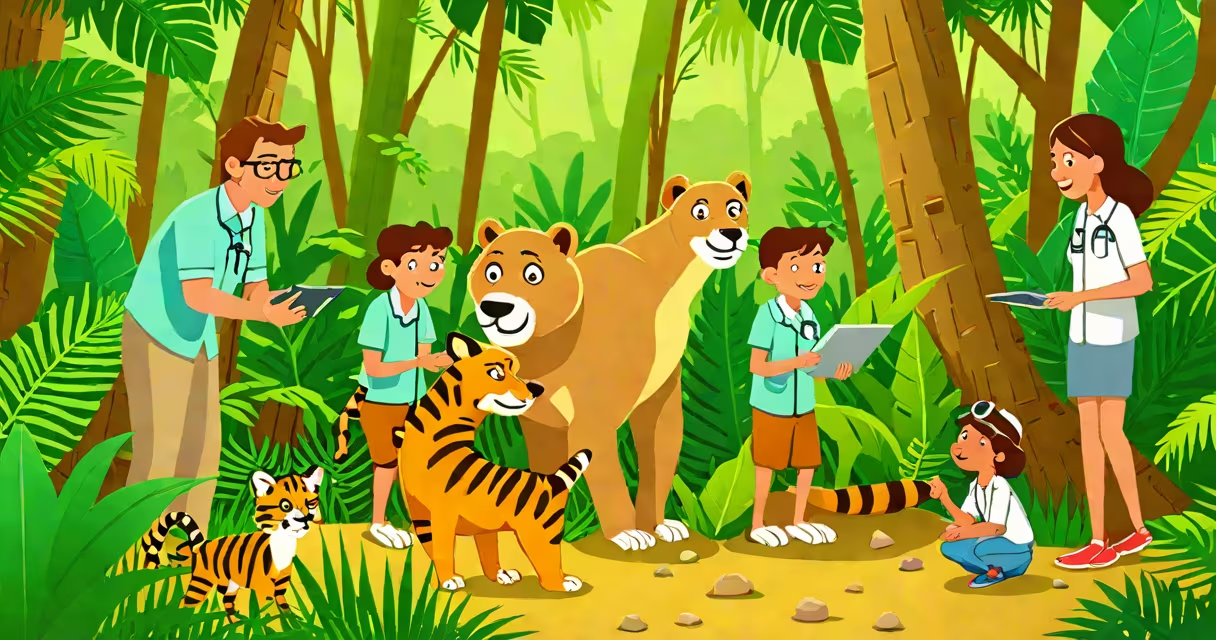
Animal Planet Kids and Us is a live-action educational television series that takes children on real-world expeditions to explore animal behavior, habitats, and conservation efforts through hands-on experiences and expert interviews.
The show centers on young explorers who travel to diverse global locations-from rainforests to deserts-to meet scientists, observe animals in their natural environments, and participate in field research. Each episode combines documentary-style filming with narrative storytelling, making complex ecological concepts accessible to elementary and middle school audiences.
Produced by Discovery Education and aired on Discovery Family, the series aligns with Next Generation Science Standards (NGSS), ensuring curriculum relevance. Episodes typically run 22 minutes and include interactive segments where kids ask questions, conduct simple experiments, and learn how human actions impact wildlife.
Unlike animated or dramatized children's shows, Animal Planet Kids and Us uses actual footage from expeditions. Cameras follow teams of students and biologists as they track animal movements, collect soil samples, or monitor nesting sites. This authenticity builds trust and encourages critical thinking.
Each episode begins with a central question-"Why do meerkats stand on their hind legs?" or "How do octopuses change color?"-then follows a structured exploration process: hypothesis formation, observation, data collection, and conclusion. This mirrors the scientific method used in classrooms.
For example, in Season 1, Episode 5 ("The Great Migration"), a group of kids traveled to Tanzania to study wildebeest migration patterns. They used GPS trackers to map herd movement, recorded temperature changes in the savanna, and interviewed a local conservationist about poaching threats. The final segment showed how their data helped estimate population shifts over time.
The show divides each episode into three core segments: Introduction (question setup), Fieldwork (hands-on activities), and Wrap-up (discussion and reflection). This format supports cognitive scaffolding, helping younger viewers build mental models step by step.
Topics covered include predator-prey relationships, animal communication, adaptation, biodiversity, and climate change impacts. For instance, an episode on Arctic foxes explored thermoregulation by measuring fur insulation levels using infrared thermography-a technique used by real researchers at the University of Alaska Fairbanks.
Episodes also show careers in science. Children meet marine biologists, wildlife photographers, and ecologists who explain how they chose their paths. These segments aim to inspire STEM interest early, particularly among underrepresented groups in science.
Animal Planet Kids and Us features four distinct episode types, each designed to teach different skills:
| Type | Purpose | Example Topic | Duration |
|---|---|---|---|
| Field Investigation | Teach observation and data recording | Tracking frog calls in a wetland | 22 min |
| Career Spotlight | Introduce science professions | Working with a beekeeper in Costa Rica | 22 min |
| Conservation Challenge | Explore solutions to environmental problems | Restoring coral reefs in Fiji | 22 min |
| Myth Busting | Correct misconceptions about animals | Debunking the "shark attack" myth in Australia | 22 min |
These formats ensure variety while maintaining consistent learning objectives. The Conservation Challenge episodes, for example, often feature measurable outcomes-like planting 50 native trees or removing 120 pounds of plastic from a beach-which gives kids a tangible sense of impact.
Many assume Animal Planet Kids and Us is a fictional show with actors. It is not. All participants are real children and professionals. The production team selects schools and communities based on geographic diversity and prior engagement with environmental programs.
Another misconception is that the show promotes fear of wild animals. On the contrary, it emphasizes respect and coexistence. An episode on African elephants focused on how human-wildlife conflict arises from habitat loss-not aggression-and demonstrated non-lethal deterrent methods used in Kenya.
A lesser-known fact: the show avoids anthropomorphizing animals. Scientists explain behaviors using evidence, not emotions. For example, when discussing wolf pack dynamics, the host says, "Wolves stay together because they share food and protect each other's young," not "They're loyal family members." This preserves scientific accuracy for young learners.
In 2022, Discovery Education reported that 68% of teachers using Animal Planet Kids and Us in classrooms saw improved student engagement in science topics. A survey of 1,200 parents found 74% believed the show increased their child's curiosity about nature.
I've watched several episodes with my nephew, who initially thought all animals were either dangerous or cute pets. After watching the episode on axolotls in Mexico City's canals, he asked to visit a local stream to look for amphibians. He later brought home a notebook filled with drawings and notes on water quality and species presence-real field journal habits forming.
Teachers often use the show's companion website for lesson planning. It includes printable worksheets, discussion prompts, and extended activities. One teacher in Oregon adapted the "Beetle Census" episode into a month-long classroom project involving daily observations and data charts.
The series is used in U.S. public and private elementary schools, homeschool curricula, and after-school science clubs. Its alignment with NGSS makes it a recommended resource by state education departments in California, New York, and Texas.
Libraries and science centers also screen episodes during summer reading programs. The Denver Public Library hosted a "Wildlife Week" event featuring a screening of the "Penguin Parents" episode, followed by a hands-on activity where kids built miniature ice shelters using recycled materials.
Parents value the show's balance between entertainment and education. Unlike many children's programs that rely on exaggerated voices or cartoonish effects, Animal Planet Kids and Us maintains a calm, observational tone. This reduces sensory overload and supports sustained attention in neurodivergent learners.
Animal Planet Kids and Us delivers accurate, engaging science content through authentic exploration. It doesn't simplify facts-it invites kids to discover them. The series stands out in children's media by prioritizing real data, real people, and real places over scripted narratives.