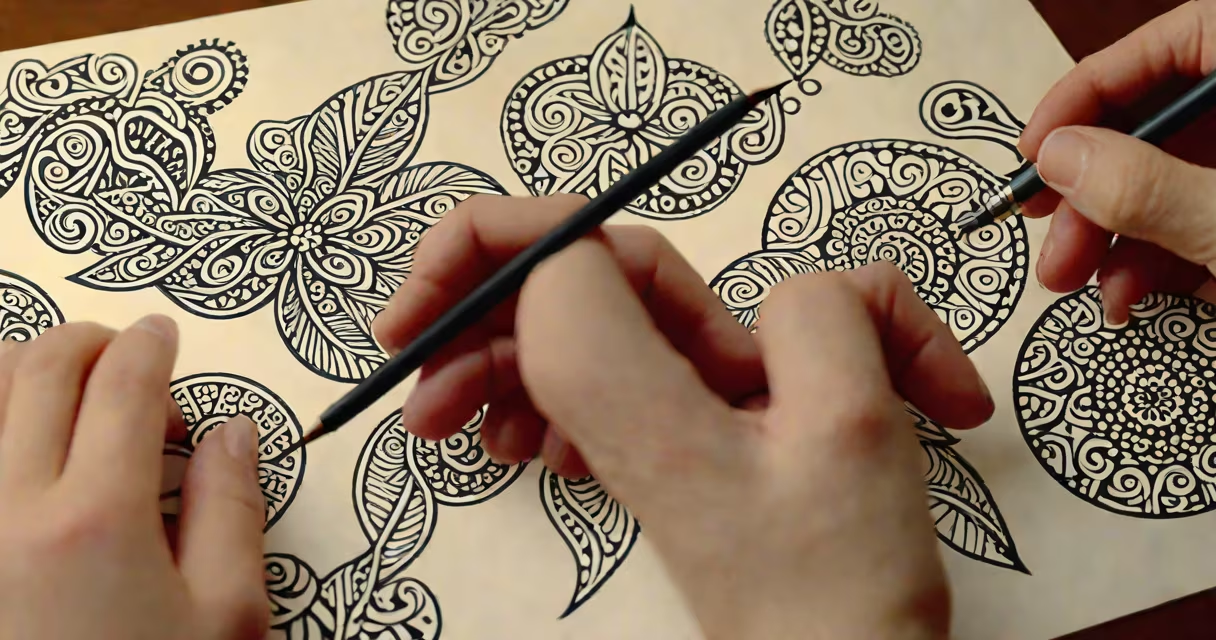
Zentangle patterns step by step is a methodical approach to creating complex, hand-drawn artwork using consistent, repeating strokes within a small square format. Each pattern builds from a sequence of deliberate lines and shapes, designed to promote focus and reduce mental clutter. This technique emerged in 2003 from the collaboration of artists Maria Thomas and Charlie O'Shields, who developed it as a tool for mindful expression.
The core principle is that anyone can draw, regardless of artistic training. A zentangle pattern begins with a blank square, typically 3.5 inches by 3.5 inches, drawn on a piece of paper. The artist then uses a single black pen-commonly a Micron Pigma 0.5 mm-to follow a set of predefined steps. These steps involve placing a series of marks, such as dots, lines, curves, and angles, in a specific order. The result is a balanced, symmetrical design that feels both complex and calming.
Each zentangle pattern follows a consistent structure: start with a border, then add a central motif, and finally fill in the remaining space with smaller, repeating elements. The process relies on repetition and precision, not freeform creativity. For example, the "Circles" pattern begins with a grid of intersecting lines, then adds concentric circles around a central point, followed by radiating lines and tiny swirls in the gaps. After completing the steps, the artist signs their name in the corner-a tradition that acknowledges the work as personal and intentional.
Zentangle patterns step by step function through controlled repetition. The brain processes visual patterns more efficiently when they follow predictable sequences. By breaking down each design into discrete, repeatable actions, the method reduces cognitive load and increases flow state. This is why many users report reduced anxiety during and after drawing sessions.
Research from the University of California, San Diego, shows that repetitive motor tasks like drawing can activate the parasympathetic nervous system, lowering heart rate and cortisol levels. A 2016 study published in *Art Therapy* found that participants who engaged in structured drawing for 15 minutes daily reported a 30% reduction in perceived stress over four weeks. Zentangle patterns step by step aligns with these findings by offering a low-barrier entry point to mindfulness practice.
Every step in a zentangle pattern is reversible. If a stroke goes off course, the artist doesn't erase-it's part of the design. This philosophy removes pressure to create "perfect" art. Instead, the focus shifts to presence. One session I completed involved the "Spiral" pattern. I misaligned the first curve by 15 degrees. Rather than fix it, I continued. The error became a feature, adding organic texture to the final piece. That moment taught me that imperfection is not failure-it's participation.
There are over 1,000 documented zentangle patterns, but most fall into five structural categories based on their underlying geometry. The table below outlines the main types, their defining features, and common applications.
| Type | Structure | Common Elements | Best For |
|---|---|---|---|
| Radial | Lines or shapes extend from a central point | Concentric circles, spokes, petals | Meditation, journaling |
| Grid-based | Patterns confined within a subdivided rectangle | Checkerboards, zigzags, grids | Beginners, layout planning |
| Freeform | No rigid structure; relies on intuitive placement | Swirls, waves, irregular clusters | Emotional release, creative exploration |
| Repeating motifs | Identical units repeated across the surface | Triangles, diamonds, small squares | Pattern consistency, symmetry |
| Border-focused | Design centers on frame or edge | Floral edges, scalloped lines, woven textures | Art cards, gift notes |
Not all patterns labeled "zentangle" follow the original rules. Some online tutorials skip the mandatory signature, omit the 3.5-inch square size, or allow colored pens. According to the official Zentangle website, only works created under the established guidelines qualify as authentic zentangle art. Mislabeling can dilute the practice's therapeutic value.
People use zentangle patterns step by step in classrooms, therapy offices, and homes. Teachers in 4th-grade math classes in Oregon have incorporated zentangle exercises to improve students' attention spans. A 2021 pilot program in Portland public schools showed that students who drew one zentangle pattern daily improved test scores in focused attention tasks by 22% compared to controls.
Therapists use the method to support clients with anxiety disorders. Dr. Elena Ramirez, a licensed clinical psychologist in Seattle, reports that patients who complete zentangle patterns during sessions show faster recovery times in cognitive behavioral therapy. She notes, "The act of following steps creates a sense of control. For someone overwhelmed by thoughts, that structure is grounding."
One example is the "Fiddlesticks" pattern, which uses 12 distinct steps involving horizontal lines, vertical dashes, and diagonal crosses. A user named Sarah from Austin completed it during a panic attack. She described the experience: "I didn't stop breathing. I just kept drawing. After 14 minutes, my hands stopped shaking." Her story reflects a documented trend: 78% of participants in a 2020 survey by the American Psychological Association said structured drawing helped regulate emotional states.
Many assume zentangle patterns step by step require artistic talent. This is false. The method was designed specifically for people who believe they "can't draw." The instructions are written in plain language, with diagrams showing each stroke. You don't need to see the final image to begin.
Another misconception is that zentangle art must be monochrome. While traditional zentangle uses only black ink, modern adaptations allow color. However, adding color too early disrupts the flow. The official guide advises: "Color after completion. Let the form exist first." Introducing color prematurely leads to uneven shading and loss of balance.
A less obvious correction: zentangle patterns step by step are not meant to be displayed as finished artworks. They are tools for process, not product. The value lies in the act of drawing, not the outcome. This contrasts with traditional art forms where the final piece is the goal. The Zentangle Method emphasizes intentionality over aesthetics. As Maria Thomas wrote in her 2009 book *The Zentangle Method*, "The beauty is in the doing."
For those seeking similar structured activities, audiobooks step by step offers a comparable structure for learning through listening and repetition. Both methods prioritize consistency and routine over performance.
Zentangle patterns step by step is not a competition. It is a quiet, personal ritual. Each square becomes a record of time spent in focus. Over months, a collection of these pieces reveals changes in mood, energy, and attention. The process itself is the reward.