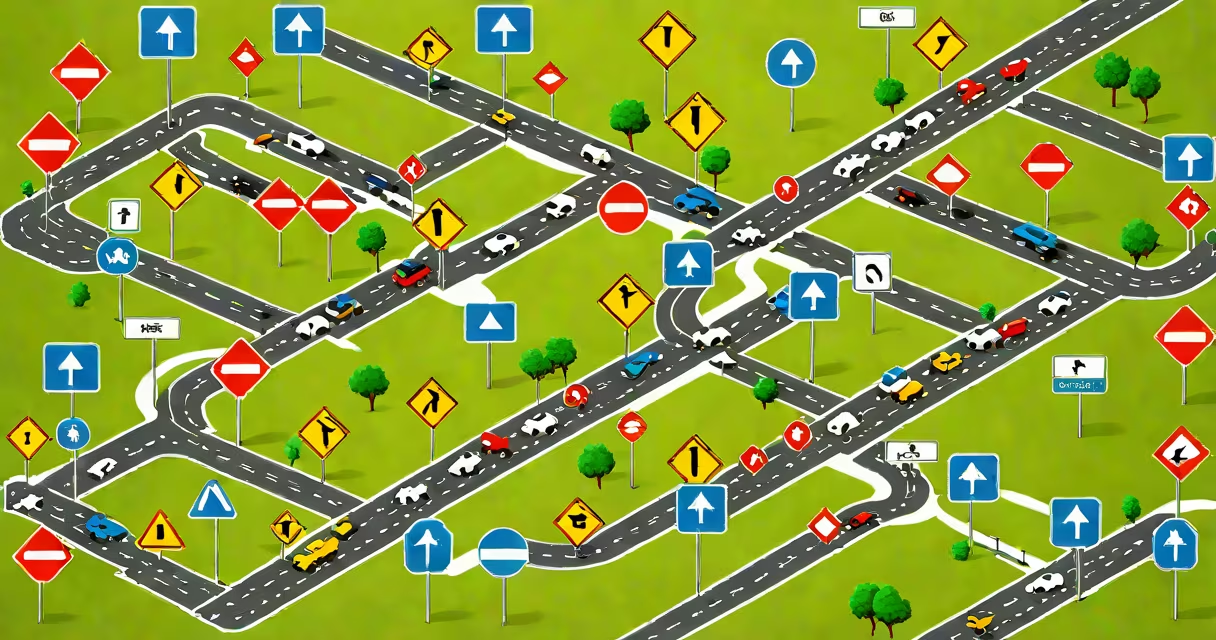
Road signs convey critical information through standardized colors, shapes, and symbols to guide drivers safely. Each sign type serves a distinct purpose based on regulatory, warning, or informational intent.
Regulatory signs are typically rectangular or circular with white backgrounds and black text or symbols. They enforce laws such as speed limits, stop requirements, and lane usage. Warning signs are diamond-shaped with yellow backgrounds and black symbols, indicating hazards like sharp curves, school zones, or animal crossings. Guide signs are green or blue with white text, directing travelers to destinations, exits, and services.
The Federal Highway Administration (FHWA) mandates sign design through the Manual on Uniform Traffic Control Devices (MUTCD). This document standardizes signage across all U.S. states and territories. For example, a red circle with a diagonal line through a bicycle symbol means "bicycles prohibited," while a yellow triangle with a black exclamation mark signals "uneven pavement ahead."
Signs rely on visual cues rather than text to ensure instant recognition. A red octagon always means "stop." A yellow diamond warns of danger. A green rectangle with white letters indicates a route or exit. These conventions reduce cognitive load during high-speed travel.
Color coding is consistent nationwide. Red denotes prohibition or emergency actions. Yellow signals caution. Green shows direction and guidance. Blue provides information about services like rest areas or hospitals. Orange, used for construction zones, alerts drivers to temporary changes in traffic flow.
Shape matters too. Triangles signal warnings. Circles indicate regulations. Rectangles deliver directions. The MUTCD specifies that all signs must be legible from 500 feet away under daylight conditions. This requirement ensures clarity even at high speeds.
Understanding the most frequently encountered signs prevents accidents and reduces driver stress. Below is a breakdown of major categories:
| Color & Shape | Meaning | Example |
|---|---|---|
| Red circle with diagonal line | Prohibition | No left turn |
| Yellow diamond with black symbol | Warning | Deer crossing ahead |
| Green rectangle with white lettering | Guide/Direction | Interstate 95 North |
| Blue rectangle with white icon | Service information | Rest area 2 miles |
| Orange rectangle with black text | Construction zone | Work zone ahead - slow down |
Orange signs are especially important during infrastructure projects. They appear at least 500 feet before work zones and remain until the project ends. According to the FHWA, 60% of construction zone fatalities occur due to failure to recognize or obey orange signs.
A common misconception is that all yellow signs mean "danger." While many are warnings, others indicate upcoming changes in traffic patterns. For instance, a yellow diamond with a black arrow pointing down means "merge left" - not a hazard, but a directional instruction.
Drivers who misread signs often make split-second decisions with serious consequences. In 2022, the National Highway Traffic Safety Administration (NHTSA) reported that 18% of crashes involved confusion over signage. Most occurred at intersections with multiple conflicting signs.
For example, a driver approaching a four-way intersection may see a "yield" sign on the left and a "stop" sign on the right. Confusion arises when both signs are visible but only one applies. The MUTCD clarifies that the sign closest to the intersection controls traffic flow. A yield sign takes precedence over a stop sign when posted at the same location.
I once observed a collision in suburban Atlanta where a motorist failed to notice a "school zone" sign with flashing lights. The sign was yellow with black text and located 300 feet before the school entrance. The driver entered at 35 mph, striking a child walking across the crosswalk. The police report noted that the sign had been properly installed and illuminated. The accident resulted from ignoring a standard warning sign.
Many drivers assume that all signs with arrows are directional. Not true. Arrows on regulatory signs indicate restrictions. A red circle with a black arrow pointing left means "no left turn." A green arrow on a traffic light means "go." The context determines meaning.
Another error is assuming that all white-on-blue signs are directions. Some are informational, such as "rest area" or "hospital 2 miles." Others are regulatory, like "no parking" or "no U-turn." The absence of a symbol doesn't imply safety - it only means the sign doesn't regulate movement.
Orange signs are frequently overlooked because they're temporary. Yet they carry legal weight. The FHWA requires that construction zones maintain minimum lighting levels and sign spacing. Failure to comply results in fines and liability in case of injury.
When in doubt, treat any unfamiliar sign as a warning. Always reduce speed and assess the situation. If you're unsure what a sign means, pull over safely and consult a map or navigation app. The safest driver isn't the fastest - it's the one who reads the road correctly.