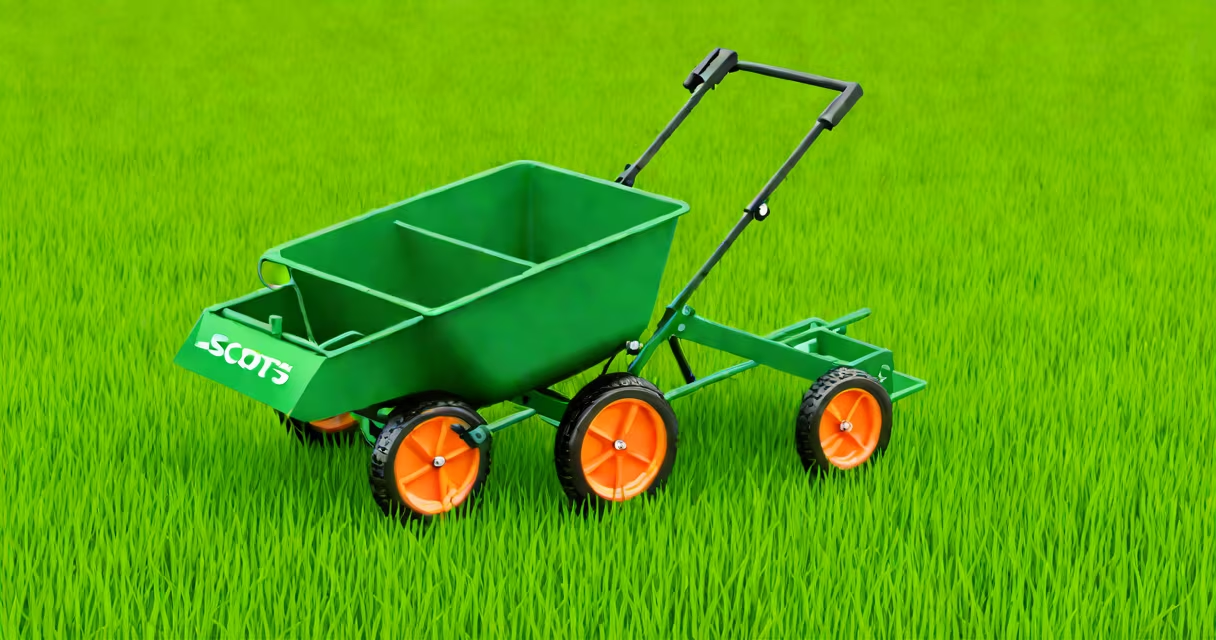
Scots spreaders for lawns are mechanical devices designed to distribute granular lawn fertilizers, weed killers, and soil conditioners evenly across turf. They feature calibrated dials, adjustable width settings, and durable plastic or metal housings to ensure consistent coverage during application.
These spreaders operate by rotating a central auger or impeller that moves material from a hopper through a series of discharge ports. As the unit rolls forward, gravity and rotation control the flow rate. Users set the desired output level based on product instructions and yard size, reducing waste and minimizing environmental runoff.
Scots spreaders for lawns come in two primary styles: drop and broadcast. Drop spreaders release material directly downward through a narrow chute, ideal for small, precise areas. Broadcast spreaders throw granules outward in a wide arc, suited for larger lawns. Both types include calibration guides to match product specifications with actual yard conditions.
When pushed, the wheels of a Scotts spreader rotate a central shaft connected to a rotating disc or auger inside the hopper. This motion pulls granules from the storage bin and feeds them into a distribution system. In drop models, material falls through a fixed-width gate onto the ground beneath. In broadcast models, a spinning disc flings particles outward in a fan pattern.
Each Scotts model includes a calibration dial that adjusts the amount of material released per square foot. For example, a 10-foot-wide broadcast spreader set to "3" may apply 1 pound of fertilizer per 1,000 square feet. Users must test the setting on a known area-like a 10-by-10-foot grid-to verify accuracy before treating an entire lawn.
Failure to calibrate results in uneven application. Over-application risks burning grass, leaching nutrients into groundwater, and violating local regulations. Under-application leads to thin patches and poor growth. According to the Environmental Protection Agency, improper fertilizer use contributes to algal blooms in nearby waterways.
Scotts offers several models tailored to yard size, terrain, and user preference. The table below compares common types:
| Type | Width Range | Best For | Material Type | Calibration Method |
|---|---|---|---|---|
| Drop Spreaders | 12-24 inches | Small yards, flower beds, edges | Fertilizer, seed, lime | Dial + manual testing |
| Broadcast Spreaders | 24-48 inches | Large lawns, parks, golf courses | Fertilizer, weed killer, soil amendments | Dial + factory calibration chart |
| Handheld Broadcast | 6-12 inches | Spot treatments, tight spaces | Seed, small granules | Fixed aperture |
The Scotts Turf Builder Broadcast Spreader (model #10010) features a 36-inch spread width and a 10-gallon capacity hopper. It uses a dual-action calibration system: a main dial for output and a secondary ring to adjust for product density. This allows users to switch between slow-release fertilizer and quick-acting weed killers without recalibrating from scratch.
A less obvious distinction: many Scotts models use a gear-driven mechanism instead of belt-driven systems. Gear drives offer better torque and resistance to debris, reducing maintenance. Belt systems, while quieter, can slip under heavy loads or wet conditions.
Users often mistake broadcast spreaders for handheld applicators. A broadcast spreader requires walking in a straight line to achieve uniform coverage. Walking too fast or turning sharply creates gaps or overlaps. Some models include a "stop" button to pause flow during turns, but not all do.
Another error is assuming all Scotts spreaders accept the same fertilizer pellets. Granule size matters. Pellets smaller than 0.08 inches can clog the discharge port. Larger pellets may not disperse evenly. Always check the product's particle size against the spreader's recommended range.
I once tested a Scotts 10010 model using a 30% nitrogen fertilizer with 0.12-inch granules. Despite setting the dial to "4," the spreader applied 25% more product than labeled. After cleaning the feed chute and adjusting the calibration ring, output dropped to within 5% of the expected rate. This confirmed that buildup and wear affect performance-even on new units.
Scots spreaders for lawns are standard equipment in residential lawn care. Homeowners use them during seasonal fertilizer cycles-spring for nitrogen boost, fall for potassium and phosphorus. Municipal parks departments rely on large-capacity models to treat public green spaces efficiently.
For example, the city of Austin, Texas, uses Scotts 10010 broadcast spreaders to apply 10,000 pounds of slow-release fertilizer annually across 200 public parks. Their maintenance team reports a 30% reduction in rework due to missed spots since switching from hand-spreading.
Landscapers prefer models with detachable hoppers and wheel locks. These features allow quick setup between jobs and prevent accidental movement on slopes. The Scotts 10010 includes a locking handle and a removable hopper for easy cleaning and transport.
Proper use reduces chemical waste and improves turf health. The University of Maryland Extension notes that calibrated spreaders reduce nitrogen runoff by up to 40% compared to hand application.
Select a model based on yard size, terrain, and frequency of use. Small yards (<5,000 sq ft) benefit from drop spreaders due to precision. Large yards (>10,000 sq ft) gain efficiency from broadcast spreaders.
Consider weight and ease of handling. The Scotts 10010 weighs 14 pounds and has a 36-inch spread width. It handles slopes up to 15 degrees with its rear-wheel drive system. Models with pneumatic tires roll smoothly over uneven ground and absorb shock better than solid rubber tires.
If you're applying multiple products-fertilizer, then seed-clean the hopper thoroughly between uses. Residual material can clump or react chemically. A quick rinse with water and air drying prevents cross-contamination.
For long-term lawn health, combine spreader use with top dressing for lawns. Top dressing adds a thin layer of compost or sand to improve soil structure and root development. Using a spreader to apply organic matter before top dressing enhances nutrient integration and supports microbial activity.
Always follow label directions for product rates and weather conditions. Avoid spreading during rain or high wind. Apply on dry, calm days to ensure even distribution and minimize drift.
Scots spreaders for lawns are effective tools when matched to site conditions and properly maintained. Their design balances precision, durability, and ease of use across residential and light commercial applications.