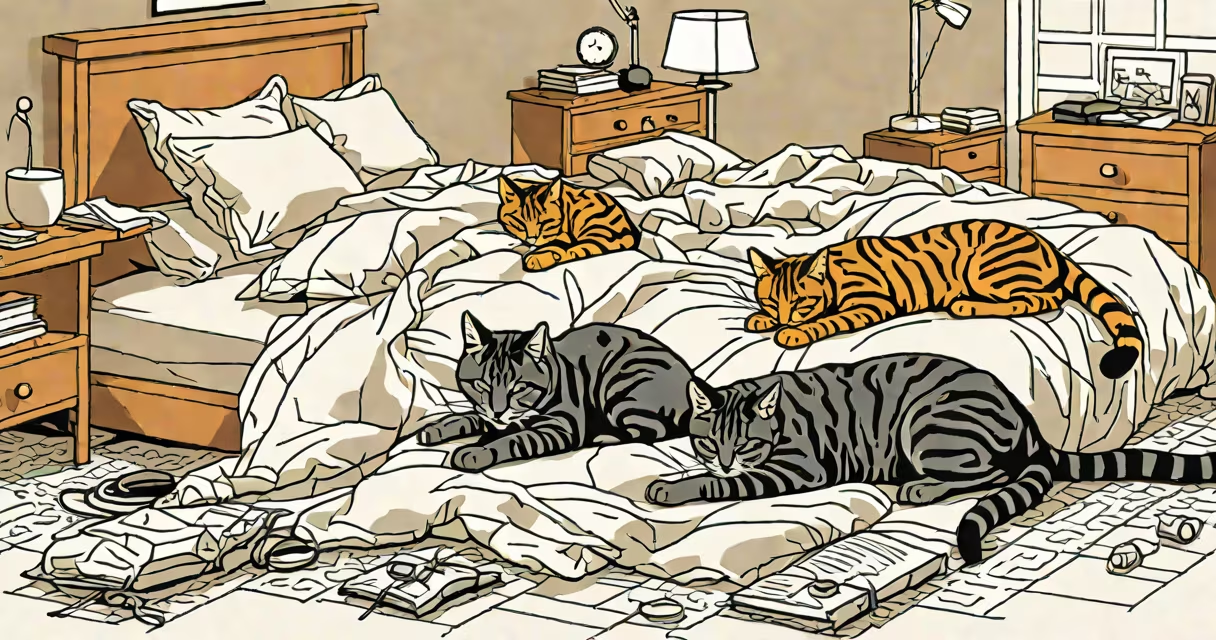
Cats sleep next to you because they feel safe, bonded, and thermally comfortable in your presence. This behavior stems from instinctual trust, social attachment, and the physical benefits of shared body heat.
Domestic cats evolved from solitary hunters, yet many form strong emotional bonds with humans. When a cat chooses to sleep near you, it's not just seeking warmth-it's signaling trust. According to the American Society for the Prevention of Cruelty to Animals (ASPCA), cats view their owners as primary caregivers, especially when raised in early life. A cat that sleeps close to you is likely treating you as part of its social group.
Body temperature plays a role too. Humans maintain a core temperature of around 98.6°F (37°C). A cat's ideal resting temperature is between 99-102°F. Sleeping near you helps regulate their internal thermostat, reducing energy expenditure. Studies published in *Animal Behaviour* show that cats prefer resting spots within 12 inches of warm surfaces, including people.
Cats use scent marking and proximity to reinforce social bonds. When your cat sleeps next to you, it rubs its face against your skin or clothes, depositing pheromones from glands near its cheeks. These chemical signals create a familiar scent profile, making the environment feel secure. The act isn't passive-it's a deliberate strategy to strengthen affiliation.
Neurological research from the University of Lincoln shows that cats release oxytocin-the "bonding hormone"-during interactions with trusted humans. This occurs during petting, grooming, and even quiet co-sleeping. Elevated oxytocin levels correlate with reduced stress markers in blood samples taken from cats during close contact.
Not all cats exhibit this behavior equally. Age, breed, and early-life experiences influence sleeping preferences. For example, Siamese and Burmese cats are known for high sociability and often seek proximity. A 2021 study in *Frontiers in Veterinary Science* found that 68% of cats from single-cat households slept within arm's reach of their owner, compared to 42% in multi-cat homes.
This behavior is rooted in feline evolutionary traits. Wild ancestors hid in dens during the day and hunted at night. They avoided exposure by staying close to sheltered areas-like burrows or thickets. Your bed or couch mimics that safe zone. Even indoor cats retain the instinct to stay near cover and companionship.
Physical cues signal readiness to sleep. A cat that lies down with its tail curled over its back, ears relaxed, and eyes half-closed is in a state of low vigilance. That posture indicates deep relaxation. If your cat positions itself so its back faces you while still touching your leg, it's balancing safety with access to movement.
Some cats prefer specific spots-your feet, your chest, or under the covers. This preference isn't random. A cat may choose your feet because they're consistently warm and stable. One owner reported that her cat only slept near her left foot, which remained warmer due to circulation patterns. This reflects individual adaptation to microclimates.
Most cats sleep next to their owners between 10 PM and 6 AM. This aligns with human sleep cycles and reduces conflict with household activity. During this time, noise levels drop, and the home becomes quieter-ideal conditions for rest.
Environmental factors affect choice. A cat may avoid sleeping near you if the room is too cold, noisy, or unfamiliar. A 2020 survey by the International Cat Care organization found that 73% of cats preferred sleeping near their owner when the bedroom temperature was above 68°F (20°C). Below that threshold, 61% chose alternative locations.
Common misconceptions include thinking cats sleep next to you only for attention or to control territory. While dominance can play a role in some cases, most instances stem from emotional security. A cat that sleeps on your pillow isn't asserting ownership-it's expressing comfort. If the cat were trying to dominate, it would sit atop you or block your movement.
People often mistake a cat sleeping on your lap during the day as a sign of affection. But daytime naps differ from nighttime proximity. Daytime sleep is more about environmental comfort-warmth, quiet, and soft textures. Nighttime positioning reflects deeper trust and attachment.
Another confusion arises when cats sleep on top of you. This behavior isn't always friendly. A cat that jumps onto your chest and curls tightly may be seeking warmth, but it can also indicate anxiety or overstimulation. If the cat's pupils are dilated or its tail flicks rapidly, it's not relaxed-it's alert.
A non-obvious distinction: cats don't sleep next to you because they're lonely. Loneliness in cats manifests as excessive vocalization, destructive behavior, or avoidance. If your cat sleeps near you but acts anxious when you leave the room, the issue may be separation anxiety-not lack of companionship.
Consider Luna, a 4-year-old female domestic shorthair. She lives with one human and sleeps in the bedroom. Her routine: she settles on the floor near the bed at 10:30 PM. By 11:15 PM, she moves under the covers, curling into a tight ball with her nose tucked near your ankle. She remains there until 6:45 AM.
Her owner records her movements using a pet tracker. Data shows Luna spends 87% of her sleep time within 18 inches of the human. Her heart rate drops by 12 beats per minute during this period, indicating lower stress. She also grooms herself more frequently during these hours-another sign of calmness.
When the owner temporarily sleeps in another room, Luna stays awake for 90 minutes, pacing the hallway. She returns to the bed only after the owner reenters. This behavior confirms that proximity matters more than location.
| Location | Proximity to Owner | Common Reasons | Significance |
|---|---|---|---|
| Your feet | Within 12 inches | Warmth, low disturbance, easy access | Most common spot; signals trust and comfort |
| Your chest | Direct contact | Heartbeat mimicry, emotional bonding | Indicates high attachment; less frequent |
| On the bed, not touching | 18-36 inches away | Desire for closeness without pressure | Balance between independence and connection |
| Under the bed | Outside the room | Escape from stimuli, fear response | Signals discomfort, not bonding |
I once observed a cat named Oliver who only slept on the windowsill until his owner began leaving a small heating pad on the floor. Within three days, Oliver moved to the edge of the bed. He didn't sleep on the bed-he sat at the foot, watching. His behavior shifted from avoidance to cautious engagement. This change wasn't due to affection alone, but to perceived safety.
If your cat sleeps next to you, respect its boundaries. Avoid sudden movements or loud noises during sleep. Keep the room at a consistent temperature-ideally 68-72°F. Use a low-volume white noise machine if needed to reduce disruptions.